Turning Point 2026: The Three Stocks We’d Buy Today
Beyond Petroleum
BP (LSE: BP.L) is one of the world’s five “supermajor” energy companies. It is highly integrated, meaning operations span from exploration through to retailing. It is also highly internationally diversified, meaning oil and gas production all over the world.
But here’s why it caught my eye…
BP spent more than a decade investing heavily in renewable energy. But recently shifted back towards oil and gas projects.
The reason was simple. Renewables and other green projects failed to pay a decent return. And so BP fell behind competitors such as ExxonMobil and Chevron, which didn’t make the same mistake.
BP (blue) has underperformed Exxon (yellow) and Chevron (turquoise)
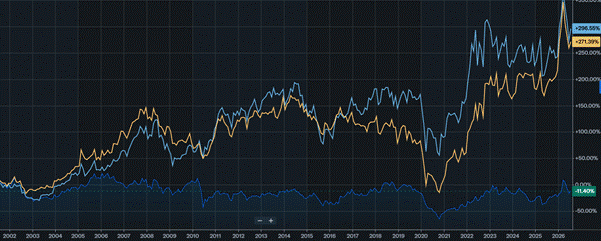
Source: Yahoo Finance
Since a shareholder revolt over BP’s attempt to transition “beyond petroleum,” the leadership has been in a lot of turmoil.
Under former CEO Bernard Looney, BP sought to transform itself into an integrated energy company with substantial investments in offshore wind, solar, hydrogen, bioenergy and electric vehicle charging.
Under the recently removed CEO Murray Auchincloss, BP “reset” its strategy. Oil and gas began to dominate capital expenditure again. But even Auchincloss wasn’t sceptical enough about the legacy green projects.
Fortune Magazine reported on the latest CEO:
New BP CEO Meg O’Neill is making fast work restructuring the struggling Big Oil giant, simplifying the organizational chart and eliminating the “low carbon energy” business unit as it reemphasizes its core oil and gas businesses.
So BP isn’t just dialling back on green investments. It is actively selling them to pay down debt. It already sold its US onshore wind business and exited several renewable developments.
BP’s strategy is to be politically savvy. It invests where governments support it. And abandons regions that are turning on BP’s projects. Be they oil, gas or renewables.
What BP needs to succeed is new projects in regions where the government is shifting in its favour, and it holds an existing advantage. A shift in UK energy policy would achieve just that.
BP would have a home-ground advantage at a time when governments are openly supporting national champions in strategic industries. The war in Ukraine and Iran exposed oil and gas to be just such a field.
BP could maximise the profitability of new UK-based oil and gas projects through its substantial trading division, as well as providing additional energy security for the country.
But that’s the future.
What are shareholders getting today?
BP’s earnings come from three broad businesses. The upstream division explores for and produces crude oil and natural gas. The downstream business refines crude oil into fuels and lubricants and operates one of the world’s largest fuel retail networks.
Last but not least, BP has one of the world’s largest energy trading businesses. That’s especially useful during periods of volatility in energy markets, like the last few years.
The trading business has been busy both buying and selling natural gas, LNG and refined petroleum products. This trading arm often generates substantial profits, but those earnings are very volatile.
Oil contributes roughly two-thirds of upstream earnings while gas contributes about one-third. Gas nevertheless remains strategically important because BP is one of the world’s largest LNG suppliers and traders.
Geographically, BP’s portfolio is unusually diversified. The United States has become its single most important producing region because the government there is far more positive about oil and gas. Production in the Gulf of Mexico and the Permian Basin, Eagle Ford and Haynesville are now central to the overall production profile.
The North Sea remains historically important, but is now a mature, declining province. BP continues producing from UK and Norwegian fields, but many fields are approaching the end of their productive lives.
Azerbaijan has become another important location for BP’s portfolio. Oil and gas fields there supply Europe. That’s why Azerbaijan has been one of BP’s highest-return regions for decades. It demonstrates what should’ve happened to BP, if it hadn’t attempted to transition to green industries.
In the Middle East and North Africa, BP has significant gas production in Egypt, Iraq and Abu Dhabi. Egypt has become one of BP’s largest gas-producing regions.
During 2025 the company announced major exploration discoveries in Brazil, Libya, Namibia and the Gulf of Mexico. This is a good reminder that exploration remains an important part of the overall strategy.
BP’s dividends are paid quarterly and the yield is around 5%. That means investors are paid to wait for the transition back to petroleum.
Like almost all energy companies, the dividend fluctuates significantly depending on oil and gas prices. As does the share price.
The key risk in this investment is global oil and gas demand. Economic crises can cause energy prices to plummet in the short term. But, in the long term, oil and gas will remain a crucial part of our energy mix and overall demand will grow.
Because energy security has become a political football, it has become politically acceptable to favour “national champions” to secure supply. It’s easy to see how such a policy would be politically popular. The big question is how long we have to wait for a government to implement it.
We also live in an age of trade wars. This exposes countries with a trade deficit to supply cuts. Countries that have a domestic supply of energy are immune to the threat.
Perhaps most important of all, the UK government needs the money that local oil and gas projects would bring in.
Be it political, economic, financial, or fiscal, the reasons to bring BP’s vast investment clout back to UK oil and gas projects is too good to ignore.
The trillion-dollar chip company hiding inside Amazon
Everyone thinks they already know Amazon.
It’s the parcels on the doorstep, the Prime subscription, maybe the cloud business if you follow tech.
That familiarity is exactly why the market keeps undervaluing it.
Inside this one company sit businesses that would each rank among the most valuable in the world if they traded on their own. And right now, you can buy all of them under one ticker.
Earlier this year I read Andy Jassy’s annual shareholder letter about two hours after it went up on Amazon’s site. I read a lot of these letters and most of them tell you nothing you didn’t already know. This one I’ve now been through three times, and one line stopped me cold:
“ We’re not investing approximately $200 billion in capex in 2026 on a hunch.”
Two hundred billion dollars of infrastructure spending in a single year. That’s more than the entire market value of most FTSE 100 companies. No board signs off on that kind of money for a maybe. Amazon can see demand the rest of the market can’t
A $50 billion chip business the market ignores
Buried in that same letter was an incredible admission from Jassy.
Amazon’s custom chip division, which is Trainium, Graviton and Nitro combined, already runs at more than $20 billion in annual revenue.
Then Jassy said that if the division sold its chips externally the way Nvidia or AMD do, its effective annual run rate would be roughly $50 billion.
Put that in context. Nvidia trades at around 25 times sales. Apply anything close to that multiple and you get a chip business worth north of $1.25 trillion, sitting inside Amazon, and I don’t believe the market is pricing it in at all.
The demand backs it up. Trainium2 delivered about 30% better price-performance than comparable GPUs and sold out. Trainium3 started shipping early this year with another 30% to 40% improvement and is nearly sold out too. Trainium4 is 18 months away and already has significant capacity reserved.
On the latest earnings call, Amazon revealed revenue commitments for Trainium of more than $225 billion.
Then there’s Cerebras. In March, AWS agreed to deploy Cerebras CS-3 systems inside its own data centres, available through Amazon Bedrock. Trainium handles the compute-heavy prefill stage of an AI query, then hands off to Cerebras for the decode stage, where output is generated at speeds AWS described as an order of magnitude faster than anything else available.
I think this chip business is so big, growing so fast, and so strategically important that Amazon eventually spins it out as a standalone company. If that happens, existing Amazon shareholders would likely end up owning the chip company too.And my take is you’d effectively be getting it for free at today’s valuation.
And then there’s space
While the chips story builds, Amazon is also assembling a credible rival to SpaceXAI’s (NASDAQ: SPCX) Starlink.
Amazon Leo, the satellite broadband network formerly known as Project Kuiper, now has more than 375 production satellites in orbit, making it the third-largest constellation flying.
In January, the FCC approved a second-generation expansion of 4,500 additional satellites, taking the planned network to 7,727.
This has moved well past the science project stage. The enterprise beta went live in April with a customer list like Verizon and AT&T in North America, Vodafone across Europe and Africa, NASA, Australia’s NBN Co, and JetBlue, which plans to fit Leo terminals to about a quarter of its fleet from 2027.
Delta has signed up for in-flight Wi-Fi too. Commercial service is targeted for the middle of this year, with enterprise terminals delivering up to 1 gigabit per second.
Every Leo connection feeds data towards AWS, and every government, airline and telecom that refuses to depend on a single supplier for critical connectivity needs a second option.
Starlink is ahead, no argument there. But plenty of customers want an alternative to infrastructure controlled by Elon Musk, whose own AI and compute ambitions increasingly compete with theirs. Amazon is that alternative.
Underneath all of this, the foundations of Amazon are still also accelerating. First quarter revenue came in at $181.5 billion, up 17% year on year. AWS grew 28%, its fastest rate in 15 quarters, and now runs at $150 billion annualised.
The AWS backlog stands at $364 billion, and that’s before counting the recently announced Anthropic deal, which Jassy says is worth more than $100 billion on its own.
Amazon is a giant that is behaving like a small-cap growth stock.
The risks
But it will never be completely smooth sailing.
First, there’s their spending.
$200 billion of capex only works if AI demand keeps growing. If demand pauses, even for a few quarters, free cash flow gets crushed and the market will punish the stock hard.
It’s happened to Amazon before during previous investment cycles.
Also there’s the Jassy-claimed $50 billion chip figure too. It’s an internal, effective run rate, not third-party revenue earned at Nvidia-style margins.
Nvidia’s CUDA software ecosystem remains a genuine moat, and developers don’t switch platforms easily. A meaningful slice of Trainium demand is also concentrated in Anthropic, so that one customer matters a lot.
And the spin-out idea is speculation on my part. It may never happen, so don’t buy the stock for that reason alone.
Leo carries its own risks. Amazon is spending billions against an entrenched leader in Starlink, it has asked the FCC for more time on its July 2026 milestone of 1,618 satellites, and its launch schedule partly depends on rockets it doesn’t control. Delays at Blue Origin have already rippled through the programme.
Finally, scale cuts both ways. This is a $2.6 trillion company. The retail business is exposed to the consumer cycle, regulators on both sides of the Atlantic are still probing, and the law of large numbers is real.
Amazon is still growing with several hidden growth engines, not a microcap moonshot. So yes, I still expect growth, but will it 10x in the next 18 months? Unlikely.
The shares trade around $244, roughly 12% below their high, while AWS accelerates and the chip and satellite businesses build huge value the market hasn’t recognised.
That gap is the opportunity.
ACTION TO TAKE: Buy Amazon.com (Nasdaq: AMZN) up to $275 per share.
Google’s $629 million clue to the next space winner
Earlier this year we spent three days at SpaceCom watching the future get built in real time. This wasn’t distant sci-fi decades away. We heard about satellites already in orbit testing things that seemed impossible five years ago, from space mining tech to nuclear propulsion to orbital manufacturing of computer chips and new drugs.
Everyone is building pieces of something massive. And the biggest piece everyone is now talking about is orbital data centres.
And the money has already voted.
Last month SpaceXAI, the company formed when Elon Musk folded his AI business xAI into SpaceX, listed in the biggest IPO in history. It raised $75 billion, dwarfed Saudi Aramco’s old record, and finished its first day of trading worth more than $2 trillion.
The pitch at the heart of that listing? Orbital AI data centres.
Musk isn’t alone. Startup Starcloud has launched a satellite carrying Nvidia AI chips.
Aetherflux is targeting orbital data centre nodes for 2027.
Even Jeff Bezos says the future of compute is data centres in orbit.
The Suncatcher catalyst
Google isn’t sitting idly by either. This is the company that pioneered transformer-based AI and built the TPU, its custom tensor processing chip, and its CEO Sundar Pichai has gone on record saying, “In 10 years, most compute will be going up to space.”
Late last year Google announced Project Suncatcher. The goal is simple but revolutionary, put its AI processors in orbit to tap free solar power and free cooling from the cold vacuum of space.
The hyperscalers are running out of power on Earth, and they’re looking up. This stopped being sci-fi and started being a race.
But someone has to build the satellites that make it work.
SpaceXAI won’t sell you its manufacturing capacity, it’s too busy spending $75 billion of fresh IPO money on its own empire. If you need satellite infrastructure at scale, there are only a few real options, and Google has been placing its bets.
Its investment filings show its two largest equity positions outside the core business are AST SpaceMobile and Planet Labs, both space infrastructure companies with in-house satellite manufacturing.
While ASTS handles the cell tower in the sky for direct-to-device 5G, Planet Labs is becoming the go-to fabrication partner for specialised constellations. Google owns $629 million worth of it.
Suncatcher will launch two prototype satellites in early 2027 to test thermal management, formation flying and inter-satellite communications.
Those prototypes use the same satellite bus Planet designed for Owl, its next-generation monitoring constellation. One platform, multiple missions.
For Planet, Suncatcher is an R&D contract today and an option on a much bigger future. If the orbital data centre buildout is real, Planet just locked in a manufacturing partner role with one of the biggest AI hyperscalers in the world.
What Planet Labs actually does
Set the Suncatcher headlines aside for a minute, because this is already an operating space infrastructure platform, not a concept company.
Planet runs four active satellite constellations today with a fifth on the way: PlanetScope, hundreds of shoebox-sized satellites imaging Earth’s entire landmass every day at 3-metre resolution; Pelican, the new high-resolution fleet delivering 30-centimetre imagery with Nvidia chips onboard for AI processing at the edge; SkySat, the legacy high-res fleet being phased into Pelican; Tanager, a hyperspectral satellite that sees beyond visible light and can detect methane leaks and CO2 emissions; and Owl, the next-generation constellation with a first tech demo planned for late this year.
Planet has launched more than 600 satellites, all designed, manufactured, integrated and tested in-house near San Francisco, with a second manufacturing site planned for Berlin to double Pelican production.
When Planet’s CEO says “there’s only a couple of companies in the world that have done scaled constellations, basically us and SpaceX,” he’s stating a fact that took a decade and hundreds of millions of dollars to prove.
The business is accelerating
The latest results, for the first quarter of fiscal 2027 reported in June, show a company hitting its stride. Revenue rose 42% year on year to a record $94.2 million. Backlog grew 72% to more than $906 million, and remaining performance obligations jumped 81% to $816 million. Management raised full-year guidance to between $425 million and $441 million, roughly 41% growth at the midpoint, and the company is sitting on $731 million in cash.
Growth is coming from three engines.
Defence and intelligence. The National Geospatial-Intelligence Agency awarded a $12.8 million contract for AI-enabled maritime awareness in the Asia Pacific, the US Navy renewed vessel monitori ng for $7.5 million, and N ATO expanded a pilot programme before it even finished. When governments want sovereign satellite capability, Planet is the first call.
Satellite services is the high-margin segment. Japan’s SKY Perfect JSAT signed a $230 million deal for ten dedicated Pelican satellites. Germany committed €240 million for dedicated capacity and direct downlink. Sweden signed a low nine-figure agreement with its armed forces in January, and its first sovereign reconnaissance satellite went into orbit on a Pelican launch earlier this year.
Customers fund the satellite buildout upfront, then pay Planet ongoing fees to operate them. The capital efficiency is excellent. Management is tracking more than 20 of these opportunities at an average contract value of $170 million each.
Then their commercial engine is stabilising around fewer, larger accounts, with insurance giant AXA integrating Planet’s imagery directly into its disaster response platform. And the credibility keeps building. In February, at the Munich Security Conference, Planet formed two advisory boards stacked with names like Carl Bildt, David Miliband, former GCHQ director Jeremy Fleming and General Tod Wolters, former Supreme Allied Commander Europe.
You don’t assemble that roster unless you’re locking in the national security establishment across NATO.
The risks
Planet Labs is a genuine business with real contracts and proven technology. But the stock market noticed in a big way, and that creates its own kind of risk.
Shares ran above $50 earlier this year before roughly halving to around $28. Even after that pullback, the market cap sits near $9.2 billion, about 21 times this year’s guided revenue. That premium still prices in years of strong execution.
Profitability needs watching too. Planet strung together four straight quarters of adjusted EBITDA profit through last fiscal year, then slipped to a small $1 million adjusted EBITDA loss in the first quarter as it invests ahead of contract deliveries.
The headline net loss of $138.9 million looks scarier than it is, since about $106.5 million of that was a non-cash warrant revaluation triggered by the share price rally, but real losses sit underneath. The path to sustainable profits is longer than the growth numbers suggest. But very importantly I believe they’re on the right path to profitability long term.
Dilution adds another layer. Planet issued more than 11 million earnout shares early this year after hitting price milestones from its SPAC merger, and insider selling picked up after the rally, including the CFO and co-founder Robert Schingler. That’s not unusual after a big run, but investors notice.
Competition is real. Maxar is investing heavily in its next-generation constellation away from public market scrutiny, while BlackSky, Satellogic and Airbus Defence and Space push into the same market.
Planet also relies on SpaceX rockets for launch, a $2 trillion public company explicitly also chasing orbital AI compute. Today’s launch provider could become tomorrow’s competitor.
And separate the proven business from the speculative upside. Suncatcher is an R&D programme and a real moonshot idea. Prototypes don’t launch until early 2027, and commercial orbital compute is years away.
If the concept proves impractical or Google bins it, that entire leg of the story disappears. The stock is priced for a future that still needs to be built, so treat it as such.
Why now
These are exactly the kinds of asymmetric opportunities we look for. The share price halved while the business accelerated. Revenue growth went from 33% to 42%. Guidance points to roughly 41% growth this year. The backlog keeps stacking, the advisory boards keep adding credibility, and the sovereign contract pipeline keeps converting, with Sweden’s satellite already in orbit.
Planet isn’t really competing with SpaceX. In many cases it’s the alternative to SpaceX, the partner governments and hyperscalers turn to when they want satellite infrastructure at scale from a company that will actually pick up the phone. And the nine years of daily Earth imagery is becoming what CEO Will Marshall calls Large Earth Models. Think ChatGPT, but instead of querying all human text, you’re querying the physical planet.
The space buildout is real. The public markets just valued its leader at $2 trillion, and Planet Labs is one of the only other companies with the proven ability to manufacture satellites at that scale.
ACTION TO TAKE: Buy Planet Labs PBC (NYSE: PL) up to $38 per share.
09/06/2026
Important Risk Warning:
General – Your capital is at risk when you invest. You can lose some or all of your money, so never risk more than you can afford to lose. Past performance and forecasts are not reliable indicators of future results. Commissions, fees and other charges can reduce returns from investments.
Small cap shares – These can be relatively illiquid meaning they are hard to trade and can have a large bid/offer spread. If you need to sell soon after you bought, you might get back less that you paid. This makes them riskier than other investments.
Overseas investments – Some shares may be denominated in a currency other than sterling. The return from these may increase or decrease as a result of currency fluctuations. Any dividends will be taxed at source in the country of issue.
Taxation – Profits from share dealing are a form of income and subject to taxation. Tax treatment depends on individual circumstances and may be subject to change. Always seek personal advice if you are unsure about the suitability of any investment.
Registered in England and Wales No 9539630. VAT No GB629728794. Registered Office: 95 Southwark Street, London SE1 0HX. Southbank Investment Research Limited is authorised and regulated by the Financial Conduct Authority. FCA No 706697. https://register.fca.org.uk/.
© 2026 Southbank Investment Research Ltd.