Early Money Edge: Why mega money is made when you’re early money
My investment journey started off 30 years ago as a kid. You may be familiar with my story, but maybe not. It’s important because it gives some context as to how I approach the markets.
It was my grandfather (we called him Pop) who I remember teaching me (and my brother) early on about investing.
That’s because when we were little he had begun investing for us. Not huge amounts, just little bits here and there, slowly building up over the years, reinvesting dividends, compounding growth… all the fundamentals of basic, long-term investing.
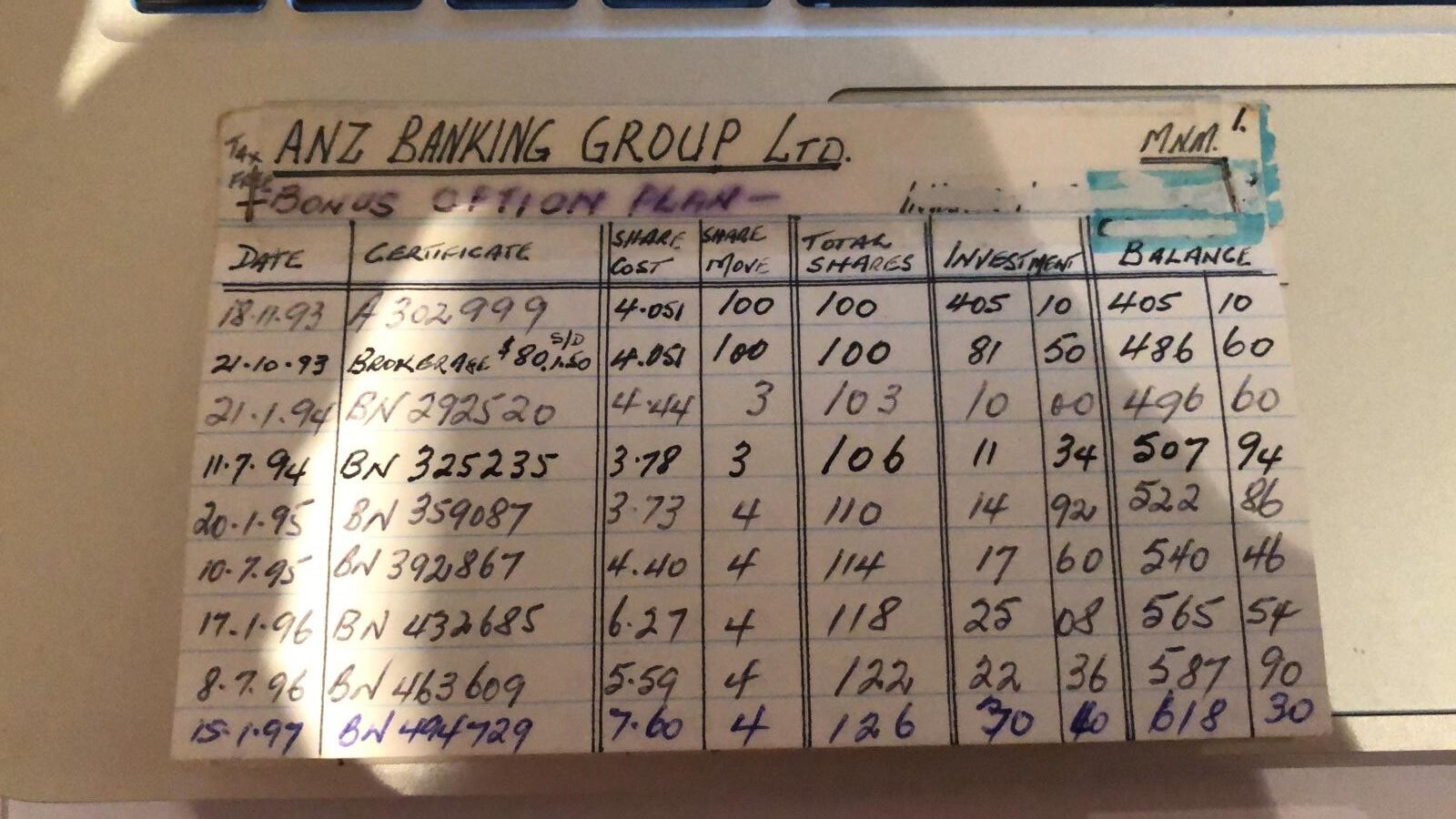
See this card above? This was my introduction to it all. This is just one of several share cards my Pop had in the records, of all our investments. This was the card for our ANZ bank shares. See that first date on the top-left of the card? It reads 18.11.93 – November 1993. I was ten years old.
This card and the others (for all the other stocks) lived in a small, grey metal box with a Royal Australian Air Force insignia on it. Today, I log into one of several broker apps on my phone to do all this.
I’ve been in the markets a long time. I’ve seen a lot. Learnt a lot. Had incredible successes, heartbreaking failures and missed opportunities, but I’ve also been at the forefront of some of the biggest and best-performing stocks in the world. I’ve grown up immersed in how to invest, find where opportunities lie and, very importantly, learnt the different ways in which you can invest outside of “traditional” channels.
Over the years I’ve been investing in the markets, only a handful of things really get me excited and pumped about investing. One of those is the explosion of the crypto markets; the other is a way to invest in exciting, early-stage companies that have the potential to transform your wealth with early money.
But it all boils down to knowing how and knowing what to put your capital behind.
Big money, bigger money, MEGA MONEY
One of my greatest successes for my readers was (before I was working with Southbank Investment Research) back in 2013 when I recommended Nvidia as a buy to my readers. It was an $8.9 billion company at the time.
Today, having recently tipped past a $1.7 trillion market cap, that makes it 191 times bigger in terms of market cap. The stock price at the time was around $15. It then did a 4:1 stock split in 2021, and last week hit a high of around $697.
In other words, $1,500 invested in 2013 at $15 per share would today be worth in the ballpark of $278,800.
That’s wild. But that’s nothing compared to even earlier investors.
You see, Nvidia was founded in 1993. It took the company six years of development and growth to get to an initial public offering (IPO). The IPO in 1999 was at $12 a share – and at the close of its first day of trading, it had a market cap of $626 million.
Over the years and multiple stock splits, one share from 1999 equates to 48 shares today.
So that same $1,500 in 1999 is today worth $4.182 million. Not bad for 25 years of diamond hand-holding. But I reckon you’d be hard-pressed to find many (if any) that bought Nvidia in 1999 that still have the stock. If you do, drop me a line – you are my hero!
Still, $4.182 million is impressive… but it’s also not where the mega money was made.
As I say, Nvidia was founded in 1993. And between 1993 and 1999, while building the company, it still needed funding and capital to grow the business.
Pre-IPO, Nvidia did two fundraising rounds. The first was in June 1995, from Sequoia Capital and Sierra.
The second was in 1996, again from Sequoia and Sierra.
The early investment from Sequoia was estimated at around $20 million and helped get Nvidia products to market. It’s fair to say that early on, the valuation of the company would have only been in the tens of millions – certainly not near the IPO valuation.
That’s because its NV1 Product, the company’s first, was a bit of a dud and almost sent the company bankrupt – and erasing Sequoia’s investment. But the rest, as they say, is history.
This example of Nvidia is relevant because take a moment to think about having invested in Nvidia in 2013. Now think about having invested in the company at its IPO… Tantalising.
But what if you could have invested in Nvidia, providing early seed money in 1995? What if you were not just early but one of the first investors in Nvidia? You’d have made a mint along the way.
Well, the good news is that today you can invest in companies in the earliest stages of their journey. You can invest early in companies that are not yet publicly listed. You can be your own venture capital investor…
Just like Jeff Bezos.
Bezos’s missed billion
Did you know that in 1998, Bezos – already successful and wealthy by that stage – invested $250,000 into a little-known start-up that was just a few months old?
This company would also go public just six years after it was founded, with an IPO valuation of $23 billion.
That company was Google.
That’s right, Bezos invested $250,000 into Google when it was just a few months’ old start-up. By the time Google IPO’d, it’s believed Bezos’ stake was about 3.3 million shares, or around $280 million.
Had he held through to Google’s explosion towards a trillion-dollar company, it’s believed his stake would have been worth more than $4.8 billion.
Now, I don’t think Jeff’s that bothered about it now, for obvious reasons. But I’m sure there’s a little bit of missed-opportunity hurt in there somewhere.
Bezos was early – even earlier than Sequoia. Sequoia invested in Google too, in 1999, with its Series-B raise. The company put in $12.5 million which became $4.3 billion come IPO time. Not a bad outcome there too.
Had you got in on Google’s 2004 IPO, you’d have made a packet too. After stock splits (about 40x multiple over the years), $1,500 into Google would have turned into about $84,000 today.
Take a moment to think about what that would feel like.
Now take a moment to think about what it would have been like investing alongside Jeff Bezos when Google was just a few months old.
It might seem ridiculous or even impossible to think that you could invest in a company like Google or Nvidia in the earliest stages of their existence.
Crazy to think that you could sit at the table with venture capital and wealthy tech titans, investing in potential trillion-dollar companies in the future, but when they’re valued in the millions.
Well, in 1995 and 1998, it was crazy. It was impossible. You’d have never got near companies like Nvidia or Google back then, pre-IPO. The very best chance you’d have would be to get lucky on IPO and get a chunk then.
That’s great, that’s making money, but it’s not making MEGA EARLY MONEY from investing.
The big upside comes when you’ve got a chance to invest in companies well before they get near public markets. The real exciting and crazy high-risk investment opportunities come when you can invest in a company that’s just getting off the ground. Companies that are raising Seed or Series-A or Series-B funding rounds.
For a long time, investors just like you were cut off from these opportunities. To seed money into exciting, promising, future-looking companies was the realm of the financial elite.
But with changes that have mainly occurred in the last few years, these opportunities have been unlocked – meaning that today you do have the chance to invest in tomorrow’s market darlings well before they IPO and trade on the stock market.
How, you ask? How on earth could you get near a seed round or Series-A for an up-and-coming company? Well, over the next few days, I’ll explain more, exclusively for you – so don’t miss it!
I think you’ll want to pay attention, because I will explain more in the next couple of days about something special we’ve been cooking here at Southbank Investment Research – behind the scenes – to deliver to you, exclusively as one of our most loyal subscribers.
Keep an eye out in the coming days for more…
Until then,
Sam Volkering
Editor, Southbank Investment Research