Frack, luv, frack
They say war breeds innovation.
Back in 1862, Edward A. L. Roberts was fighting for the Union Army at the Battle of Fredericksburg. He noticed the strange effect of wayward artillery shells hitting a nearby riverbank. A geological theory popped into his mind as the bullets whizzed overhead.
Three years later, he decided to test it.
He lowered a torpedo filled with nitroglycerin into an oil well and then filled the shaft with water. The blast that followed increased oil and gas production by more than tenfold.
And so the Roberts Petroleum Torpedo Company was born.
It made Edward very rich.
It took another 130 years for shale fracturing to become commercially viable at scale.
Fracking famously powered the US energy boom and transformed the American economy.
I don’t think Britain will have to wait that long.
Our own fracking revolution could be just months away. All we need to do is figure out how to capture the gains ourselves.
Unfortunately, that’s a far more challenging prospect than you might think. Decades of environmental policy have hollowed out Britain’s oil and gas exploration sector.
It’s not impossible, mind you.
So before we dig into that, let’s remind ourselves what the petroleum torpedo unleashed in the US — and why so many energy-dependent allies now rely on American oil and gas exports to keep the lights on…
The magic of modern fracking
One of the next generation of innovators was Bud Brigham. In the late 2000s, he figured out how to combine horizontal shale drilling with hydraulic fracturing.
In North Dakota’s Bakken formation, Brigham’s team drilled horizontal wells stretching roughly 10,000 feet before completing them with dozens of hydraulic fracturing stages along the wellbore.
Instead of the single explosive charge Ed “Petroleum Torpedo” Roberts had used in the 1860s, modern crews pumped high-pressure fluid into the rock at carefully spaced intervals, repeatedly cracking the shale along the horizontal leg.
It was a far more controlled — and far more expensive — evolution of the same basic idea: break the rock to free the oil.
Brigham was among the first operators to prove that long laterals combined with intensive multi-stage fracking could unlock enormous production rates in the Bakken.
The results were dramatic.
Some wells flowed at more than 1,000 barrels of oil a day.
Successes like these helped standardise long-lateral, multi-stage shale development, accelerating the “drill, baby, drill” boom that transformed US oil production and reshaped global energy markets.
Not to mention…
Eight 10-baggers for investors
A 10-bagger is a stock that goes up 1,000%.
Fracking technology triggered a gush of them amongst shale oil and gas companies…
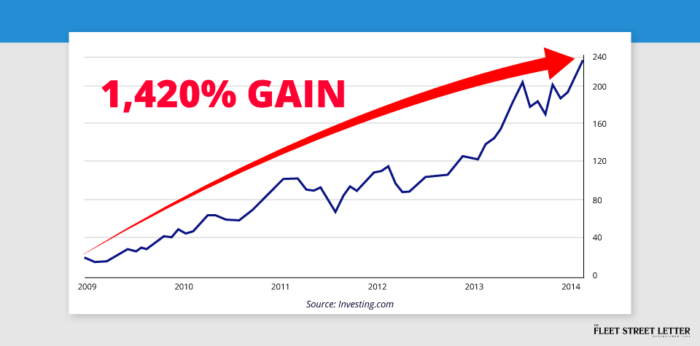
Independent shale company Pioneer Natural Resources (acquired by Exxon Mobil in 2024) went from $15 to $228 – a gain of 1,420% – in less than six years.
EOG Resources (NYSE: EOG) was another early mover in the fracking industry, finding success in the Barnett Shale as early as 2004.
But the modern fracking revolution transformed the business. Between 2003 and 2014, its share price climbed more than 1,071%.
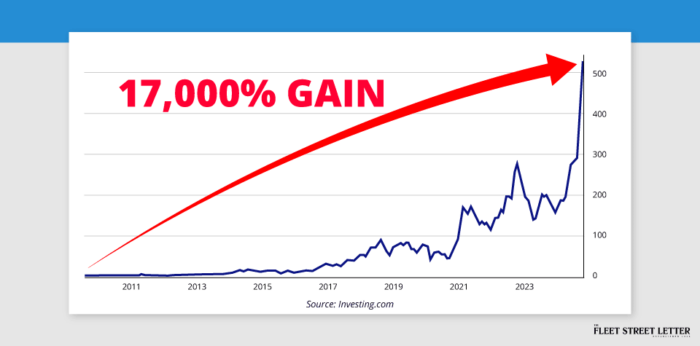
Then there was Texas Pacific Land (NYSE: TPL).
The company spent the 2010s buying and leasing land to fracking operators. As the shale boom gathered pace, the value of that land exploded. Its share price eventually peaked with a gain of more than 17,000% in 2024.
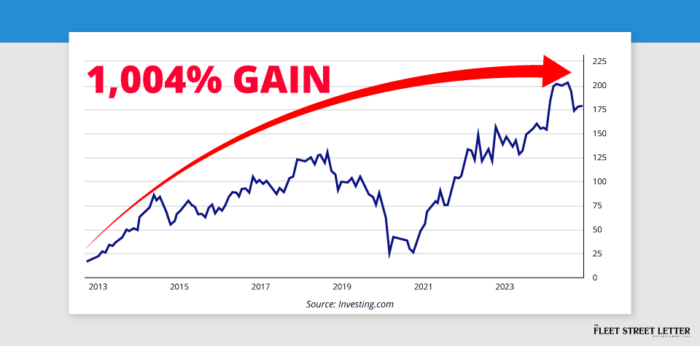
Diamondback Energy (Nasdaq: FANG) is another unconventional shale producer focused on the Permian Basin.
After listing in 2012, the stock went on to rise more than 1,000%.
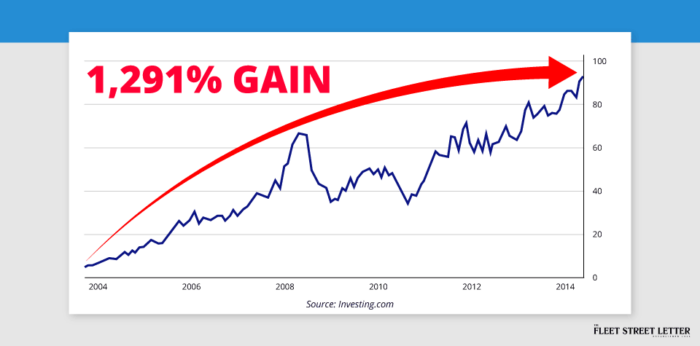
Range Resources (NYSE: RRC) pioneered commercial hydraulic fracturing in the Marcellus Shale in 2004.
Ten years and a fracking revolution later, its share price was 1,291% higher.
Halliburton (NYSE: HAL) was the first company to use fracking technology on a commercial scale. As other oil and gas producers rushed to catch up, its shares climbed as much as 1,167% over the following decade.
Cabot Oil & Gas – now Coterra Energy (NYSE: CTRA) – began fracking in 2006. If you bought its shares in 2005, you would have watched the stock rise tenfold by January 2014.
Concho Resources (NYSE: CXO) listed at US$11.50 a share and grew into the largest driller in the Permian Basin through a series of acquisitions. By 2018, the stock had peaked at US$157 — a gain of 1,265%.
Don’t get me wrong. These stocks suffered plenty of busts along the way. And not every fracking company delivered a 1,000% return. Some, like Whiting Petroleum (NYSE: WLL) and Devon Energy (NYSE: DVN), managed only a “sub-par” fivefold return.
Ten-baggers or five-baggers, we now have another opportunity to invest early in what could become Britain’s next energy boom.
Fracking saved Europe once already
When Europe rejected Russian energy at the start of the Ukraine war in 2022, America filled the void. The continent now gets almost 60% of its LNG (liquid natural gas) from the US.
Ironically enough, Russia’s attempt to seize eastern Ukraine was replaced by the US’ attempt to seize Greenland.
Gas is the gun pointed at Europe’s head in both cases.
As one Wall Street Journal commentator put it, “I think Greenland was a wake-up call. There is more talk [in Brussels] about replacing one dependency with another.”
The point is that shale oil and gas is not just a speculative mania. It’s a potential solution to the geopolitical, economic, and fiscal nightmare that many nations face right now:
- Europe is energy-dependent on geopolitical adversaries
- We have high energy prices that undermine economic growth
- We are expanding an energy system that requires subsidies instead of paying royalties – a fiscal drag we cannot afford given debt levels
Just as governments painted themselves into this miserable corner, a shale gas revolution paves the way out of it.
The US has proven it. It made the country energy independent and even a gas exporter that can strong-arm its dependents on the geopolitical stage.
It kept energy prices low, creating economic growth. And it paid a vast fiscal and trade balance tailwind.
These are all the things the countries of Europe need.
The technology and environmental concerns are now known from experience. But that hasn’t stopped Europe from destroying its own prospects of a shale revolution.
A gas implosion
Estimates for Europe’s fracking potential vary widely. The consensus, however, is that the opportunity is immense.
Original UK government estimates suggested there could be enough recoverable gas to meet between 20 and 150 years of current UK demand. The US Energy Information Administration put recoverable reserves towards the lower end of that range. Then, in 2019, an academic study roughly halved the estimate.
Across Europe, recoverable reserves are still estimated at the equivalent of 35 to 50 years of EU gas demand.
The key point is that only a small fraction of the gas underground is considered recoverable.
But…
That’s exactly what the estimates for US shale oil and gas once assumed too. Then advances in fracking technology dramatically improved recovery rates.
Do you think oil and gas technology will simply stand still?
Or do you think it will continue unlocking Europe’s shale resources?
We already know the gas is there.
The UK and Europe once had a thriving shale gas industry built on fracking. But environmental and seismic concerns prompted governments to impose moratoriums.
Then, in February 2022, the Oil & Gas Authority ordered the plugging and abandonment of Britain’s shale wells.
So despite the enormous potential, a long list of companies have since relinquished licences or plugged and abandoned shale wells across the UK and Europe.
Exodus of European shale & fracking companies
- Aurora Energy Resources
- South Western Energy
- Heyco Group
- Egdon Resources
- Hutton Energy
- Warwick Energy
- Third Energy
- Celtique Energy
- Igas
- UK Oil and Gas
- Star Energy
- Europa Oil and Gas
As a result, the US “fracks on more unconventional wells probably in a week than what happens globally in a year,” according to Liberty Energy’s CEO, Ron Gusek.
Instead, Europe pursued wind and solar. Now we’re paying the price. Not just through high energy costs, but also subsidies and the need to keep backup coal and gas power online. No form of power is cost-efficient when it is only used as a backup.
Wake up and smell the lack of gas
Having exhausted all other options, European governments are now waking up.
Germany is building gas power plants and import terminals at an extraordinary pace. Its new Chancellor – Friedrich Merz – recently admitted that shutting down nuclear power was a terrible mistake… outclassed only by the decision to make Germany reliant on Russian gas.
In Spain, gas power is back after an experiment with renewables contributed to an international blackout that left tens of millions without power.
Italy’s government is expanding domestic gas production and allowing offshore gas exploration.
Poland and Hungary’s governments are open proponents of fracking specifically. The Alternative für Deutschland (AfD) party that’s topping German polls is too.
European oil and gas companies are reporting a change of heart that has led to projects in places like Greece and Italy already.
In the UK, Reform came out in favour of fracking last year. The party is also disproportionately targeting the electorates that would see fracking on their land. Reform has highlighted that most of the issues that brought down the UK’s fracking revolution can be solved by a strong mandate and the right government policy.
The boom is very much in its infancy though. After five years of war in Ukraine, Europe still hasn’t learned its lesson. Gas storage levels are dangerously low. European gas production continues to decline.
The obvious solution is to reverse the moratoriums and “drill, Fräulein, drill.”
But where?
Basins galore
Analysts are fond of saying that rare earth metals are not rare. They have rare properties that make them useful.
The point is that they could be mined in many places. The real question for geopolitical strategists and investors is where they’re refined.
The story is similar for frackable oil and gas. You can find vast reserves of the stuff spread quite equally around the world. These regions are known as “basins” because they hold the oil and gas.
This map from the Energy Information Administration shows the even smattering of resources.
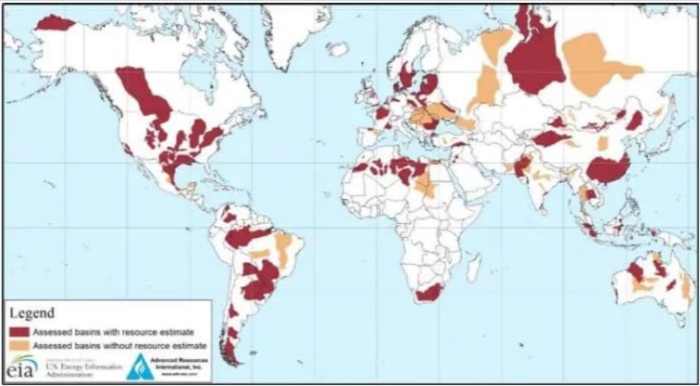
Source: EIA
The real question is which countries make the decision to permit fracking first.
Now there’s a particular reason why Europe might want to pivot to producing its own oil and gas rather soon…
Priced for decline
The US shale boom is essentially over. American oil and gas is facing decline starting… last December.
The number of oil rigs operating in the US has halved since 2019 and fallen by a third since 2023. Oil production from unconventional sources peaked in December and is expected to fall in coming years. Exploration is plummeting too.
The boom in shale oil also added a new dynamic to oil supply. Shale oil well production declines faster than conventional oil wells do. Companies need a more frantic pace of new drilling just to maintain production, let alone grow it. Without more investment, supply could decline faster than it did in past oil cycles.
If you’ve been wondering why Trump is so keen to unlock offshore and South American oil reserves, now you know. The US is running dry.
Eventually, Europe will figure out that its energy saviour is going to withdraw, just as the US withdrew from guaranteeing Europe’s defence. Then the same scramble that’s now taking place in Europe’s defence industry will kick off.
First mover advantage
Many countries around the world are already looking to repeat the US shale boom.
China has unleashed fracking to a spectacular extent since 2012. It could soon become the world’s third-largest gas producer thanks to fracking’s ability to enhance production.
A vast shale basin in Argentina already turned the country from a net importer to an exporter of energy. It achieved a $6 billion surplus in the first 10 months of 2025. Local companies hope energy will outpace Argentina’s huge agriculture exports in just a few years. More LNG export terminals should come online next year.
Bolivia’s new president came to power declaring “capitalism for all.” He plans to overhaul oil and gas resources law to encourage foreign investment.
Sand is being shipped from a port in California to be used in a fracking project the size of Belgium in Australia! Yes, sand is being shipped to Australia.
Even Europe’s current crop of governments is having second thoughts on producing gas.
Forbes has noticed the trend too:
As the U.S. shale revolution matures and its growth shows signs of plateauing, energy markets are increasingly evaluating which countries might follow the path of the U.S. Several countries are positioning themselves for a shale boom, with profound implications for energy security, geopolitical leverage, and investment opportunity.
So, many regions of the world are vying to host a US-style shale revolution just as US companies need a new source of production.
It’s this combination that’s so powerful. And the big players know it, as the Financial Times reports:
“There’s no expectation of material growth [in US shale], and some foresee gradual decline starting in the near term,” said Ruaraidh Montgomery, analyst at market intelligence firm Welligence.
To counter this, he continued, “some American shale companies are now looking to diversify abroad and partner with local companies, which gives them first-mover advantage over other US rivals”.
They won’t find many local companies left over to partner with.
The fracking Americans are coming
American frackers are already expanding overseas at a rapid pace. There’s been a flurry of investment deals in recent months.
Tamboran Resources (NYSE: TBN) expects to begin selling gas from its pilot shale project in Australia’s Beetaloo Basin later this year.
Shale pioneer Harold Hamm struck a partnership with Turkey’s national oil company to fund $200 million a year drilling in Argentina’s Vaca Muerta.
And oil majors are piling into shale projects in the Middle East.
Goldman Sachs estimates fracking in Argentina and Saudi Arabia will meet a fifth of expected global oil demand growth over the next four years. The impact on gas will be even larger.
But I believe this boom will also play out very close to home.
“Go back to Europe, young man”
If Europe decides that energy security matters after all, we may be on the cusp of a shale and fracking boom comparable to the US’ over the past 20 years.
This would coincide with successful and experienced American fracking companies hunting for their next big basins.
The result is a win-win scenario for everyone, including investors.
If inviting the Americans in sounds implausible, consider this: It just played out in the defence sector.
European defence companies are struggling to secure a disproportionate share of the boom in European defence spending. US firms continue to dominate.
About two-thirds of European defence spending on procurement goes to American companies. The share of US defence exports going to Europe doubled to 50% after the invasion of Ukraine. And this vastly understates the true proportion because US partnerships in the EU are counted as local.
I’m anticipating US fracking companies could raid European basins in the same way that American defence companies are soaking up European defence budgets.
Homegrown heroes are almost gone… for now
When I first began writing this report, I presumed there would still be some unloved European or UK oil and gas companies trying to get approval for fracking. But there aren’t. I could only find one worth considering. Which we’ll get to.
Back in 2022, UK shale gas stocks still existed. They suddenly surged on news the government may be reconsidering its position on fracking. Igas (LSE: IGAS.L) was up 47% and Egdon Resources (LSE: EDR.L) was up 36% in a week. Both companies have since abandoned hope and shifted their focus to green energy.
Back then, politicians were worried about relying on Russian gas after the invasion of Ukraine. These days they’re worried about relying on Trump’s gas given his demands over Greenland. Not to mention relying on the Middle East instead…
Sadly, UK oil and gas exploration has since evaporated. Companies have pivoted to things like hydrogen storage in salt caves and geothermal energy.
These companies may well spike spectacularly should fracking be legalised and permitted in the UK. But they’re tiny and illiquid stocks we can’t recommend here. And it’s not certain they could pivot back to oil and gas quickly.
Before I reveal which stock I do recommend you buy today, let’s clarify the opportunity…
What are the risks?
A US-style fracking revolution in European energy could deliver astonishing gains to investors. But we’re stringing together a lot of predictions and assumptions. Politics, industry, geology, and technology would have to come together.
It is possible that governments and environmentalists will succeed in further delays of fracking in Europe. The UK government is attempting to make the moratorium on fracking very difficult for a Reform UK government to reverse, for example.
However, as we made clear, there are shale basins dotted around Europe. Only a few governments need to lift their moratorium and begin permitting for a boom to begin.
In addition to the regulatory risk, we have the risk of who actually finds the oil and gas in Europe’s basins. We may invest in the wrong companies.
There may also be substantial competition coming from South American and African basins. Although I expect Europe to prioritise domestic supply to avoid becoming an energy vassal to yet another geopolitical rival.
The stock best poised to frack the UK
I believe Energean (LSE: ENOG.L) is the European company best positioned to profit from Europe’s looming fracking boom.
It’s a mid-tier oil and gas producer focused on the Mediterranean. Right now, it’s selling mature oil assets to concentrate on natural gas.
Energean still holds interests in several oil fields, including one in the North Sea. But its future increasingly revolves around gas. In 2023, it supplied around 60% of Israel’s domestic gas demand, and its giant Katlan field, also offshore Israel, is expected to begin production next year.
The dividend has held steady at 30 cents (US) a quarter for years, while debt is falling and the balance sheet continues to strengthen.
The company doesn’t use fracking itself. But it’s exactly the sort of local partner an experienced American operator would want for a joint venture.
Here’s why it sits at the top of my list…
The CEO and founder of the company – Mathios Rigas – is well aware of the investment thesis I just outlined to you. In fact, he’s outright pursuing the agenda. He told the Financial Times that European governments are keen to expand oil and gas production:
“Europe has the capacity [to become energy independent] . . . Unfortunately, European leaders in the past few years have taken the wrong course. There has to be a change in mentality.
“If you look at Greece five years ago or seven years ago, [it] was only talking about green investments: shutting down lignite-fired power plants, promoting only green investments. Now, one of the top items on the agenda is the well we will drill with Exxon . . . in western Greece. That’s a big shift.
“Potentially — using the words very carefully because we still have to drill the wells — we have the ability to create a situation where Greece becomes energy independent.
“I’m not saying we are there, but we are at least in active discussions about reopening exploration. The Italian government is actively looking at allowing new activities to happen, when a few years ago it wasn’t even . . . on the agenda.”
If Europe’s capitals are led by pro-gas and pro-fracking governments in coming years, projects will begin to roll out as they once did in the US. But, this time, the technology will be proven and understood. Established companies with expertise and track records will pile in. And many may do it with Energean at their side.
Energean’s impressive Israeli gas projects could keep paying the bills while we await that radical change.

Nick Hubble
Editor, The Fleet Street Letter