How I won big and lost big in the “off-market” investment world
Yesterday I wrote to you about why it pays to be an early investor into early-stage companies.
I looked at two of the biggest companies in the world: Nvidia and Google.
If you missed yesterday’s piece, be sure to check it out here, as today’s piece follows on from that.
Here’s the rub… Nvidia and Google are massive outliers. They are two out of hundreds of thousands of companies around the world. They are the best of the best, the biggest and most insane stories of riches to be made.
There are others like them, of course. Microsoft, Apple – you know the names, you know money was to be made at the initial public offering (IPO), but you also know that the MEGA MONEY was really made by those who were able to invest in those companies before they went public.
Again, they are outliers. And I reckon that nobody could foresee just what those companies would become.
Heck, not even Jen-Hsun Huang (founder and CEO) of Nvidia could foresee that his companies would eventually be involved in deep learning and artificial intelligence (AI) back in the 1990s.
Still, at some point, all those companies named above were worthless. They started off on a shoe-string budget: Nvidia had $40k to start with, Apple was just Jobs and Wozniak in a garage, Microsoft only raised $1 million in the late 80s and Google took on $250k from Bezos in 1998.
At some point, someone, or groups of people (and funds), took a calculated risk on these companies because they saw potential – and opportunity.
So they invested, early, into something they believed in – something they believed they could profit from in the long term.
They also did so outside of the stock market. They invested privately into these companies. And it’s through private investing, in private companies (those not yet listed on public stock markets), that I believe not only do some of the most exciting companies currently exist, but some of the biggest opportunities exist too.
Private companies, private investing, funding with a crowd
Early-stage companies always need capital. Capital to grow, to develop, to go to market. That capital comes from investors. And for a long time these private investments into private companies were off the radar and shut off from everyday investors.
But since 2011 the rise in equity crowdfunding has unlocked access to a whole range of exciting companies and wealth-creation opportunities.
Equity crowdfunding is where investors of any size can invest in a private company that’s seeking to raise capital. What makes equity crowdfunding so appealing is that typically even with a nominal amount of capital you can invest in a company that could be tomorrow’s Google, Nvidia or Apple.
The chances of getting that kind of opportunity are rare, but there’s a lot of success stories that help demonstrate just how exciting equity crowdfunding can be.
But be aware, it’s also highly risky. That’s right for every success story. There are losers too, and sometimes they’ll wipe the entire value of your investment off the face of the planet.
What better way to illustrate this than with two more recent experiences I’ve had with equity crowdfunding – one hugely successful; the other, hugely disappointing.
The first is with a little online investment fintech called Freetrade. I first spotted Freetrade on one of the equity crowdfunding platforms a few years ago.
With the work we do at Southbank Investment Research, we’re typically restricted from investing in a lot of the small, tiny, publicly listed companies that we recommend. But when it comes to equity crowdfunding, we’re good to go.
Knowing that I could invest in small start-up companies, in their earliest stages of development, excited me. And as I was on the hunt for fintech and knew that it was a growth area, I decided to invest.
In mid-2019 I bought a bunch of Freetrade stock as the company was raising funds through a crowdfund series. The cost base per share worked out at 89p.
That was it. I was (and still am) a shareholder in Freetrade. Now the valuation has bumped around a bit, and the company is still private. But in late 2021, Freetrade did another raise with a £650 million valuation at £9.25 a share.
In other words, my share had increased in value (along with the company) 939% in just over two years. Things changed in 2022 and the market took a hit. As such, the valuation of Freetrade fell. The current valuation, I don’t know, but it’s still multiples higher than 89p, that’s for sure.
Aside from my Freetrade example, Seedrs provides an example of the kinds of success it’s seen on its platform previously:
Houst is a short-let management company making it easy for property owners to host on Airbnb, Booking.com, Expedia and more. Houst has crowdfunded a few times on our platform raising a total of £10,952,852 from 2,526 investors. Houst’s valuation has increased by 3,279.4% which means there’s been an increase in share price and holding value.
These are great, but one of the things with equity crowdfunding is that you need a long-term mindset with your investments. I would say at least five to ten years.
That’s because with private companies there’s not often a liquid market for you to sell your shares or buy outside of crowdfund raises. That’s starting to change with things like the Seedrs Secondary Market, but for now, typically when you equity crowdfund, it’s illiquid – and even if you wanted to sell, there’s a good chance you won’t and can’t.
The way you can exit your position is to get lucky with some liquidity on a secondary market, when the company is bought out and cash is paid to shareholders (and/or stock depending on the acquisition) or – which is what most people aim for – when the company does conduct an IPO and launches on the public markets.
Until those exits, you’re kind of stuck with your investments. That’s good, and bad. Good in that it means you can’t “weak hands” out of an investment and it forces you into that long-term mindset.
But also bad because if you want or need access to that capital in a rush, it’s not coming to you in a hurry. If at all. So you need to expect to lock away for a long time however much you invest.
And that makes things risky too. Because as I said above, I wanted to share with you the good and the bad.
Blowing up in your face
I invested in another company too, this time in 2020. This was a medical technology company that was developing a cellular platform for cancer research and the biotech industry. Very interesting and exciting stuff. A lot of upside potential.
Except in January 2023, the company released an update noting that it had, “… become aware of a scientific issue with the models in our biobank…”
In short, its tech and its platform didn’t work. Or there were significant and serious problems with it that the company couldn’t fix.
By April this year, the company had appointed administrators and the company was being wound up and liquidated. Damn.
Now if that update in January had come out for a publicly listed company, yes, the stock price would have tanked, but you’d still have been able to exit the company with something left of your capital.
In this instance, without a liquid market, there’s nothing to do but kiss goodbye to my capital investment. It’s that black and white. I don’t expect liquidation will amount to anything, so it is a 100% write-off.
This is the risk of investing in equity crowdfunded early-stage companies. They can win, and win big. They can also blow up in your face.
Either way, your capital invested is typically locked away, for better or worse. And that’s a consideration you always need to make when investing in equity crowdfunding. Ask yourself: a) do I need this money? b) do I need this money to be liquid? c) is the long-term risk-reward profile suitable for me, my plans, goals and investment strategy?
There are ,of course ,specific risks to each individual investment you make when it comes to equity crowdfunded opportunities. And each deal should always be given its own attention and respect.
But the principles and basics of equity crowdfunding also need to be considered and you need to ensure you’re comfortable with it.
As I say, however, I think it’s still one of the most exciting ways to invest. These are just two personal examples to balance out all the successes you hear about, which are real and achievable, and to highlight the failures that you often don’t hear about which are a very real and present possibility too.
With that said, what are the considerations you need to be thinking of if you decide that equity crowdfunding is for you?
Equity crowdfunding considerations
Comprehensive due diligence
- Team evaluation: one of the critical aspects of due diligence is evaluating the startup’s team. Assessing the founders’ background, experience and skills, as well as their ability to execute the business plan, is crucial. A strong team with a proven track record, relevant industry experience and complementary skill sets is more likely to steer a startup towards success.
- Market analysis: understanding the market opportunity for the startup’s product or service is essential. Conduct thorough research on the market size, growth potential and target customer segments. A startup with a substantial addressable market and a well-defined target audience stands a better chance of achieving significant growth.
- Product or service assessment: evaluating the startup’s product or service, its unique selling proposition (USP) and the problem it aims to solve is crucial. A successful startup typically offers a product or service that addresses a pressing market need or creates a new market altogether.
- Competitive landscape: analysing the competitive landscape and identifying the startup’s main competitors is important. A thorough understanding of the competition can help investors gauge the startup’s chances of success and its ability to differentiate itself in the market.
- Financial projections and valuation: reviewing the startup’s financial projections, historical financial performance and valuation is necessary. Assess the reasonableness of the projections and ensure that the valuation is fair and reflective of the startup’s growth potential, risks and stage of development.
- Legal and regulatory compliance: ensuring that the startup complies with all relevant laws and regulations, including intellectual property rights, tax laws and industry-specific regulations is crucial. Legal and regulatory compliance minimises potential risks and liabilities.
A disciplined investment approach
- Diversification: as mentioned earlier, diversification is essential in mitigating risks associated with private investments. Allocate investments across various startups, sectors and stages of development to reduce the impact of potential failures and increase the likelihood of securing high-performing investments.
- Risk tolerance: determine your risk tolerance, investment objectives and ensure that your private investment strategy aligns with them. Be prepared to accept the inherent risks and uncertainties associated with early-stage investments and adjust your expectations accordingly.
- Long-term perspective: adopt a long-term perspective when investing in private companies. Patience is key, as liquidity in private investments is limited, and it may take years before you see any returns. Be prepared to weather the ups and downs of a startup’s journey and remain committed to your investment thesis.
- Continuous learning and adaptation: stay informed about market trends, emerging sectors and new investment opportunities. Continuously refine your investment strategy, learn from your successes and failures, and adapt to the ever-changing investment landscape.
A lot of work… for someone
What’s clear is that when it comes to equity crowdfunding, there’s huge opportunity available. But there’s also a lot of legwork needed to do the due diligence on opportunities.
I also wanted to put my thoughts on the whole idea of crowdfunding, why I believe it’s such a great way to invest and some of the tricks and traps involved in a video so you can hear it from me directly.
You can see that video here:

I think when you consider the smart way to get involved in crowdfunded investments, the due diligence involved, the investigations, research, learning, analysis, evaluation and then, of course, balancing it all against your own risk tolerances, plan and strategy. It might seem a lot, but the upside can be massive – and I’ll dive a little more into the successes in later this afternoon with another email you’ll be getting from me – keep an eye out for that.
There’s a lot of things to consider. But the good news is that we’ve been working hard behind the scenes for a few months now on something new for you, exclusively.
And it won’t cost you a thing. We’re not selling you anything, you don’t have to subscribe to anything, this is just something we want to offer up to you for being one of my subscribers.
One more thing…
Now, before you get this afternoon’s email, I want you to do something for me. In fact, to make sense of everything else coming your way this afternoon and then tomorrow morning – you really need to do what I’m about to ask.
You see, the work we’ve been doing behind the scenes and all this talk around unlisted, private companies is because we’ve been building on something with crowdfunding platform Seedrs.
Again, more on that later today, but as a prerequisite for what’s coming, I want you to head to Seedrs’ site now, via this link – GO TO SEEDRS – and get familiar with its site. But importantly, if you’re interested in these types of opportunities, you should set up and register an account with them.
This will make everything else coming so much easier with what’s coming your way.
It’s super easy to register too. Just head to its site, click on “Sign Up” (top-right corner of the site) and you’ll be taken to the following screen:
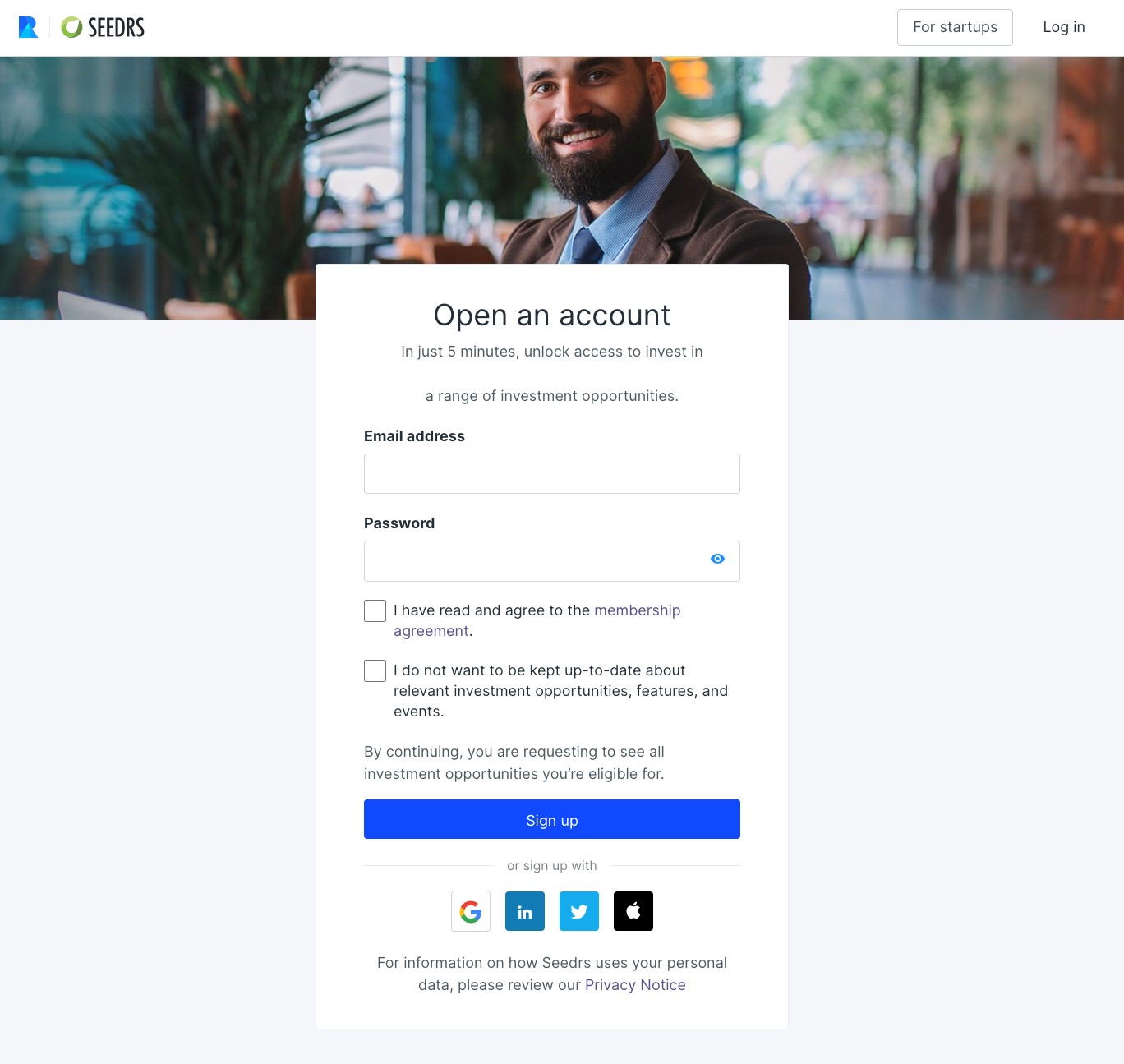
You can then sign up quickly with Google, LinkedIn, Twitter or your Apple ID. Or you can just use your email and a new password.
If using your email and a password, a verification email will head your way,
Part of the registration process involves information such as full name, date of birth, address, tax residency status and national insurance number.
It also provides a link to understanding the risks of investing in startup and early-stage businesses – it’s very important that you read and understand this.
After that, homework time!
Just kidding. Not homework as such, but there is a small multiple-choice quiz you need to take to prove that you truly understand the risks of investing in early-stage and startup companies. You’ll need to know this before doing anything else we’ve got coming your way.
I can’t coach you on what the answers are. But if you’ve read my work long enough and you’ve read today’s and yesterday’s pieces that I’ve sent to you, then you should pass with flying colours. If you fail, then maybe you’re not quite ready for this kind of investing yet.
After the quiz, you then need to self-certify as one of the following:
- Everyday investor
- High-net-worth investor
- Sophisticated investor.
Then you just need to verify your identify – and you’re done.
Yes, it might seem like a lot, but it’s not too much considering what’s coming. And when you see what we send you this afternoon and then tomorrow, I think this little effort spent will all be worthwhile.
So head to Seedrs now, get a feel for the site (you’ll be coming back here again soon I expect…), set up your account, and then hold fire for our next email later this afternoon and then something very special coming your way tomorrow.
Until then,
Sam Volkering
Editor, Southbank Investment Research