How to manage your portfolio risk
The complete guide to losing as little as possible when things do not go your way.
Most investing advice is obsessed with the upside.
What share will fly… which theme will run… what to buy next.
That’s the fun part.
But the investors still standing after 20 years are rarely the ones who picked the most winners. They’re the ones who lost the least when they were wrong.
And you will be wrong, regularly, because everyone is.
The whole game is making sure that being wrong costs you a bruise rather than a limb. This is the discipline behind Law Three from the live stream, and it’s worth more than any single hot tip.
All of this rests on one thing… knowing why you’re invested in the first place.
Money you will need next year has no business in a volatile small-cap. Money you will not touch for a decade can ride out storms that would force a short-term investor to sell at the worst possible moment.
Match each holding to its time horizon, write down what you own and why, and the day-to-day noise stops being terrifying. A plan you can see on paper is far harder to abandon in a panic than a vague intention you carry in your head.
The cruel maths of a loss
Start with a formula that should be tattooed on every new investor. If you lose 50% on a position, you do not need a 50% gain to get back to even. You need 100%.
A share that falls from 100p to 50p has to double just to return to where you started.
Lose 80% and you need a fivefold gain to recover.
The deeper the hole, the steeper the climb out, and the climb gets harder far faster than the fall. This is why protecting against large losses matters more than chasing the last few percent of a gain.
Avoid the disasters and the winners take care of the rest.
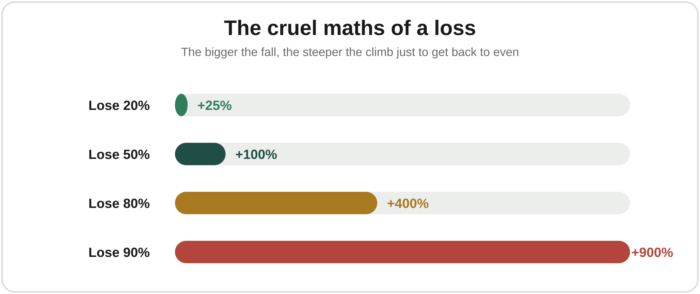
A small loss is easy to recover. A big one is brutal.
Position capital, the decision that decides everything
Before you worry about stops or charts, there is a more basic question.
How much of your money goes into any single idea?
This does more to decide your fate than any individual pick. Put 50% of your portfolio into one speculative small-cap and it halves… then you’ve lost a quarter of everything.
Put 3% into it and it goes to zero, and you barely feel it.
The lesson I learned the hard way is to size positions by how risky they are and how much you understand your own risk tolerance.
A large, stable, profitable company can carry a bigger weighting if you don’t have the stomach for risk.
A tiny, early-stage punt might be small, precisely because you accept it might not work. With the really speculative stuff, only ever commit money you can afford to see disappear entirely.
The riskier the idea, the more you must completely understand what you’re prepared to lose.
Now to some people it should also be considered that you may be fully understanding and appreciate that you’ve bet a whole heap of money into one or two highly speculative plays.
That’s ok, so long as you know and can deal with massive losses, then go for it. If you cannot afford the loss, do not take the added risk.
Diversification, done properly
You have heard the line about not putting all your eggs in one basket. The subtlety most people miss is what counts as one basket. Owning 20 shares feels diversified. But if all twenty are AI and semiconductor names, you do not own 20 baskets, you own a semiconductor ETF replicant.
When the mood turns against the whole theme, they fall together.
Real diversification means spreading across things that do not move in step. Different sectors, different geographies, a mix of racy growth and steadier dividend payers, perhaps some exposure to defence, energy or precious metals that march to their own drum.
There is a limit. Spread across 80 shares and you cannot follow any of them. Somewhere between 15 and 30 holdings, most private investors get the benefit without losing the plot.
Also understand that when you spread and diversify widely, you can deal with the risks and the ups and downs smoother, but you may also limit your potential upside.
What no one ever taught me until I figured it out for myself is that, if you concentrate you can make outsized returns compared to highly diversified investors.
If you decided to concentrate on memory and storage tech 18 months ago, in maybe two or three of the big names, you’d likely have made generational wealth.
Now that needed a few things…
It needed complete conviction that those were smart plays, tied to the rollout of AI. It also required absolute risk understanding because the volatility in those stocks meant you might have been up 20% in a week, and then on the wrong day, 20% down in a single day.
Those without a plan, without true understanding of risk may have sold off on the big downswings. But those with the plan, the strategy, the understanding of risk, the limitations of diversification and the nature of concentration will have outperformed by some margin.
So yes, diversification can help you sleep a bit easier at night. But if you really want to maximise outcomes, consider smart concentration with conviction in the right idea.
That said, you also don’t want to fall madly in love with an idea gone wrong, so you must also plan for an exit…
Know your exit before you enter
The professionals have a saying. Plan the trade, then trade the plan.
The time to decide when you will sell a loser is before you buy it, while you’re calm, not while you’re watching it fall with your stomach in knots. This is where the stop-loss earns its keep.
Set a level at which you get out, as an automatic order or a line you commit to in your notes.
Many investors use something in the region of a 20% to 25% fall, then adjust for how volatile the share naturally is. A sleepy utility and a wild biotech should not carry the same stop.
Exits cut both ways, and selling a winner is often harder than selling a loser.
When you’re sitting in a position that has run hard, every instinct says let it ride. That is exactly when a plan matters, so you take some profit off the table instead of watching a brilliant gain erode back to nothing.
Decide both halves in advance: the level that gets you out of a loser, and the discipline that books profit on a winner.
Set the rules while you’re thinking clearly, because in the moment your brain will try to sabotage you at the worst possible time.
Cash, patience, and your own temperament
Two more tools belong in any guide to risk.
The first is cash. Holding some of your portfolio in cash is not a failure to invest, it is a position in its own right. It cushions the falls but I would say, more importantly, it gives you the firepower to buy when everyone else is panicking and shares are cheap.
The best opportunities tend to arrive when markets are ugly, and you can only take them if you keep something back.
If you have steady income that you know you can invest even when the market is in panic mode, that’s good. But if you just need to keep some ready to go, make sure you balance that out. You want some cash ready to pounce, but also you don’t want to carry too much cash that you’re not maximising your full potential.
The second tool is drip-feeding, also called pound-cost averaging.
Investing steadily over time rather than all at once means your money buys more shares when prices are low and fewer when they are high, but it spares you the misery of going all in the day before a slump.
There’s nothing worse than investing a heap of cash into a position to see it drop 10% the next day. Likewise nothing worse than investing a little bit of a bigger pile to see it go up 10% the next day.
Know the risks and volatility, but if you’re not prepared to live with your timing decision, pound-cost averaging is a great way to smooth out your entry and take timing out of the equation.
Which brings us to the most underrated risk of all…
You.
The biggest destroyer of returns is not a crash, it’s the investor who panics at the bottom and sells, then buys back near the top once it feels safe again.
Knowing your own temperament, and building a portfolio calm enough that you can sleep through a bad week, is a genuine risk-management skill. The best strategy in the world is useless if you can’t bring yourself to stick to it.
Room for the moonshots
None of this means avoiding the asymmetric ideas that can multiply your money.
The appeal of a small, early-stage company is that it can return many times your stake while it can only ever cost you what you put in.
That is a bet worth making. The trick is to make it the right size at the right time with the right conviction.
The best moonshot investors almost have a disregard for risk. They know it, understand it deeply but do not care about it.
Not in a dismissive way, but in a way that respects the risk and knows how hard it bites, but also how rewarding it can be.
It is not a strategy for everyone. True moonshot investors will risk it all, and often lose it all. But they keep coming back to the table with the conviction that their best ideas pay off and outweigh the losers. And there is always losing trades in this kind of investing.
As I say, it isn’t for everyone. And for most people who want to invest in moonshot, managing the capital allocation is critical. A small punt on a massive upside potential idea is often a great approach, because the pay off is asymmetrically large.
A small amount of capital for a big pay day.
If it works, great. If it doesn’t (as many don’t), then you’ve not lost a huge amount of capital.
I love asymmetric investing. It’s the most fun. But it’s also the most risky and dangerous. To do it you must deeply understand the risks you’re comfortable taking in the market.
Sets of habits
Good risk management is not one clever trick. It’s a set of habits that work together.
Size your positions so no single mistake can sink you.
Appreciate the positives and limitations of diversification.
Consider if concentration is for you or not.
Decide your exit, on both the downside and the upside, before you enter.
Keep some cash for the bad days and the bargains they bring.
And build something you can actually live with, because the strategy you abandon at the worst possible moment is worse than a duller one you keep.
Do all this and you will still have losing trades, plenty of them. The difference is that they will be the kind you shrug off, rather than the kind that ends your investing story.
Over time, you’ll find investing fun, exciting, and rewarding both financially and intellectually.
Until next time,

Sam Volkering
Investment Director, Southbank Investment Research