How to profit from market crashes
Financial markets are fragile. Every now and then, things go badly wrong. Stock markets crash. Banks fail. Property prices slump. Governments default. Commodity prices collapse.
But most people don’t realise how often crashes happen. So they don’t prepare for or profit from plunging markets.
Well, here’s how often you can expect a major stock market index like the FTSE 100 or S&P 500 to take a tumble:
- 5% pullback: several times per year
- 10% correction: every 18–24 months
- 20% bear market: every 4–6 years
- 30%+ major bear market: every 8–12 years
These air pockets are far too common to ignore.
Investors need to know what to do when markets crash, because they’ll almost certainly live through several of them.
Financial crises are as old as financial markets. Perhaps even older. Yet most people still don’t know how to profit from them. Or they assume it’s too complicated, too risky, or too arcane. Perhaps that was true once. But the past 20 years have changed two things.
First, they’ve made it easier and cheaper than ever to profit from falling markets.
Second, they’ve shown why you can no longer afford to ignore these opportunities if you want to grow your wealth.
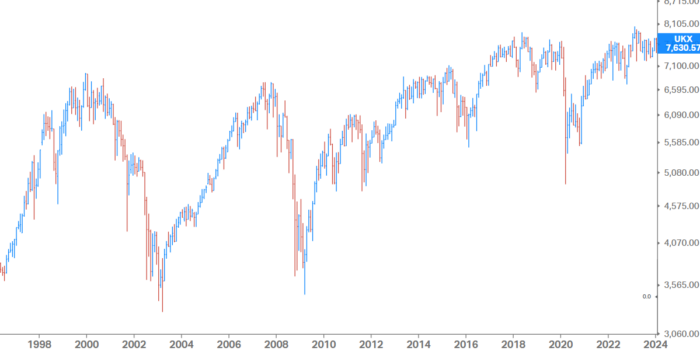
Between 1998 and 2024, the FTSE went nowhere. I bet you were furious every time you heard someone repeat the mantra that “stock markets always go up in the long run.”
Two major market crashes delivered devastating setbacks for investors. Then COVID-19 added insult to injury.
So why not turn those crashes into opportunities to protect yourself — or even profit from them?
FTSE 100 going nowhere
Source: Koyfin
If you’re concerned about the fragility of the financial system, as am I, you don’t need to run for the hills. Well, not with all your capital anyway.
Instead, I’d like to show you how you can turn the financial system’s weaknesses to your advantage using investments that are likely already available through your existing brokerage account.
There are always ways to profit from big moves in the market, whether they’re up or down. The trick is thinking ahead and understanding the tools available to you.
That’s what this report is about.
One thing to keep in mind before we begin: the ideas outlined here ARE NOT LIVE RECOMMENDATIONS.
My aim is simply to walk you through the different approaches available and introduce the kinds of opportunities you might want to look for when the time is right.
Some of the ideas are speculative and carry significant risk, so always do your own research and assess whether they’re appropriate for your circumstances before investing. And never invest more than you can afford to lose.
With that bit of housekeeping out of the way, let’s dive in.
Aggressive defence
These days, it’s possible to profit from falling asset prices almost as easily as rising ones. But never forget, these instruments are speculative by nature. They’re designed to be part of a well- balanced portfolio, or only to be used as a short-term trade.
Short selling
Short selling is a simple idea. But it’s one many investors struggle with because it sounds backwards. It also gets a bad rap, mostly for political reasons. People don’t like short sellers because they have a habit of exposing accounting frauds and corporate scandals. Worse still, they profit from them.
I see them differently.
They’re the private detectives of the investment world. Their financial incentive is to uncover things everyone else has missed. In that sense, they’re whistle-blowers with skin in the game.
So what is short selling?
Normally, you buy an investment first and sell it later. If the price rises, you make a profit.
Short selling simply reverses the order.
You sell first and buy later. If the price falls in the meantime, you profit because you sold at a higher price than you eventually paid to buy the investment back.
How can you sell something you don’t own?
The answer has been around for centuries.
Farmers and winemakers have long sold future harvests before they’ve been produced in order to lock in a price. Short selling applies the same basic principle to financial markets.
The mechanics aren’t especially important because your broker handles them.
There are several ways to short sell, but the most common is simply borrowing shares, selling them, and then buying them back later before returning them to the lender.
If the price has fallen, you’ve made a profit.
The exact process depends on your broker, so it’s worth checking how they offer short selling, along with the fees and borrowing costs involved.
The important point is this.
Short selling gives you a way to profit when markets fall.
If it’s something you’d like to use one day, it’s worth getting familiar with your broker’s requirements before the next crisis arrives.
Most brokers will also require you to keep cash on deposit as collateral. This is known as “margin” and protects the broker if the trade moves against you.
A “margin call” simply means the broker wants you to deposit more money because the position has moved against you. That sounds alarming, but remember why you’re doing this. If you’re using short positions to hedge a broader portfolio, losses on the short should be offset, at least in part, by gains elsewhere.
So why short sell instead of simply selling your investments?
There are plenty of reasons.
Tax, transaction costs, and portfolio management all play a role. Sometimes it’s far more efficient to hedge part of your risk than to sell everything outright.
Short selling also allows you to construct what’s known as a “pair trade.”
Instead of simply betting against the market, you buy one company and short another similar one.
For example, you might buy a low-debt gold miner while shorting a heavily indebted rival.
You’ve isolated debt as the key difference between the two businesses.
If a crisis hits, the highly indebted company is likely to underperform regardless of whether the gold price rises or falls.
That relative underperformance is where your profit comes from.
It’s a good example of how you could use short selling as a risk-management tool rather than simply a speculative bet.
Why not explore the option with your broker? It could become one of the most useful tools you have when markets eventually turn lower.
Short/inverse ETFs
Short selling is the original way to profit from falling markets. But these days, it probably isn’t the most convenient.
The easiest approach is often to buy an exchange-traded fund (ETF) designed to rise when another investment falls.
There are plenty listed in the UK. You can bet against stock market indices, currencies such as the euro, commodities like oil, and much more.
I’ve listed a few that might be worth exploring.
So how do they work?
Different ETFs achieve their objective in different ways.
Some use futures or other derivatives. Others hold the underlying assets they’re designed to track.
The important thing to understand is that ETFs don’t perfectly mirror the investments they’re tracking, especially over long periods.
Management fees, trading costs, and the way some ETFs are structured all create what’s known as “tracking error.”
That becomes even more noticeable with inverse and leveraged ETFs.
They’re designed as trading tools rather than long-term investments.
Used over the medium term, however, they can give you access to opportunities that would otherwise be difficult to exploit.
Because ETFs are so flexible, there are several features worth paying attention to.
The first is the currency they’re denominated in. Many providers offer sterling-hedged versions alongside US dollar or local currency versions.
That choice matters.
During the 2008 financial crisis, for example, a sterling-denominated gold ETF outperformed a US dollar version simply because of what happened to exchange rates.
The second feature is whether the ETF is “inverse.”
Inverse ETFs rise when the underlying investment falls.
On the London Stock Exchange (LSE), they’re often labelled “Short” rather than “Inverse,” in reference to short selling.
The third feature is leverage.
A 3x ETF aims to deliver roughly three times the daily movement of the underlying investment. If the pound falls 1%, a 3x inverse sterling ETF should rise by around 3%.
That extra return comes with extra risk.
|
Leveraged and inverse ETFs are more complex products, and their performance tends to diverge more from the underlying investment over time.
Most providers use well-established futures markets to achieve these returns.
But don’t mistake that for being risk-free.
Like any investment product, you’re relying on the fund manager and the structure working as intended.
So do these ETFs actually deliver?
Let’s look at one example.
Ahead of the Brexit referendum, an investor expecting sterling to fall could have bought the ETFS 3x Short GBP / Long USD ETF (SGB3).
The name tells you almost everything you need to know.
“ETFS” is the provider.
“3x” means three times leveraged.
“Short GBP / Long USD” means the ETF profits if sterling falls against the US dollar.
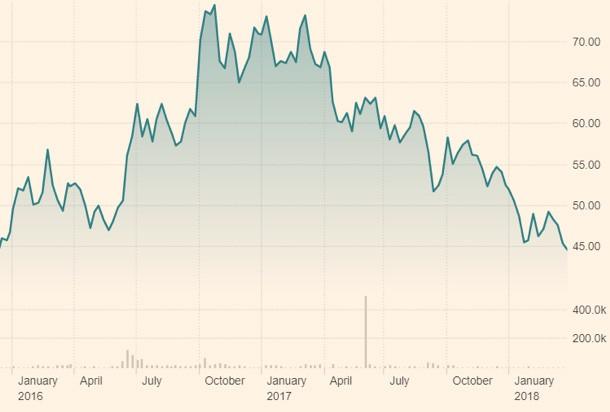
If you’d bought it just before the Brexit vote, you would have roughly doubled your money within four months as the pound slumped.
ETFS 3x Short GBP Long USD after Brexit
Source: Financial Times
As the pound recovered, the ETF lost value again. It’s not a bad reflection of the currency market. Although the ETF has fallen further than the pound has recovered. So this is a good example of why you shouldn’t hold such an investment too long. These are for trading, not investing.
To summarise, ETFs are the convenient way to profit from downward trends in the medium term across a wide variety of investments. They are probably the ideal first step for profiting from a crash in financial markets.
Trading volatility itself
Risk and volatility are almost synonymous in financial markets. When markets panic, volatility spikes.
Price movements that would normally be measured in tenths of a percent suddenly become whole percentage points.
Thanks to ETFs, it’s even possible to invest in that surge in volatility itself.
The attraction is simple. A market crash is rarely a straight line lower. Markets lurch, bounce, and whipsaw before often continuing their decline.
By investing in volatility rather than betting purely on direction, you’re positioning yourself to profit from the turmoil itself.
In other words, you don’t have to be right every day about whether markets are rising or falling. You simply need to be right that they’re becoming increasingly unstable.
Just like other ETFs, volatility ETFs track an underlying index.
The best known is the VIX, traded in Chicago, which measures expected volatility in the S&P 500.
The UK has had its own FTSE 100 volatility index since 2013, although there are still very few ETFs linked to it.
For now, the US VIX remains the dominant market for volatility investing.
One example available on the London Stock Exchange is the WisdomTree S&P 500 VIX Short-Term Futures 2.25x Daily Leveraged (VILX.L).
As the name suggests, it aims to deliver roughly 2.25 times the daily return of VIX futures, before fees.
It’s designed as a short-term trading vehicle, not a long-term investment.
One important point to remember is that VIX ETFs don’t track the VIX directly. They track VIX futures instead.
Historically, those futures have tended to move by roughly half as much as the underlying VIX index, making the ETFs somewhat less volatile than many investors expect.
Keep that in mind when deciding how much capital to allocate.
Do these ETFs actually work?
Recent history suggests they certainly can.
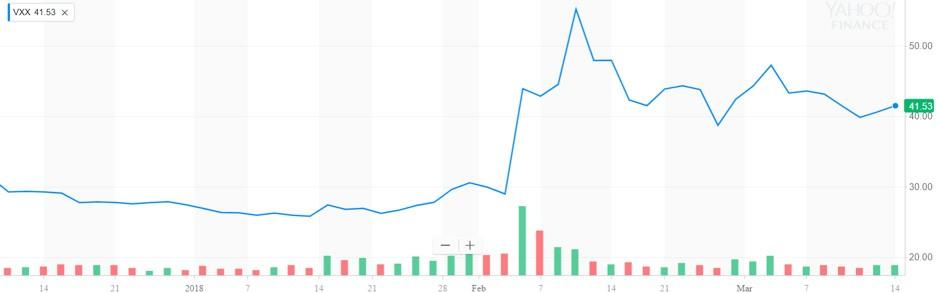
During the sharp market correction in February 2018, this ETF roughly doubled in value.
VIX ETF VXX during the February 2018 correction
Source: Yahoo Finance
That’s an unusually dramatic jump though. The surge happened from a record low VIX to a recent high. It turned out that many people had been speculating the VIX would fall. But they were caught out. In the end, the dramatic action in the VIX became part of what destabilised the market in February 2018.
The trouble with using a normal VIX ETF to make money from a crisis is that they steadily decline in value until market turmoil hits. Then they surge. But they don’t remain high for long. So this is purely a trading opportunity. It’s highly unlikely to retain its value over time. Do not forget to sell out once you’ve made your profits.
Stock market crash insurance
The traditional way to profit from a falling stock market is by buying put options. They pay off when an investment falls below a specified price.
To understand why they’re so useful, you first need to understand how options work.
An option gives you the right — but not the obligation — to buy or sell an investment at a fixed price before a specified date. For that right, the buyer pays the seller an upfront premium. Think of it as an insurance premium.
When the option expires, you can either exercise it or simply let it lapse. Either way, the seller keeps the premium. That’s why options are so popular with sophisticated investors and institutions.
One of their best uses is as portfolio insurance.
If you’re worried about a market crash, you can buy put options that rise in value if your investments fall. You pay the premium upfront.
If markets tumble, the option gains value and helps offset losses elsewhere in your portfolio.
If markets remain strong, the option simply expires and your only cost is the premium you paid.
There are two main types of options — calls and puts — and each can be bought or sold, creating four possible strategies.
For the purposes of this report, we only need one of them: buying put options.
Let’s take a simple example.
Imagine you own shares in BP (BP.L) and you’re worried they’re about to fall sharply. You could buy a put option giving you the right to sell those shares for 460p at any point over the next year. Suppose the premium costs 1p a share.
If BP never falls below 460p, the option expires worthless and you’ve lost only the premium. But if the shares plunge, the option becomes increasingly valuable because it gives you the right to sell at 460p even though the market price is much lower.
In practice, most investors don’t wait for options to expire. They simply sell the option itself once it has risen in value and lock in the profit.
Many options today are cash settled rather than settled by delivering the underlying shares.
Instead of actually selling your BP shares at 460p, you’ll simply receive a cash payment reflecting the option’s value. The further BP falls below 460p, the more valuable the option becomes.
There are also options available on major indices such as the FTSE 100, making them an effective way to hedge an entire portfolio against a broad market decline.
Just like short selling, every broker offers different products, fees, and rules. Before using options, spend some time understanding how your broker handles them. And if your goal is protecting yourself against a market crash, focus on buying put options.
Note that options do come with elevated risk so be very careful when trading them.
Become a cautious CFD trader
Contracts for difference (CFDs) have developed an undeservedly bad reputation. The way regulators and much of the media portray them is, in my view, deeply unfair.
The important thing to understand is that CFDs offer one of the simplest and most efficient ways to trade a falling market.
With a CFD, it’s just as easy to profit from a falling investment as a rising one.
The basic idea is straightforward.
You’re not buying the underlying investment. Instead, you’re taking a position on whether its price will rise or fall.
That simplicity is also where the danger lies.
CFDs can make investing feel as easy as placing a bet.
Before long, some people stop treating them like investments and start treating them like gambling.
The real risk isn’t the product itself. It’s using too much leverage or risking more money than you can comfortably afford to lose.
Assuming you’re disciplined and manage your position sizes carefully, there’s no reason to dismiss CFDs altogether.
In fact, during a market crash they can become an extremely useful tool.
A CFD account that you understand and know how to use allows you to profit from falling markets quickly and efficiently.
Those gains can help offset losses elsewhere in your investment portfolio.
Never forget that crashes really do happen
The challenge of profiting from a crash is the same as normal investing – timing. That’s why I can’t make specific investments in this report.
But I can tell you the most important thing to keep in mind: Crashes do happen. Never forget this. Forewarned is forearmed.
When trying to profit from falling markets, the risks are higher than usual investing. For example, options prices can surge or fall far faster than stocks.
You need to properly understand how these financial products function. And never invest (or trade) more than you can afford to lose.

Nick Hubble
Editor, The Fleet Street Letter