An expert take on the current crypto landscape…
13th June 2022 |
Sam is away on annual leave for the next few weeks.
Before he went away, he spoke with his colleague and fellow crypto expert Ryan Dinse, who gave Sam the nod to re-publish one of his own juicy crypto articles for you.
You can see the article in question below.
The Most Dangerous People in Crypto
So it appears we’re at the stage of the cycle where the mainstream media gets the knives out…
In the past week, we’ve had not one but two hit pieces on terrestrial TV.
First was a Four Corners episode entitled ‘Behind the Hype of Cryptocurrencies’.
Then the very next day came the 60 Minutes segment with the very unimaginative title of ‘Crypto Crash’.
As expected, both shows were nothing more than one-sided attacks, masquerading as ‘news’.
They concentrated on the absolute worst aspects of our industry while conveniently ignoring the immense benefits.
I mean, if you’re going to buy ANY asset because the likes of Kim Kardashian or Matt Damon tweet about it, then you’re going to be parted with your money quick smart!
But how about mentioning how decentralised finance was creating a fairer, cheaper, more efficient financial system?
How about mentioning the enormous harm being done to people worldwide right now through the hyperinflation brought to you by the current ‘masters of money’?
And how about mentioning how certain cryptos — particularly Bitcoin [BTC] — are helping tens of millions of people across the globe who live in authoritarian regimes?
Nope, not a peep on any of these positive aspects.
Just the same tired, old narratives…
A force for good
I’m not downplaying the very real harm some in our industry do.
I mean, I spend every day trying to get people to ignore most stuff in crypto and instead focus on the real revolution.
Because behind the scenes, crypto is already making a difference for those who need it most.
On that note, a letter was just sent to Congress signed by 21 human rights advocates from 20 countries.
It started:
‘Dear U.S. Congressional Leadership, Committee Chairs and Ranking Members,
‘We are 21 human rights advocates from 20 countries across the globe who have dedicated ourselves to the struggle for freedom and democracy. In this struggle, we have relied on Bitcoin and dollar instruments known as stablecoins, as have tens of millions of others living under authoritarian regimes or unstable economies.
‘Bitcoin provides financial inclusion and empowerment because it is open and permissionless. Anyone on earth can use it. Bitcoin and stablecoins offer ungated access to the global economy for people in countries like Nigeria, Turkey, or Argentina, where local currencies are collapsing, broken, or cut off from the outside world.’
You can read the full letter here. One notable signatory was Russian ex-chess Grandmaster Garry Kasparov.
The truth that’s not reported is that crypto comes with both pros and cons, just like any tech before it.
And yet, the mainstream just likes to focus on the bad.
I mean, it would be like putting out a show in 2000 saying that the internet was just a passing fad, only of use to criminals…oh wait, that kind of stuff happened all the time back then too!
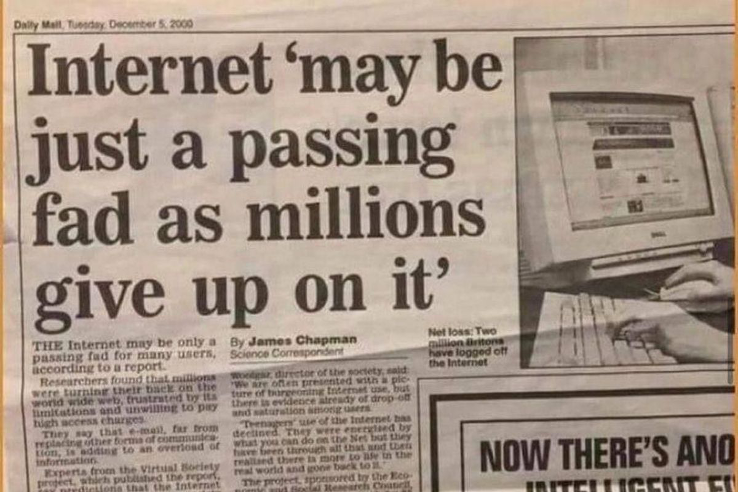 Source: Upworthy
But like I said, this is just the part of the cycle where you’ve got to expect such attacks.
For example, here are multiple shows from the same 60 Minutes team back in the crypto winter of 2018/19:
 Source: Google
Funnily enough, such shows are actually a good sign a bottom is near. It helps wipe out the weak hands, creating a base for the next bull run.
For example, bitcoin went up around 20-times since that 2019 hit piece!
The fact is these types of shows don’t care about the big picture, the technology, or the nuance.
They’re ‘entertainment’, and just want to get attention by ramping up the fear. That’s their stock and trade.
Ignore them…
This is worse
But even worse than these ‘current affairs’ shows are the cranky finance types who think they know better.
They’re usually sceptical of every new thing and make money from cultivating an image of being the wise, dependable sage.
But it’s a marketing gimmick that flies in the face of reality.
When you look at their investing returns, you usually find they have a remarkable knack for being wrong pretty much all the time!
And yet, their overblown egos don’t seem to notice.
You can find them taking victory laps right now on their ‘warnings about crypto’, despite the fact they’ve missed out on the best investing opportunity for anyone who has been in it longer than five minutes!
It’s not just crypto they’re wrong on either…
One doomsayer I know has been advocating for an all-cash portfolio since at least 2015, helping his followers miss out on the mother of all stock market booms…and yet is right now dishing out the ‘I told you so’s’ left, right, and centre!
These people often happily add crypto scepticism to their long line of failed investment theses because it’s a new area and, therefore, a threat to the perception of their ‘expertise’.
And no amount of being wrong can change their mind, it would seem.
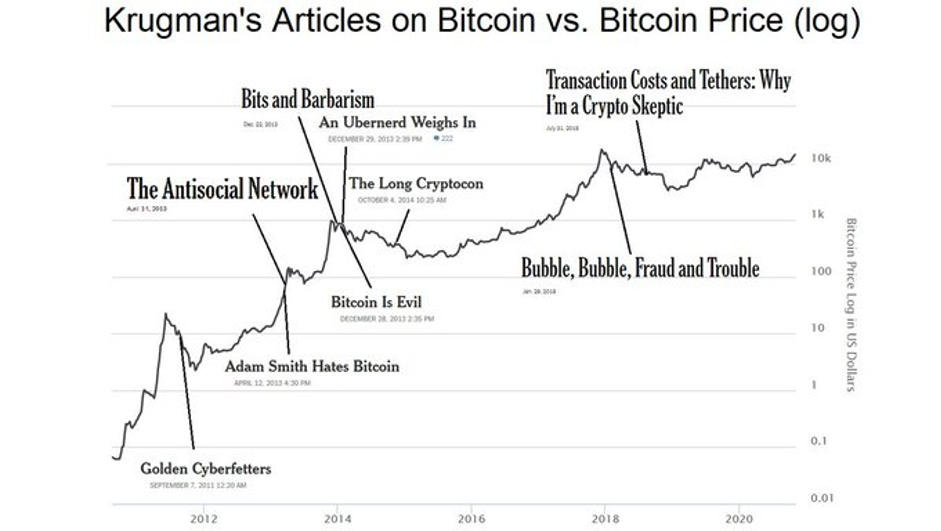
Take this chart showing negative articles on bitcoin published by Nobel Prize-winning economist Paul Krugman versus the price (log scale):
 Source: Twitter
The chart is a bit old (2020), and all the articles were published with bitcoin at less than US$10,000.
Fancy knowing about bitcoin since 2012 and seeing the price go nuts without having any!
That’s got to hurt.
But people like Krugman don’t make their money from being right — only for selling an image that they know better.
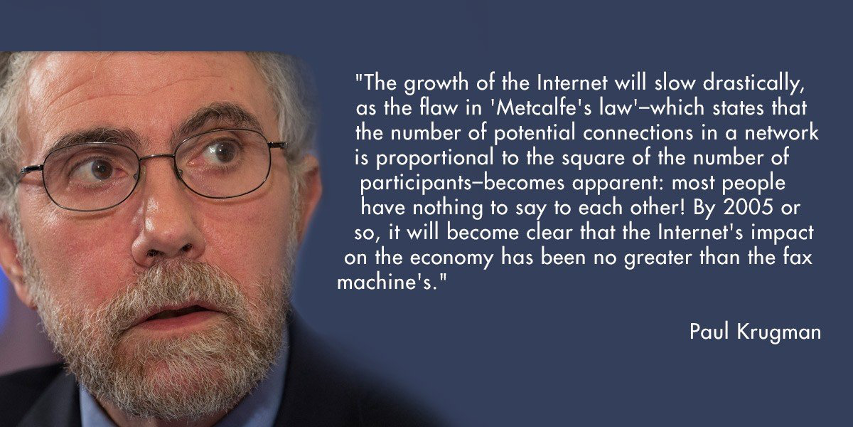
Anyway, he has form in being spectacularly wrong in assessing tech revolutions.
Here’s his famous quote about the internet from the mid-‘90s:
 Source: Twitter
I mean, anyone else would probably learn a little humility from this and keep their mouth shut in future.
Not these overblown egos.
They’ll bang the drum of negativity, even while the world changes around them.
This isn’t just harmless commentary either.
These people are given big platforms to set agendas, which is why crypto folk push back against them so strongly.
We know their seeds of negativity rob ordinary people from having a stake in this exponentially growing network.
As I showed last week, whales (big buyers) are soaking up the fear and buying quality crypto projects left, right, and centre.
They know the future is bright for crypto.
I want ordinary people to benefit from this future too.
Which is why I say these people are the most dangerous people in crypto. They’re just like the bull market scammers in a way, but instead of using greed, they use fear.
By taking such an extreme stance of negativity, they ignore the nuance involved in investing in a new technological frontier.
I’ve always said that investing in crypto comes with extreme risks, but also, extreme opportunities.
Navigating that context is where you need to be smart.
There is a middle road that a sensible speculator can take, while understanding that the future is always unknowable.
As Mark Zuckerberg once remarked:
‘The biggest risk is not taking any risk. In a world that’s changing really quickly, the only strategy that is guaranteed to fail is not taking risks.’
My role in this part of the cycle hasn’t changed much either.
My job is to keep laying down the facts, show you how the industry is developing, try and manage our portfolio as best we can, ignore the scams (that was actually part of my job in the recent bull run phase!), and to make sure you don’t lose interest at precisely the wrong time.
Because, despite what you’re hearing elsewhere, crypto is now inevitable.
And news this week only proves it…
Regulators, mount up!
There were several big news items this week that point to the fact crypto adoption continues to soar.
First there was huge progress in the race to have a Bitcoin ETF approved in the US.
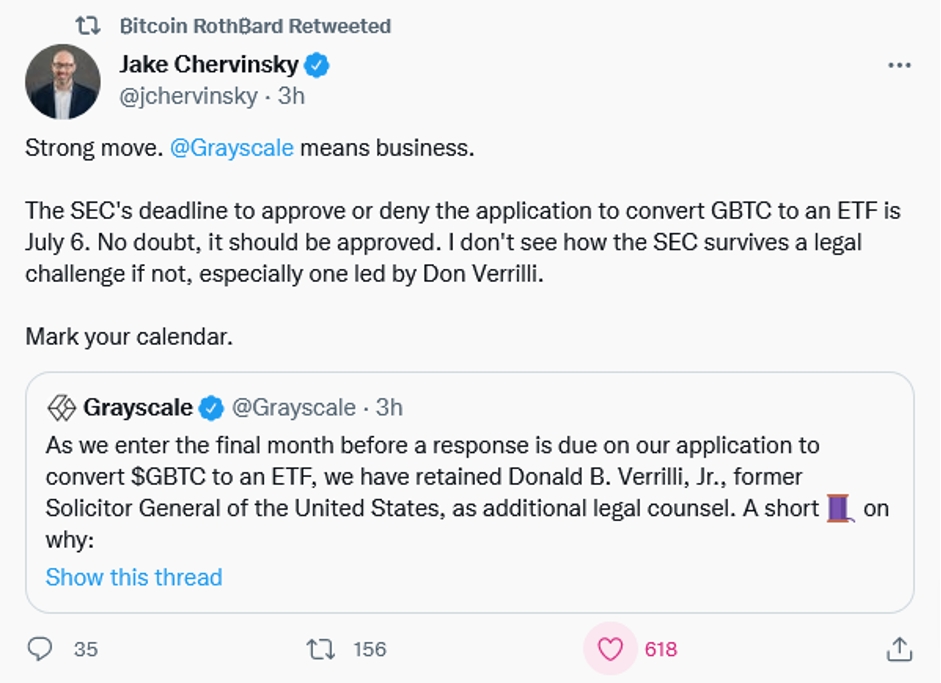
Grayscale, who already has the largest bitcoin fund, has just hired a former US Solicitor General to help them push through their application.
As this tweet shows, they’re bringing the big guns out to put the pressure on the SEC, which seems to be unreasonably stalling on this issue:
 Source: Twitter
6 July could be a huge day for bitcoin if the ETF is approved, as it’ll open bitcoin to billions of dollars of institutional capital in the US.
But even if it isn’t approved then, it seems to me it’s only a matter of time.
Next came news that US$40 billion payments giant, Checkout.com, is going to start accepting stablecoins in a major crypto push.
As CNBC reported, this is mainly a technology decision:
‘The feature will allow merchants to settle payments even on weekends and public holidays, something that’s not currently possible with fiat currencies, according to Jess Houlgrave, Checkout.com’s head of crypto strategy.’
Funny how you’ve probably only been hearing ‘how bad’ stablecoins are from the sceptics.
And yet here’s a major payments company telling you why they’re better.
Interesting, no?
Next up…
There was an announcement that Fidelity, Charles Schwab, Citadel, and Virtu have formed a consortium to build a crypto trading platform.
There’s a lot of money and time from serious players going into building something to trade ‘tulips’!
Perhaps they think there’s something in this crypto malarky…?
But the biggest news of the week was the long-awaited crypto draft bill proposed by a cross-party group headed by the Senator for Wyoming, Cynthia Lummis.
There was a lot to like about this bill, with some things to think about too.
Here are the major points as I saw them:
- Medium of exchange — the bill provides a tax exemption for transactions under US$200. This could encourage people to spend some of their bitcoin using networks like the Lightning Network. Remember, Jack Mallers’ Strike inked some huge partnerships with leading US payments processors at the recent Bitcoin Conference. Maybe soon we’ll all be buying cups of coffee with our bitcoin after all!
- Commodity or security? — the bill explicitly states bitcoin and Ethereum [ETH] as commodities rather than securities. Other cryptos would have to go through the ‘Howey Test’ to determine what kind of asset they are. But from the expert commentary I’m reading, most crypto assets would be classified as commodities and therefore fall under the supervisions of the CFTC (the commodities regulator). And so far, this agency has been a lot more friendly to crypto than the SEC (securities regulator). A point to note from an investing angle is we’ll have to make sure we steer clear of ‘unregistered security’ type cryptos in the near term until there’s more clarity on this. But we’ve been doing this mostly anyway.
- Spot Bitcoin ETF more likely — as the CFTC will have sole jurisdiction over digital assets registered as commodities (i.e. bitcoin). Some think this will make a Bitcoin ETF more likely as it takes the SEC out of the equation (who have been a roadblock so far).
- Energy — the bill requires a study on the power consumption of digital assets. It seeks to help find the best way of ensuring climate goals are met. This is actually good for US bitcoin miners, as many are close to 100% renewable anyway. Furthermore, a lot of energy experts are starting to realise how bitcoin mining can help the adoption of renewables by grid providers by ensuring flexibility in load power. The ‘climate’ attacks are one of the biggest lies purported by the enemies of bitcoin, so this should help clear things up.
- Miners — crypto miners won’t be deemed as brokers. Bitcoin obtained won’t be treated as income until converted into fiat. Digital asset lending agreements are not taxable events. This is all positive in terms of safeguarding bitcoin mining businesses in the US. And is probably good for their profit reporting too.
- Consumer protections — providers of digital assets are to disclose information about their product and legal treatment. This may stifle some innovation by increasing start-up costs. But a lot of crypto projects are outside the US anyway, so I don’t think it’ll have a major effect in the grand scheme of things. But more detail is required here.
- Self-custody — the bill grants the right to a person to control the digital assets they own. It’s a huge win for crypto and nullifies a big regulatory threat. Not that any bill could stop people doing so anyway, but it’s better for mainstream adoption to have clarity on this.
- Stablecoins — the big one was a requirement for more disclosure and 100% reserve backing.
I think, broadly speaking, this draft bill is extremely positive for crypto adoption in the US. Though, bear in mind, it’s only a draft and it remains to be seen what a full version will look like.
But in terms of how bad it could’ve been, this is a big win, especially for bitcoin and Ethereum.
I’ll have to mull over this further to see how we should position our investment portfolios to best take advantage of this evolving situation.
In response to Dinse’s piece, Sam gave the following response:
Good piece mate.
I’ve been at Money20/20 Europe all week, and I can guarantee you that none of them look at crypto in a dirty way anymore. Global fintech, big institutions, regulators, all of them are looking to integrate, accept, understand, utilise and innovate with crypto. All of them.
It’s no longer a matter of “if” crypto becomes widely accepted and used in global e-commerce, just a matter of “when” it’s integrated, and most are saying in the next 12 to 36 months. It’s also going to completely change the fabric of correspondent banking and B2B banking. Did you see the ANZ stablecoin mint? I’m sure you already have? They utilised platforms like Fireblocks to make that happen. That’s not stuff 60 Minutes or 4 Corners would ever report on.
The future is brighter than it has ever been for crypto, man. I genuinely can’t believe how open and accepting the whole fintech and banking and finance world is with it all now.
A fad, this is not. This new, revolutionary asset class is only just getting started.
Until next time,
Sam Volkering
Editor, Sam Volkering’s Crypto Network