Bitcoin and the real estate cycle
26th February 2021 |
I have certainly enjoyed watching the price action of bitcoin and other cryptocurrencies at the start of this year. What amazing volatility; if you like your markets fast and furious, these are things to be investing in.
I don’t pretend to understand the full complexity of the crypto ecosystem and how much it will change things in the future. This is why you’re lucky to have Sam Volkering in your corner to advise you. Bitcoin, it seems, has the enduring promise of becoming a monetary alternative in the future (more on which below).
Personally, I am actually more interested in the blockchain as a technology that can disrupt everyday business processes, just as other current technological advances are doing – eg, machine learning, artificial intelligence, the Internet of Things (IoT) and so on.
One industry that is ripe for disruption is property. I was at a conference a couple of years ago where this topic came up: the blockchain is starting to establish things like fractional ownership of dwellings. So one day if you are looking for some investment exposure to property, you might be able to purchase shares in Monaco apartments via an exchange, safe in the knowledge that you own part of the underlying real estate as opposed to having to own it via the shares of a company. That would be interesting indeed – real time data on the value of real estate.
Another, more practical benefit I am interested in – because of its security, the blockchain could make the time taken to close a deal much quicker (hours as opposed to the current weeks of torture, as any homeowner will have experienced). If that’s one of the benefits the impact on the real estate cycle would be significant.
Anyway, back to bitcoin. As the surge in price, and interest, in bitcoin has exploded, I have been reflecting on what this all means in the context of the economic/real estate cycle. Because, for all technological novelty and promise there are some very old lessons to be applied to your investing.
Since bitcoin purports to be a new kind of money let’s begin with a basic question: what is money?
What is money?
This is where the staunchest supporters of bitcoin are clearest: bitcoin provides the promise of an alternative, efficient (albeit energy-intensive and complicated) money that transcends borders and the diktats of policymakers. So promising is this narrative that it has forged an unlikely (and somewhat unholy) alliance of support from older libertarians and younger millennials.
If there’s any doubt about the power of a good story in relation to investment returns, here’s your proof. Robert Shiller, a Nobel Prize-winning economist, has written an interesting book on the importance of story: Narrative Economics: How Stories go Viral and Drive Major Economic Events.
I am not saying that the idea behind bitcoin as money is somehow fictitious, far from it. It’s just important to acknowledge how much current interest (and therefore price appreciation) is linked to the underlying story.
It is important for me to emphasise here, as I have written about it often, that one of the most misunderstood ideas in economics and finance is what the nature, role and function of money is. Since money is important to the bitcoin story, I ought to point out that this mistaken thinking has infiltrated the views of the most voluble proponents of it. See these recent newsletters on what money is and how it is created, here and here.
Money = a generally accepted means of settling a debt
Money is simply a generally accepted means of settling credit (or debt) balance. What’s a “credit balance”? Well, let’s take an example. As I write these words, and on the basis of the research I’ve already done for this piece this month, I have provided a service to Southbank Investment Research. Since I am not getting paid immediately, my work has generated a positive credit balance with Southbank Investment Research. At some point (hopefully soon, as the end of the month is nigh) Southbank Investment Research will settle this balance, the debt it owes to me, by instructing its bank to mark up the account I have with my own bank by an amount that reflects the value we have agreed my writing is worth.
Taken on its own, this positive credit/debt balance is useless to me. Just numbers on a screen, or if I want, paper with the Queen’s head on it. But, it’s what I can do with that that counts.
For example: in the days when this was possible, my cleaning lady would come to my flat for a couple of hours and dust shelves, mop the floor, vacuum the carpet and generally tidy up my living space. When she finished each time, via my phone I would instruct my bank to pass some of my positive balance, earned from my writing for Southbank Investment Research, to her account. Or I could go to a local cash machine and obtain some paper tokens to do the same thing.
Effectively, I had taken the credits I had from Southbank Investment Research, received for something they wanted (my writing), and exchanged it for something I wanted (cleaning services). Key was the fact that she accepted my credit for the work she did for me, because in turn she had confidence that she could use that to get something she wanted.
The role of money is to efficiently facilitate this sequence of exchanges so that two people can swap their labour so that they are both better off, regardless of what each party wants. Money is also needed because the variety of products and services we create have different production timescales – it takes two hours to clean my flat; it takes a month for me to produce one report. And some products take much longer: building a bridge, for example. Money facilitates the exchange of cleaning, writing, bridge building and pretty much anything else you can think of.
The physical or digital item that is used for this exchange needs to be accepted as a means of settling these balances by as many people as possible, otherwise this process would not work very well. The “generally accepted” nature of money is critical to its function.
The role of banks
Now, it could be that Southbank Investment Research too had a credit balance if, for example, it was yet to collect its payment from you, the reader, for its provision of interesting reading material. But it would still need to pay me soon; so in order to do so, it could secure an advance from its bank to achieve the same effect. It does not matter that Southbank Investment Research has not yet settled the balance with you – that will happen in time, based upon your agreement and there is no significant risk to Southbank Investment Research unless you’re in some way untrustworthy.
The bank will advance the needed credit, Southbank Investment Research will settle with me and then once you have settled with Southbank Investment Research it will then eliminated the debt it owes to the bank. If the bank was not on hand to advance the credit, then the exchange might well not take place. So bank credit leads to increased production.
I hope that you’re starting to see that credit, money and debt are intimately connected. The role of a bank is to advance credit for this exchange and many, many others. And it does so by creating out nothing the means – the money – of settling those balances.
Banks create the money out of nothing
Don’t be fooled by erroneous thinking: banks do not channel pre-existing money from savers to borrowers. They create money by advancing credit to whomever needs it to support the chain of exchanges on which the productive economy depends. For a time, some of those credits, once production has taken place, get deposited back into the bank awaiting use at some future date. First comes the credit, then comes the savings.
The job of a bank is properly to assess whether someone needing an advance can do what they say they will (produce a good) and that they are trustworthy. Banks are at the centre of the capitalist economy for this reason. If a bank were not to be there, some other means of creating the credit (money) would be needed.
I hope you’re starting to see that much of the discourse around money is actually quite misleading. This includes the money conversation in relation to bitcoin.
Creating money in this way is not inflationary if what the banks do is to advance credit against increased future production. Credit is advanced, new goods are produced, they are sold to those who want them and that initial debt is repaid. More money is available to facilitate the increased number of exchanges taking place as the economy grows.
In fact, the origin of all money begins this way – with someone using a token created out of nothing, or which had some unrelated use, to settle a balance. The tokens may or may not be inherently valuable; whether they are, is irrelevant to their function as money. Their utility derives from the trust that people have that they can be used in exchange for settling their own credit balances.
This is why the tokens issued by a central authority typically works best as money because it can be mandated that all credit balances are settled in this way. And, besides, we all need to pay our taxes – and so it makes sense to use tokens stamped in the same way. Some of you may find that a controversial statement but the worst thing to have is money that you can’t use in exchange. It’s all very well wanting to bypass central authority but the key issue is that everyone has to accept your token as means of settling a debt.
So wherein lies the current problem with money in the economy? Earlier, I said that money creation by banks leads to increased production. Actually, that’s not totally true. In fact, in our current system, most of the money created by the banking system is not for the production of goods by businesses but for the acquisition of land. This is inherently inflationary because the money so created does not directly lead to increased production (it may do in part, but it may not).
Worse, it drives economies through cycles of boom and bust and at the end of it banks collapse and their money creating function for genuinely productive businesses is significantly impaired. Hence, we get the dark moments at the end of every real estate cycle, where the economy, starved of credit, sinks into an economic depression.
Frantic governments then attempt to bail out the system; what they are really trying to do is to preserve the credit creation process and fill the gap in money supply that is lost as banks stop lending.
So, to recap – money is created out of nothing. It is given its value by the fact that it is a generally accepted means of payment. How do we agree what is to be accepted and trusted? Well, that’s the issue. This depends on context. Nowadays it is government decree.
In medieval times it was often a precious metal, generally imposed on people by violence (see David Graeber’s research on this in Debt: The First Five Thousand Years). There’s nothing inherently special about gold as money – in fact during the downturns of the real estate cycle, it makes things a lot worse.
At other times, people have used rocks, such as some indigenous peoples who had highly evolved systems of credits. Or it can be cigarettes, as in some prisons. Or paper. Or, even, a digital token.
The key requirement is that when you are in possession of it you can settle a balance. Once bitcoin can play this role, it can be money. But only when it can do that; that moment is not now, though, and is some way off.
At the moment, its most important feature is the fact that it is limited in supply, which makes it a highly speculative asset. This excess demand against limited supply makes it just like a piece of land.
It’s this link to speculation that brings me to its next link to the cycle: economic rent.
The Law of Economic Rent
If there’s any concept even more misunderstood than money it is economic rent. It sounds like an obscure economic term but it’s the economic force that binds our economies together. It plays the role in economics that gravity does in physics, the foundational law that is unseen but which underlies all observable phenomena. You’ll have to delve into this prior newsletter for a full discussion of what economic rent is.
Economic rent is the surplus that is generated around the possession of an asset whose value is derived not from its input to the cost of production but as a gift of nature (as fertile land or the electromagnetic spectrum), the presence of a large community (such as urban land) or licences (such as taxi medallions or banking licences). As the community grows and demand for the scarce asset increases, its value goes up exponentially, particularly when banks lend against it. There are no limits to how high a rent-based asset can go up in price other than how badly people want it because higher prices will not create more supply.
The real estate cycle is driven by speculation in economic rent, principally land values which are by far and away the most valuable asset class around (far more so than global stock markets or bond markets – combined).
The cost of mining bitcoin is much lower than its traded price; this difference is essentially pure economic rent. Assets that generate rent are the ones most heavily speculated in, which is one of the reasons for the enormous hype surrounding the coin and the wild surges in price.
Elon Musk should know. As an engineer he may be the Tony Stark of our era but he knows when he’s on to a speculative gold mine. Tesla’s main profits are generated by the sale of carbon credits – a form of economic rent that derives its value from increasing controls around environmental pollution. Next year, Musk will be able to add the enormous bitcoin rents holdings to the profits of his company. A lesser consideration for his accountants will be the number of cars he’s built.
So if bitcoin generates rent, what are the lessons from history?
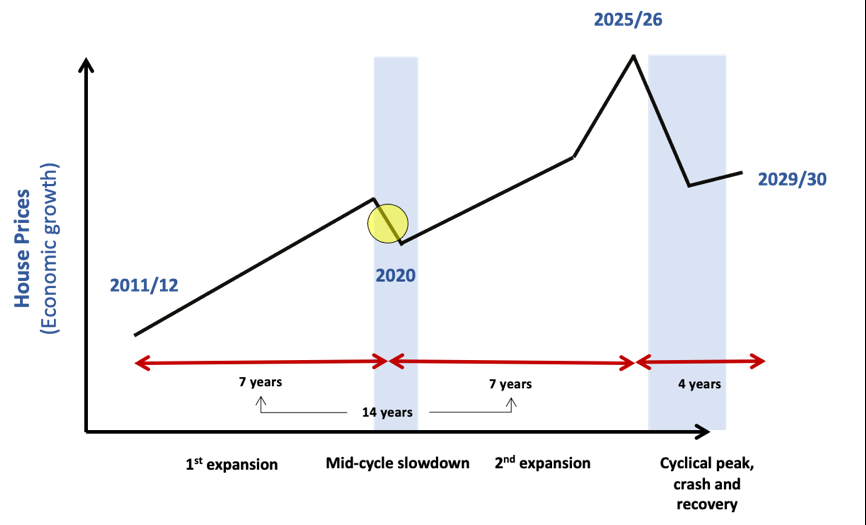
Every real estate cycle, particularly the second half which is where we are now (see Figure 1 below), ends up bringing a new generation of investors into the market, wishing to speculate and take their share of the rent. This cycle there seems to be a lot of emotion with this new generation. In addition to their views on cryptocurrencies, you also have the Robinhood crowd that want to take on Wall Street, using low-cost trading platforms and social media.
But new hype in investing is not unique to this cycle. For example, in 1918, investing in the stock market was something that only 2.5% of American households did; by the peak of the cycle in 1929, this had increased tenfold. New money drove the great Roaring Twenties bull market to its peak.
But the second half of every cycle has involved new investors jumping into the market, and often it’s through the desire to participate in the profits arising from a new technology. In the UK of the 1890s, the new technology was the bicycle and shares in cycle companies experienced a bubble.
In the 1840s in the UK, it was railway stocks (similarly in the 1850s and late 1860s in the US). In the 1820s, it was canal stocks. The technology changes but the same dynamic applies to the second half of every real estate cycle.
Figure 1. The real estate diagram and where we are in it
 Source: Akhil Patel, Property Sharemarket Economics
These movements can be prodigiously profitable but ultimately you need to know when things have gone over the top, particularly in the year or two before the anticipated peak. This is where knowledge of the real estate cycle is so valuable.
In this newsletter, I set out how you can use the real estate cycle to time your investments in the stock market. You can use your knowledge of the real estate cycle to identify when the greatest speculation is taking place, because for all the attention given to the new technology the greatest aggregate increase will be in the price of land (though it will not necessarily be obvious to many because no one systematically collects land prices).
I have long said that the boom we will experience in the second half of the present cycle in the 2020s will be the biggest in history. And bitcoin, I suspect, will ride the vanguard of that boom. Bitcoin at $200,000 – or whatever it is people are predicting – does not seem to me to be beyond the realms of possibility.
Just remember that after every boom there is always bust. The bigger the boom, the bigger the bust.
The words of Ecclesiastes, Ch. 1, verse 9, are appropriate here:
What has been will be again,
what has been done will be done again;
there is nothing new under the sun.
Until next month,
Yours sincerely,

Akhil Patel
If you have any questions please email me at akhil@southbankresearch.com or find me on Twitter @AkhilGPatel