Cycles, Trends and Forecasts: how will history remember 2020?
22nd July 2020 |
As we updated you on a couple of weeks ago, some changes have taken place to Frontier Tech Investor to provide a more rounded, better service to you.
As part of this change, Akhil Patel and his Cycles, Trends and Forecasts publication have joined us. That means that you will receive monthly updates from Akhil as he explains to you about the cycles he tracks and how it relates to investing.
It’s fascinating stuff and well worth your time as I believe it will help you to get a more rounded, thorough view of the world and markets. Bringing in different viewpoints and ideas in this way I think will help you to become a better investor and that’s why you have access to Akhil’s monthly updates going forward.
Below you’ll find his latest update, and if it’s your first time reading Akhil’s stuff, then I suggest you take the time to read it. He’ll of course explain a little bit more about himself and his ideas, but I just wanted to drop you this quick message so that there wasn’t any confusion as to why this was hitting your inbox today.
As per normal, you’ll receive your regular Frontier Tech Investor weekly update tomorrow, Thursday 23 July.
Thanks and enjoy Akhil’s update.
Regards,

Sam Volkering
Editor, Frontier Tech Investor
Cycles, Trends and Forecasts: how will history remember 2020?
By Akhil Patel
In my first contribution to Frontier Tech Investor, I am going to provide an overview of the overall economic cycle that I specialise in. This is for the benefit of new readers and a useful refresher to those who have been reading my work for a while.
Before I do that, let me introduce myself to those who’ve not come across my work before.
I’m a specialist in the study of economic and financial cycles.
I came to this study in 2008 when it seemed the global system was collapsing. People were talking about it as “unprecedented” and “unforeseeable” and all the rest of it. The problem was the banks, or the fiat system. Or maybe it was an American issue. Or the Chinese were flooding the world with liquidity, driving interest rates down.
What I felt was missing from the discussion was how similar the events of the late Noughties were to the early 1990s. In both episodes we’d had a banking/financial crisis that followed a major property boom. On both occasions, my family’s business went through tough times which caused a lot of stress and anxiety.
I wanted to know why people weren’t joining the dots. And helping people prepare to avoid the next one, which is why I started studying economic cycles because it seemed to me that if you go back far enough in history, you can start to see repeating patterns. And at the heart of this pattern is the land market – which globally is the largest market by far.
And if you understand patterns, you can understand current market events in proper context. And then you can use them to forecast events in the markets. Which is essentially what I do.
Is this a turning point in history?
This month’s edition of The Atlantic contained an interesting article with the title “How a History Textbook Would Describe 2020 So Far”.
You can access the article here.
I’d encourage you to read the article. It’s a good reminder of how turbulent the first half of 2020 has been. In just six months, we seem to have had several years’ worth of problems.
The year started with an environmental catastrophe (Australian wildfires killing an estimated one billion animals). Then we swiftly moved into a global pandemic that has seen us all spend several months sitting at home. As if that wasn’t enough, the merciless killing by a police officer of George Floyd led to a global protest movement. And in the background there has been a significant ramping up of tensions internationally between the US and China.
It has been quite the year. And we still have half of it to go!
It’s therefore not an outrageous claim to make, as the article does, that (with emphasis added) “By now it seems clear that we are living through a major turning point in history…”
Time will tell.
But as an investor you need to understand the bigger picture. And to understand the bigger picture you need to look at how events play out subsequently. This is why studying history is one of the most important things an investor can do.
What this will show is that the verdict of history looks very different based on the events that follow.
This is where knowledge of the 18.6-year Grand Cycle that I specialise in is really important.
Let me show you what I mean.
As significant as the year 2020 has been, there have been worse years in history. Consider the following year, by way of example:
- The world was in economic crisis.
- The euphoria of the prior years evaporated as stockmarkets crashed and commodity prices collapsed. The agricultural sector (a large segment of the economy) is driven to the wall.
- During the year in question, there was a global pandemic. This was many orders of magnitude worse than Covid-19 and claimed the lives of tens of millions.
- This pandemic took place on the back of a global war that had killed tens of millions more.
You’ll rightly surmise that the year I am referring to is 1920. Given how bad things were, the memory of that year should be seared into our collective consciousness.
But the fact that it isn’t is largely due to what came after. It kickstarted the “Roaring Twenties” which was one of the great bull stockmarkets in history and socially one of the most celebrated periods in modern history.
How could such a seemingly difficult start lead to such a big boom?
The 1920 recession came at the middle point of the overall 18.6-year cycle. Regular readers of my writing will know that the recession at the mid-point is typically not as severe as the recession/crisis that takes place at the end of the cycle.
And the second half of the cycle is the stronger, more bullish, half. So once the economy had got through the mid-cycle recession of 1920/21, it launched one of the great booms in history.
For an overview/refresher of the cycle, please read the following report: 18 = 14 + 4 : The Grand Equation That Explains Every Boom and Bust of the Past and Future. You can access it in the reports section of the website.
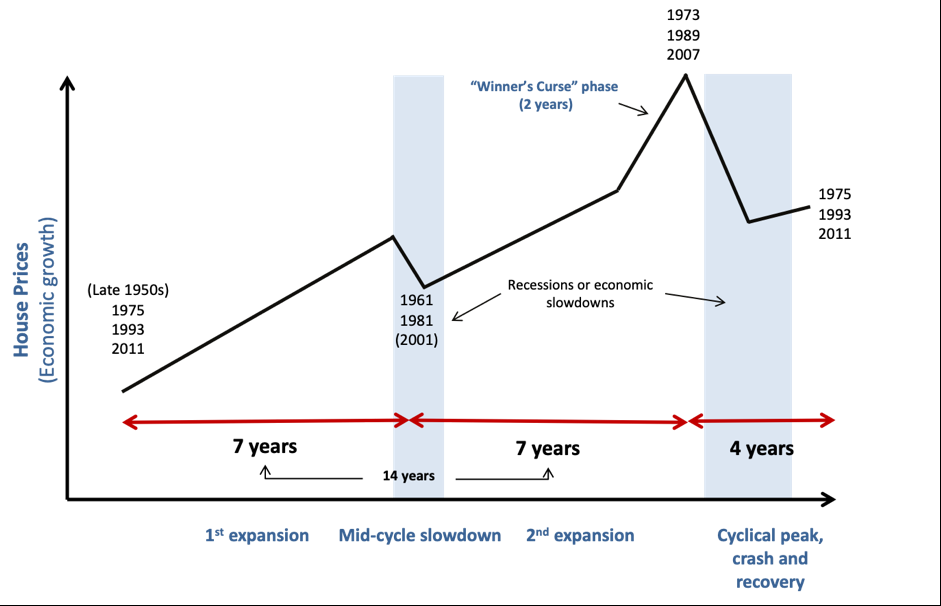
The essential structure of each 18-year cycle is illustrated in this diagram below.
 Source: Ascendant Strategy
Each full 18-year cycle consists of roughly 14 years of expansion and 4 years of crash and recovery. Each 14 years of expansion consists of roughly two seven-year halves interrupted by a mid-cycle recession.
The blue bars in the diagram above are the recessionary periods. As I mentioned above, the mid-cycle recession is far milder than the one at the end.
The cycle is driven by what is happening in the land market. Why land is so important to the economy is a topic you really must come to understand. Read this newsletter for a detailed explanation.
I have overlaid the dates of the three most recent iterations of the cycle on the diagram. The most recent past one started around 1993, went through a mid-cycle recession in 2001 and peaked in 2007, just before the global financial crisis of 2008.
The present cycle started in 2011/12. In 2020, we are currently at the mid-cycle recession.
This may look like a simple diagram but there is over 200 years of history behind it. If you are interested in knowing more of the history of this cycle, then I would encourage you to read The Secret Life of Real Estate and Banking by Phillip J Anderson.
When I first came across this book in 2008, it changed my life. At the time, I knew in my bones that there was a cycle that people weren’t seeing and I wanted to understand it better. Phil’s book provided the answers I was looking for. For the first time, someone was able to set out, in crystal clear detail, how the cycle plays out, time after time.
The cycle can be traced back to 1800 in the US. And even further back in the UK.
I had long forecast that 2019/20 would likely be a recessionary period on the basis of the above diagram. And last year, the world’s economies were slowing into a recession. The global pandemic came on top of an already-recessionary global economy.
So we’d have had a recession anyway. Would it have been as severe in the absence of Covid-19? Of course not. You can’t tell the world’s labour force to sit at home without it having a major impact.
On the other hand, the government response to the pandemic, in terms of pumping liquidity into the system, has been that much stronger, relative to other recessionary episodes. It’s guaranteed to move the world forward into the second half of the cycle.
But this will still take a few months to play out, because major recessions involve a lot of adjustments to the economy.
Get ready for the biggest boom of all time
Another of the forecasts that my regular readers will be familiar with is that I fully expect that the second half of the cycle will be the biggest one yet.
If anything, this bold statement is underselling my claim. In 2017, I spoke at a Southbank Investment Research conference. On the screen I put up the following number:
$250,000,000,000,000
That’s $250 trillion American dollars. This is a number so unimaginably large that if you took that number of pound coins and laid them one top of each other, you’d have enough to reach the sun five times.
In 2017 this number was the Credit Suisse estimate of total global wealth. This represents the cumulative wealth of the world economy from the start of time to this point.
I told the conference attendees that by the year 2026, the forecast peak year of the present cycle, that we’d have doubled that number.
(2026 is my forecast peak for the present cycle, 14 years on from the start in 2012.) This means that by 2026 we will have created as much wealth over the nine-year period from 2017 as we had in all human history up to this point.
To be so bullish and optimistic may seem far-fetched at the present moment. But I have 200 years of history to tell me this one fact: each cycle is bigger than the last. And this cycle, for the first time ever, is truly global.
It is for this reason that when the historians of the future write about the year 2020, their views may be a little different to how things are viewed right now.
Thank you to my readers
Before I go, I want to thank the many readers of Cycles, Trends and Forecasts (which is now part of this publication) for their ongoing support and excellent questions over the years.
Some of you may feel a little disappointed you won’t be hearing from me on a weekly basis as before. But it was time for a change and a big positive for me is my monthly contribution to Frontier Tech Investor frees up my time to launch two very important projects that I have been planning for years.
The first is that I am writing a book. The book will pull together my research on the overall 18-year cycle, how it works, why it endures, why no one sees it and, most importantly, what you can do it about it.
I signed a book contract with Harriman House in May and I hope to have the book completed sometime next year. Some of you have joined a reference group to help shape chapters, comment on drafts, etc. If anyone else is interested in joining the group, drop me a note.
The second project is an exciting new collaboration with my friend and business partner, Phillip Anderson. I noted above how transformative his book has been on my thinking.
Phil and I have been doing research together for years and from my work with him, I can tell you that there’s no one around who is better at applying cycles to markets to figure out what is going on and what may happen next.
Late last year we decided to pool our knowledge into a new service called Property Sharemarket Economics. We have been building up to this for years and we felt it was time.
It’s going to involve unfettered access to all of our research, insights about the various cycles we research, annual stockmarket roadmaps and analysis each year on what markets are likely to have the biggest moves each year.
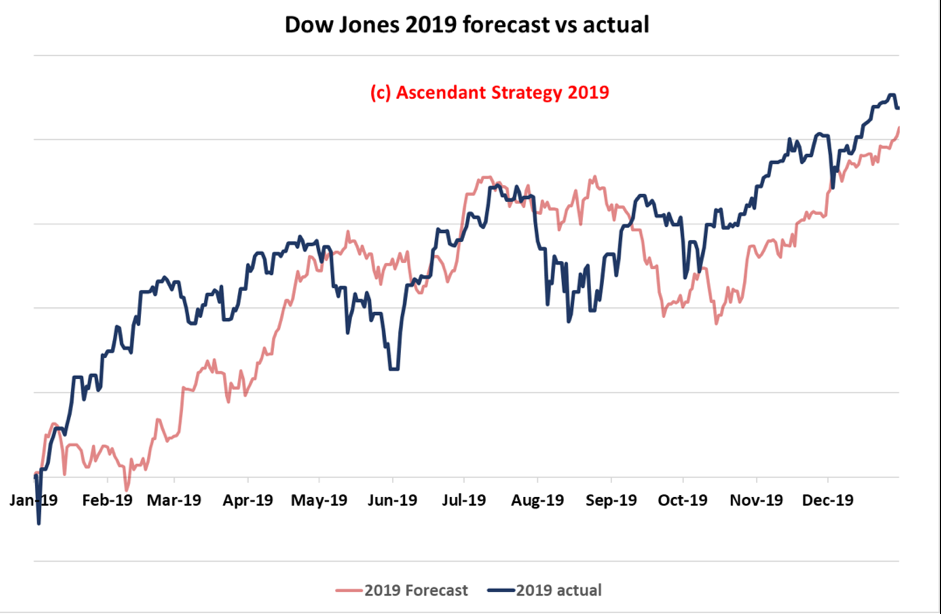
By way of example, here is the annual forecast I made for 2019 for the Dow Jones. Those of you who attended the Cycles, Trends and Forecasts seminar in June 2019 would have received this.
As you can see, the forecast was extremely good – actual movements of the Dow tracked the forecast very closely.
 Source: Property Sharemarket Economics; Akhil Patel
Our goal is simply to provide you with education and insight that will enable you to participate in what will be the biggest boom of all time. If you would like to find out more, please follow this link; if you want to join us, I’d be delighted to have you on board.
So, from a personal point of view, maybe 2020 will be a turning point in (my) history after all!
As ever, if you have any questions or comments please email them to me at akhil@southbankresearch.com. You can also find me on Twitter (@AkhilGPatel and @PropertySharem1) or LinkedIn (www.linkedin.com/in/akhilgpatel).
Until next month,

Akhil Patel
Editor, Cycles, Trends and Forecasts