Go away June, you sucked
6th July 2022 |
Just when you thought the market couldn’t get worse… it does.
One of the problems of being known as “The Crypto Guy” is that when market prices tank, people snidely cast their eye at you like you’re some kind of Bernie Madoff reincarnate.
“How’s bitcoin going?” is a popular question among the critics, not with any genuine curiosity, but full of easy-to-spot smugness.
When you’ve been in crypto for a decade, though, none of this sticks.
You think, “This is my first rodeo, fren?”
When you look at the market, you’re more than likely going to have one of two reactions.
Despair.
Excitement.
Usually in these price corrections – which the media loves to popularly call a “winter” – I’m more excited than the previous corrections we’ve survived.
That’s because, if you’re looking to make mega money in crypto, it’s at the bottom of these correction cycles that you make smart calls into the big winners of the next bull run.
A big chunk of my best-performing recommendations in crypto were made in 2018 and 2019, when the critics had said (yet again) that crypto was dead, the Ponzi had fallen apart and that people like me were nothing more than charlatans and snake-oil salesmen.
Well they’re back in force and we’re here (in force, too) ready for another round.
But this time things are a little different. The swings are bigger, scarier and certainly getting far more attention than they used to.
Why is that? What makes the crypto market every sceptic’s favourite whipping boy now?
Well, thanks to Twitter user Travis Kling, there’s a nice and tidy summary of some of the things that we’ve seen in June in the crypto markets.
Check it out here:
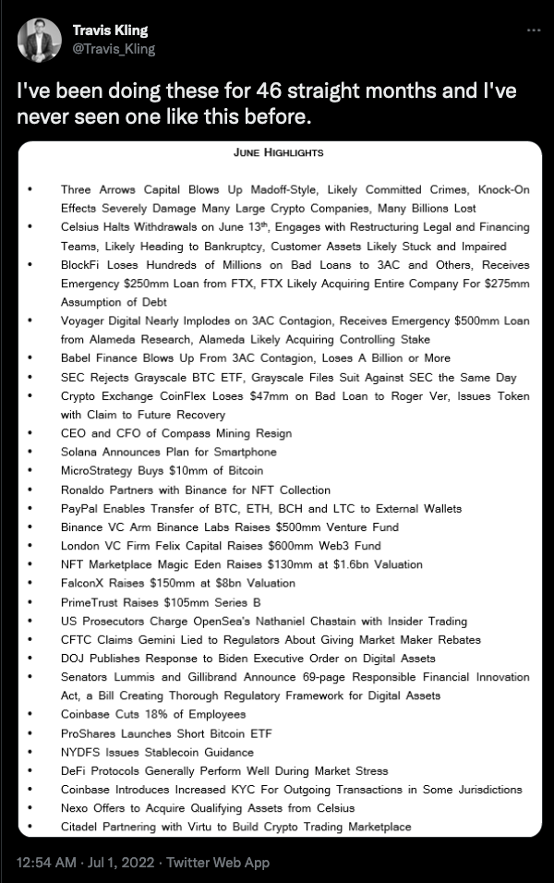 Source: Travis Kling on Twitter
Let’s look at a few of these, because they’re significant, and it’s important to understand their impact on the wider crypto ecosystem.
This should also be taken into context…
It comes on the back of the implosion of Terra (LUNA) and the UST “stablecoin” in May, which wiped billions in value off the crypto market.
First off, subsequent to the Terra implosion, Celsius (a borrowing/lending protocol) saw its token price crater and then the platform went on to “pause” user withdrawals.
The story is that it was exposed and suffered a big hit from the Terra debacle. Also, with liquidity drying up, rumour has it that it’s battling to stay afloat. Even recently, exchange giant FTX walked away from a potential acquisition due to a $2 billion “black hole” on Celsius’ balance sheet.
Then this week it withdrew around 67,000 Ethereum (ETH) from AAVE and Compound to pay down tens of millions of dollars in loans.
Along with this ongoing saga, Three Arrows Capital (3AC), a crypto hedge-fund style investment platform, also began imploding.
Reports started to emerge that it was unable to pay margin calls due to exposures in platforms such as Terra and Celsius, with the result that it was pushed into liquidation.
The problem was that other platforms had/have exposure to 3AC and, with the company going bankrupt, we’re looking at big money loans not getting repaid and then impacting these platforms’ potential value and solvency.
BlockFi is one that is said to have had a significant exposure to all of the above, and 3AC in particular. This was why we sent out a note to you last week about moving your holdings out of the platform as a precautionary measure.
If you still haven’t done so, we would again suggest moving any BlockFi assets into a wallet that you control. Safety is more important than any yield from the platform at this point.
Having said that, we will wait and watch to see how BlockFi moves forward. It did announce a deal with FTX, a bail-out to secure a $400 million revolving line of credit giving FTX the option to acquire BlockFi for up to a valuation of $240 million.
FTX is snapping up distressed assets at present, which likely bodes well for the company long term. This is also a reason why we introduced it as a “Crypto to Know” to you some time ago.
It has proved to be one of crypto’s biggest and shrewdest centralised exchanges, arguably on track to surpass Binance in terms of size and clout. And its founder and CEO, Sam Bankman-Fried, is showing that he’s more than capable of handling adverse market conditions.
On the back of the issues with Terra, then Celsius, then 3AC and BlockFi, Voyager Digital (TSE:VOYG) also began to hit shaky ground.
Aside from seeing its stock crater year to date from over $14 to $1.60 at the end of June, it too has now suspended or “paused” trading, deposits and withdrawals and looks to be on the verge of failing.
The company’s stock plummeted from $1.60 to less that 64 cents as all this began to unfold with Celsius and BlockFi, and then crashed a further 32% on Monday as it ceased activity.
It’s now trading on the Toronto Stock Exchange at 39 cents and may have even more room to fall… quite possibly into oblivion.
This is just scratching the surface of what the month of June has thrown at the market.
And you know what…
It’s ok.
Just like the Terra collapse, we don’t want to see these failures. We would love for people in this market to behave responsibly, with caution and a smart approach to growth and building out a decentralised ecosystem.
But all these failures have affected centralised platforms, and much of the unwinding was to overleveraged positions and greed and growth at all costs.
These events are a cleansing of the market. A wiping of capital that was really a rinse and repeat of all the excesses and problems that traditional finance endured in the first place.
That means that these kinds of failures in crypto always happen in market routs. And every time they happen the market absorbs them and moves forward. Eliminating problem leverage in the market isn’t a bad thing.
It also shows that solid, strong, robust platforms, protocols and decentralised systems can survive and thrive in a market that has had absolutely everything thrown at it.
This is why we’ll be looking at our “Crypto to Know” list below in the coming weeks and bringing you a couple of new ones to familiarise yourselves with as the market deals with this volatility, this cleansing, and comes out the other end stronger than ever.
Keep an eye out for it.
Finally, to sum all this up, let’s just say that, in crypto markets, we are glad to see the back of June.
Also, for what it’s worth, these are also reminders that third-party centralised risk still exists. The best thing you can do is to self-custody your assets, be prudent with what platforms you might sit crypto on, and never have all your eggs in one basket – that’s a true recipe for disaster.
Crypto to Know
Below is our “Crypto to Know” list, where you’ll find several cryptos that we think you should be taking the time to learn and understand.
They each form an important part of the burgeoning crypto ecosystem.
Several of these cryptos are doing very different things compared with others.
What’s key is to learn that every crypto has its own use cases, its own guiding principles, and its own potential. Each should be judged and assessed on its own merits.
Our aim here is to help you understand these cryptos and the wider crypto world.
These aren’t specific recommendations but a guide to help you learn and build your confidence in operating in this space.
We will add more names to this list over time. However, if you’re new to the world of crypto, these are the names where we think you should start your education and learning.
We’ve also added links to each one. The links are to what we believe, in each case, is the best resource for learning about that crypto.
“Crypto to Know” watchlist
- Bitcoin –it/wiki/Main_Page
- Ethereum – ethereum.org/en/what-is-ethereum
- IOTA – docs.iota.org
- Tezos – https://tezos.com/learn/getting-started/
- Filecoin – docs.filecoin.io
- Cosmos – v1.cosmos.network/intro
- Binance – binance.com/en/about & research.binance.com/en/projects/bnb
- FTX – ftx.com & help.ftx.com/hc/en-us
- Solana – https://docs.solana.com/introduction
- Secret Network – https://scrt.network/about/about-secret-network
Sam Volkering
Editor, Sam Volkering’s Crypto Network