Stock Alert: how to profit from the vegan movement
20th February 2020 |
Originally published under Growth Stock Network on 20th February 2020.
Some friends of ours recently got a new dog. They got a Dogue de Bordeaux puppy called Amber.
You may not have heard of the breed before. If not, you might remember the giant slobbery dog from the movie Turner & Hooch starring Tom Hanks. Well the dog in that is a Dogue de Bordeaux.
I’ve had pets my whole life. Many people do. You probably either have or have had a pet at some point over your life. They are as much a part of the family as, well, the family. We often have empathy for them, we care about their “feelings” and we worry about them as we often would our own kids.
We also often forget they’re animals. Sure, dogs and cats and horses and family pets have various states of emotion, but not in the same way that humans do – they’re simply just not as intellectually complex.
Still, that doesn’t stop us from “humanising” our animals. I’m as guilty as anyone when it comes to this phenomenon of animal humanisation.
For example, last Christmas we flew back to Australia. Clearly taking the cat and dog wasn’t an option. The dog got a holiday at grandad’s place. But considering grandad has a giant Ridgeback Rhodesian that hates cats… the cat was going to stay somewhere else.
As such, I drove an hour and a half (out and back) to a “cat hotel” to view the premises and facilities to see if it’s suitable for our cat’s tastes and needs. It was and therefore that would be the cat’s holiday destination.
Even writing that paragraph I’m amazed at the lengths we go to for our animals.
The modern “way of life”
20 years ago when I was just a kid, the idea of putting the cat in a “cat hotel” would have been a little bonkers. Today, not as much. The fact is that society is now more aware of the benefits of relationships with humans and animals as part of a healthy, whole life for everyone involved…
When we think about our animals, we think about our pets. Historically that’s where the considerations ended. But more and more people are starting to take serious notice about the lives and welfare of animals everywhere.
Suddenly in what appears to be an overnight change in societal attitudes, animal welfare is now considered on a par with human welfare. In some instances, you find people are more concerned about animal welfare than of humans.
But we also know that there’s scientific evidence to support the quality welfare of animals.
A 2013 study of the impact of human-animal interactions on animal productivity and welfare had some fascinating findings. In the abstract of the study the research noted,
Regular pleasant contact with humans may result in desirable alterations in the physiology, behaviour, health and productivity of farm animals. On the contrary, animals that were subjected to aversive human contact were highly fearful of humans and their growth and reproductive performance could be compromised.
The research concluded there is“opportunity to improve productivity and welfare of farm animals through positive human-animal interactions.”
This kind of consideration for animal welfare has led to a resurgence in a “way of life” that is taking the world by storm.
The use of animals in any way shape or form in the creation, manufacturing, sales or delivery of goods and service is something that a lot of people globally are starting to avoid. This desire to shun all animal products is known as a “vegan” way of life.
A vegan is someone who simply does not eat or use animal products. No meat, dairy, fish, eggs, furs, skins – anything with an animal. That of course extends to leather, which is why you probably don’t see many vegans riding around in a Rolls-Royce…
However, the decision to be vegan is something that you simply can’t avoid, and that you must respect. Not everyone agrees with it, but then again, who cares what someone chooses to do with their own life?
I have friends who are vegan and have been for a long time. The world is still difficult for a vegan to exist in. You can’t just lob into any old restaurant and order anything off the menu, it has to be sure to have an animal-free option.
But noticeably over the last couple of years, there has been a “vegan awakening” and most places now, particularly food venues, cater with specialised vegan menus.
In fact, the Economist said that 2019 was “the year veganism goes mainstream”.
A May 2018 article from Forbes explained,
Fiona Dyer, Consumer Analyst at GlobalData, comments: ‘The shift toward plant-based foods is being driven by millennials, who are most likely to consider the food source, animal welfare issues, and environmental impacts when making their purchasing decisions.’
This push to veganism is impacting industry all over the world. Even some of the world’s largest meat producers are investing in non-animal meat companies – that includes lab-grown “meat” that requires absolutely no livestock.
Even just this week I popped into a BrewDog pub for lunch and knocked off a “Beyond Burger”. The “meat” patty was made from plant-based ingredients from the burgeoning US company Beyond Meat, yet tasted exactly like a normal real-meat burger would.
It’s clear the vegan food movement is huge. But it’s more than just food. Animal products are also rife amongst the consumer market. And now we’re starting to see a surge in “certified vegan” non-food based products hit the market.
This is a long-term trend that we think is an opportunity to capitalise on as consumer spending patterns change.
Your latest Growth Stock Network recommendation…
Have you ever heard of the ingredients, squalene, lanolin, guanine, keratin, carmine, beeswax or collagen?
You’ve probably heard of at least one or two of them. Well they’re all major ingredients used in the manufacturing of cosmetics. And none of them are vegan friendly.
What’s important to remember is that the cosmetics industry over the last couple of decades has made an effort to combat animal cruelty. Most major cosmetics companies have cruelty-free products (still not all) but being cruelty-free doesn’t necessarily mean “vegan”.
For example, L’Oréal Group is cruelty-free. However, its Colour Riche Lipstick contains lanolin liquida, lanolin oil, PPG-5 lanolin wax and beeswax. Hence it’s not vegan friendly.
This is a common theme with most cosmetics you can buy at any high-street supermarket, chemist or cosmetics outlet. Most aren’t vegan friendly.
That’s why we think there’s real opportunity in vegan cosmetics. And there’s a small, UK-based, AIM-listed company we think could benefit most.
Warpaint London Plc [LSE:W7L] is your latest recommendation.
Warpaint is based in the UK and listed on the London Stock Exchange AIM sub-market. It currently carries a market cap of around £62.9 million and a stock price of 82p.
Warpaint and its W7 brand is a cosmetics company that’s been making and supplying cosmetics to a global customer base since 2002. Some of its bigger markets include the UK, Europe, Australia and the US.
The company is made up of two main segments – its W7 brand, which is its core brand and product line, and then the Retra Holdings brands.
Retra is another cosmetics company with multiple brands (Technic Cosmetics, Body Collection England and Man’Stuff). Warpaint acquired Retra in 2017 to expand its brand portfolio and to also access high-street retailers like Boots, Superdrug and Asda.
Across the company and all brands, products range from foundations and bronzers to nail polish, lipstick, eye shadow and eyeliners (and everything in between). It is a comprehensive cosmetics company that manufactures and distributes cosmetics for the face, eyes, lips and nails.
We’ll touch on its global reach shortly, but for us there’s one particular product area of Warpaint that we think holds tremendous opportunity for the company.
It’s its “Very Vegan” range of cosmetics.
Launched in the second half of 2017, Very Vegan is one of the company’s targets for future growth. There’s not a great deal of complexity here to illustrate what the aim is – these cosmetics do what they say on the tin.
They are cosmetics – for the face, eyes, lips and nails – that adhere to the vegan way of life. And that’s the target market it’s aiming squarely at capturing.
It’s a market the company has got a huge opportunity to take a massive slice of. Grand View Research estimates that by 2025 the global vegan cosmetics market alone could be worth as much as US$20.8 billion.
This market opportunity could be even larger than those estimates. Many regions around the world are actively backing bans on the sale of all beauty and personal care products that have been tested or involved with animals. According to Livekindly, areas such as California, New York, Canada and the EU are all pushing for these bans.
The cosmetics industry may quickly develop into a market where all cosmetics are required to be “certified vegan” and that becomes the industry standard.
We foresee that you won’t end up with “vegan” cosmetics. Instead, just regular cosmetics and the default position is vegan. The “alternative” options are those that aren’t vegan.
Speaking of New York, we already know the W7 brand has been getting its awareness out into the world having been the primary sponsor of the “Runway V” vegan charity fashion show at New York Fashion Week, around this time last year.
Our view is that Warpaint will continue to see tremendous growth in its vegan-friendly range of cosmetics and it could fast become the global brand it’s most recognised for.
As noted in its results announcement from September last year, “… our Very Vegan range continues to grow as a vegan lifestyle or product choice becomes more prevalent.”
In particular is the potential for the Very Vegan brand to hit it big in the US. And it’s this US vegan opportunity where massive potential lies. This is further exacerbated by the impending Brexit outcome the UK is going through.
Very special friends
As we know, the UK is now out of the EU. It’s going through the processes of figuring out how that plays out with trade, finance, immigration and everything else from pillar to post.
What we know is that a fractured trade relationship with the EU could hurt British companies. Warpaint is not immune for potential disruption to its revenues and profits if the trade negotiations are adverse.
The company is exposed to trade pressures from the outcome of Brexit, potentially higher taxes and tariffs for its products sold into Europe and fluctuations in the British pound.
However, the company has been proactive in its response to Brexit, but that still doesn’t mean it hurts the bottom line. As noted again in the interim results announcement,
Trading conditions in the UK remain challenging because of the UK high street slow down and ongoing Brexit anxiety. Group sales in the UK were down by 6% in H1 2019 compared to H1 2018.
While Brexit continues to pose a short-term risk, our view is that once it is over, the upside for Warpaint is exciting with its expansion into new UK retail and also overseas.
One region in particular that excites us is the US.
And that’s where we think Warpaint, its W7 brand and Very Vegan is really going to help the company boom over the coming years.
In the report from the Economist about 2019 being the year veganism goes mainstream, it also noted that 25% of all 25 to 34-year-olds in the US say they are vegan or vegetarian. We would anticipate that extends even further the younger the demographics.
If you consider there are around 76 million 18 to 34-year-olds in the US as of 2017, you can see there’s a ready-made captive market that’s 10 million more than the entire population of the UK.
This is the opportunity in front of Warpaint – and it’s one it’s ready for, prepared for and one which the political landscape is setting up perfectly for.
As the company pointed out,
In a challenging retail market, particularly in the UK, the business is showing resilience and adapting to the changing market conditions, increasing international sales by 7.8%
It continued to say,
In the US, we have made an encouraging start in H1 2019 with sales made by LMS up 36% on a like for like basis, and for the W7 brand, up 45% … We have increased our marketing spend in the US to drive brand awareness and to help support sales initiatives, which should deliver revenue in the second half of 2019.
Ready to step higher
With the opportunity clearly in front of the Warpaint, we should also note it is already a successful and importantly profitable company. This is the perfect kind of small-cap to get involved in as there’s also the opportunity to collect dividends should it decide to pay them out from profits.
Now we will add that Warpaint hasn’t released its full 2019 (ending 31 December 2019) year financials yet. We’re expecting them the week of 20 April 2020.
We want you to get into the stock before the company unveils its financials. It’s already put out a trading update, so we expect the market has somewhat already priced in expectation.
Therefore in absence of any crazy surprises, we think the potential for a tick higher is more likely that a step down.
Its trading update states it’s expecting to report revenue of £49.3 million and an adjusted before-tax profit of £5.2 million.
Now it should be noted this is a downward revised number from the end of 2019. The company puts it down to,
… a number of factors, including the geographic mix of sales, adverse exchange rate movements and the Group’s investment in its strategy for future growth, particularly in the US, are having an impact on profitability in the current financial year.
Considering the headwinds of Brexit in the UK retail space, the push to expand to US markets, the opportunity with vegan cosmetics and even the potential in the UK after the Brexit dust settles, we think now is a great time to get into this AIM small-cap.
Risks
Warpaint carries a fair degree of risk should you decide to purchase stock. We’ve already touched on a number of those in the recommendation so far.
Firstly, competition risk here is ever present. We are talking about fast-moving consumer goods (FMCG). The kinds of product that you need large volumes to shift in order to make a successful company.
This comes with brand awareness, marketing, and advertising to target markets. And when you’re competing with billion-dollar cosmetics giants like the L’Oréal Group and Estée Lauder Companies, it’s a hard market to crack, penetrate and then expand into.
But it’s not impossible as Warpaint has already displayed with its resilience in the face of Brexit and its push into new market opportunities like the Very Vegan range and overseas in the US.
Still, competition is also developing vegan ranges of cosmetics. We expect the vegan market will become red-hot with a selection of vegan-friendly cosmetics. Without a strong presence in the marketplace, without visual representation concessions in UK retail, or without the right approach to branding, marketing and advertising, it will be difficult to crack a significant slice of the vegan cosmetics market.
If it proves that Warpaint can’t deliver growth in this segment, it may cause us to reassess our view on its growth potential.
Furthermore, we see the US market as a big area of opportunity for Warpaint, particularly post-Brexit. Again, we expect to see growth from this region, particularly in the full-2019 calendar year results we expect in April.
We’d also expect the 2020 year to demonstrate growth in the US.
Absence of growth in the US we think would be a negative for the company and again may put downwards pressure on the stock price.
It’s also important to note that the US isn’t the only market that has growth potential. Warpaint is pushing into China having made its first domestic Chinese sales in the latter parts of 2018.
But that’s early stage and may take some time to properly get a foothold into. So for the short term we’re expecting big things from its US operations, not much from China just yet.
Another risk is the obvious financial risks. While Warpaint is generating profits, there’s no guarantee that will continue. As we know, stocks like this can sometimes have poor years. A downwards move in revenues, profits or the cutting of dividends could cause the market to react and sell off the stock, pushing the value lower.
While we’re not anticipating that, there’s the potential Brexit really plays out to be horrific for UK domiciled companies, and a weak sterling could have a serious effect. While the company has gone some way to prepare for it, negative reporting on financials for whatever reason may cause a level of risk too great for some.
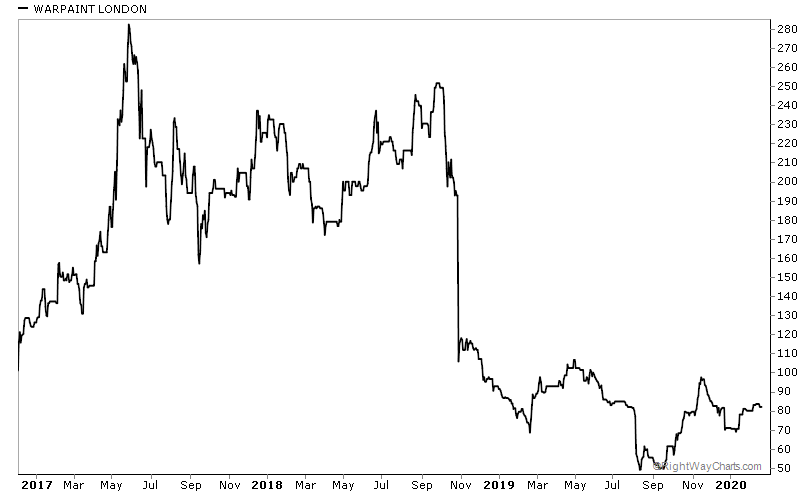
Finally, the stock has been volatile and on a downward trend over the last few days with a 52-week low of just 48.25p. But the stock has bounced back from there and we think it has demonstrated sufficient trending higher to suggest we’ve seen the bottom.
Buying instructions
Warpaint London Plc [AIM:W7L] trades on the London Stock Exchange AIM market.
It has a current market cap of around £62.9 million and trades for 82 pence.
In terms of volume, the stock is relatively illiquid. Current average volumes are around 77,500 shares trading hands. Although on some days this can be as low as a few thousand.
As such, you should ensure to set limit prices when entering the stock and don’t chase the price if it prevails the stock spikes after our recommendation. If the stock trades over our recommended buy-up-to price, do not buy, and wait for the price to settle.
You should also set a trailing stop with this stock. We suggest setting the trailing stop at 40% lower than your entry price. A 40% fall would mean a return to its 52-week lows and perhaps indicate even lower movements from there.
But we don’t expect that to happen, and if we see the stock continue to rise, the trailing stop is also designed to help retain profits if we begin to see significant stock performance.
BUY Warpaint London Plc [LSE:W7L] current price 82 pence. Buy-up-to 95 pence. Set a trailing stop at 40% below your entry price. Remember to stick to our buy-up-to prices should the stock spike after recommendation.
Action to take: buy Warpaint London Plc
Ticker: W7L LN
Price as of 20.02.20: 82 GBp
Market cap: £62.93 million
52-week high/low: 112p/ 49.50p
Buy up to: 95p
Regards,

Sam Volkering
Editor, Growth Stock Network