Stock Alert: Old plus New in cross-border payments? Equals…?
8th July 2021 |
The Medicis were a Florentine family of many talents.
They were wool merchants, bankers, and even patrons of art during fifteenth century Italy.
The family were far more than just their profession, though.
They were innovators and influencers.
They were at the heart of the major cultural and financial development that took place in Europe during the 1500s.
The Medicis were big contributors to the innovation that sparked the Renaissance.
They would pay commissions to artists and architects to produce major works.
Some of the world-renowned artists they sponsored included Michelangelo and Leonardo Da Vinci.
The Medicis’ art patronage was a testament to their wealth.
They had the luxury of spending huge sums of money on nurturing the finest artists, and artwork.
Largely, they accumulated this wealth through their success as bankers.
In fact, the Medicis were pioneers in financial services.
The Medicis opened their own bank in 1397 in Florence, Italy.
It was called, as you might expect, “The Medici Bank.”
It became one of the most prosperous and respected institutions in Europe.
This was partially because the Papacy made the Medici Bank its official bank.
The support of the Pope provided the bank with the recognition, and prestige which would encourage merchants to use their banking services.
In their banking services, the Medicis facilitated some of the earliest currency exchanges.
As their influence grew, they opened more banking branches across Europe in cities such as London, Rome and Barcelona.
These local bank branches would exchange currencies on behalf of textile merchants.
They created a nostro (“ours” in Italian) account book which consisted of two columns, showing the available amounts of foreign and local currencies.
In other words, it was the earliest and most basic form of a bureau de change.
The Medicis were shrewd, and like the exchanges of today, made a markup on the exchange rate differences at their branches across Europe.
It was an astute way to avoid the Catholic Church’s definition of usury (charging for the use of money), which was a mortal sin in much of Europe at that time.
Of course, things have changed since the Medici era.
Advancements in technology now allow us to exchange currencies at the tap of a button, from anywhere in the world.
But one thing remains apparent; the Medicis were responsible for leveraging aspects of finance that are still present in banking of the modern day.
Our latest recommendation can be linked to the theoretical foundations laid by the Medici family.
It has taken these “old money” principles, and converged them with its own version of “new money”, under a single platform.
What’s old? What’s new?
The “old money” system refers to the use of fiat currency.
In other words, fiat currency is paper money that is established as legal tender by governments.
It has no intrinsic value, but is recognised as having worth by governments.
The current fiat currency system has been around since 1971, when US President Richard Nixon brought an end to the gold standard system.
In the gold standard system, the US dollar was fixed to gold at a particular price.
Other major currencies were fixed in some way to the US dollar at pre-determined and universally known rates.
Of course, the Medici family used many of the principles of the old, traditional money system in their banking services.
For instance, their banks would accommodate and redistribute fiat currency, and ultimately have control over people’s money.
The “new money” system refers to the use of digital assets, and in particular, cryptocurrencies, as a medium of exchange.
It has been around since 2009, when bitcoin was first introduced.
With the new system, there is no third party overseeing the transactions.
It is decentralised, meaning that assets are exchanged in a peer-to-peer way: this provides autonomy, privacy and security for users.
In part, this helps to explain why cryptos have become so popular.
Financial institutions are recognising this, and are making reservations for the new, in-demand system.
Our latest recommendation has its roots firmly in the old money system.
However, at the same time, it is a progressive and innovative company.
As a result, it is starting to realise the potential of the new money system.
This is the catalyst for why we believe it will make a perfect fit into our buy list.
The bane of international payments
International payments are still inconvenient and often difficult to perform- even after a few hundred years of development in the global payments industry since the time of the Medicis.
Normally, cross-border payments are burdened with high fees, long processing times and restricted by regulatory issues.
Security concerns can also act as a deterrent when looking to send money overseas.
A report by Tearsheet found that on average, 89 percent of financial executives lost money because of inefficient cross-border payments.
In addition, 55 percent of respondents said that they lost between four to five percent of their revenue.
Inefficient cross-border payments can be a huge impediment to businesses. It can be the difference between international expansion, or deterioration.
It’s also a huge inconvenience to banking customers that are looking to access new, international markets when choosing which goods and services to buy and/or sell.
The new money system helps to fix these problems caused by international payments.
It provides a quick and efficient means of payment, and one that is not delayed by centralised authorities.
Our recommendation converges this new system with the old system, creating a financial payments ecosystem.
Introducing your latest Frontier Tech Investor recommendation…
Equals Group plc (LSE: EQLS) is a financial services business, listed on the London Stock Exchange. It has a market capitalisation of £78.73 million and a current share price of 44.05GBp.
The company was first established as a consumer facing, travel money business in 2007 – when it went by the name of FairFX.
It rebranded to become Equals Group in June 2019, after expanding into an international payments and currency exchange platform.
Today, Equals is an international payments ecosystem that provides Business to business (B2B) and Business to customer (B2C) services.
It also offers domestic payment services within the UK.
Equals has three products.
The first is Equals Money: this is a business-to-business (B2B) interface that is designed to help businesses manage their money.
Within it, businesses can make international payments in up to 140 different currencies at any time.
Payments are settled within a 24-hour period, and are overseen by a dedicated account manager.
These payments can be made using the principles of foreign exchange.
For example, limit orders can be used when exchanging currencies for payment: this is when payments are only executed when a desired exchange rate level gets hit, saving the business money.
Equals’ B2B offering
In its B2B offering, Equals claims to provide an extraordinary level of efficiency.
This area of the platform requires a simple login, giving users instant access to a variety of payment and currency options.
Part of Equals’ appeal is that it’s part of the UK Faster Payments Scheme. This is a UK banking initiative, designed to reduce payment times and fees between banks and customers.
It means Equals boasts a level of connectivity and infrastructure on par with some of the biggest banking institutions.
Indeed, some of the biggest names in payments regard Equals as a serious player in that game.
For instance, Equals announced a deal with HomeSend, a joint venture of MasterCard, in November 2020.
B2B revenues represented 70 percent of total revenues in FY2020. In FY2019, it represented 56 percent.
According to CEO, Ian Strafford-Taylor, the B2B side of the business grew 9 percent in 2020. Considering UK GDP shrunk by roughly 10 percent during the same year, this is an impressive result.
Also, the B2B product is attractive to customers because it is so easy to implement.
For example, it does not require customers to change banking provider, which can at times, be an arduous process.
The customer can simply select what Equals’ services it wants to use, on top of those that it uses from its existing provider.
In addition, there is an expense management service, which gives full transparency over business spending.
Equals provides a spend card, which can be used in up to 190 different countries.
Businesses can give spending permissions to employees, and where necessary, implement restrictions on how they use the card.
In simple terms, it’s like a company card, but with more transparency than you may have ever seen before.
Equals’ B2C offering
The second product that Equals has is Fair FX. This is the business-to-consumer (B2C) side of the business.
FairFX is the concept upon which the business was originally built: travel money.
Within it, Equals has created a multi-currency card that can handle up to 15 different currencies on it, making it ideal for holiday spending.
If they chose, customers can order travel money (i.e. actual banknotes) online, and get it delivered to their door.
International payments can also be made through this section of the business.
They can be made round the clock, with speed of execution again being a key characteristic.
The last of Equals’ products is its CardOne Money.
This offering is both B2B and B2C in nature.
It offers standardised business and personal banking services: in both instances, it makes it easier for customers to manage and control expenses.
According to CEO, Ian Strafford-Taylor:
“As the UK payments sector becomes increasingly crowded with specialist operators, our unique proposition spanning banking services, international payments and card-based solutions is proving to be a major differentiator for our customers, driving loyalty and new customer acquisition.”
So, what makes Equals different?
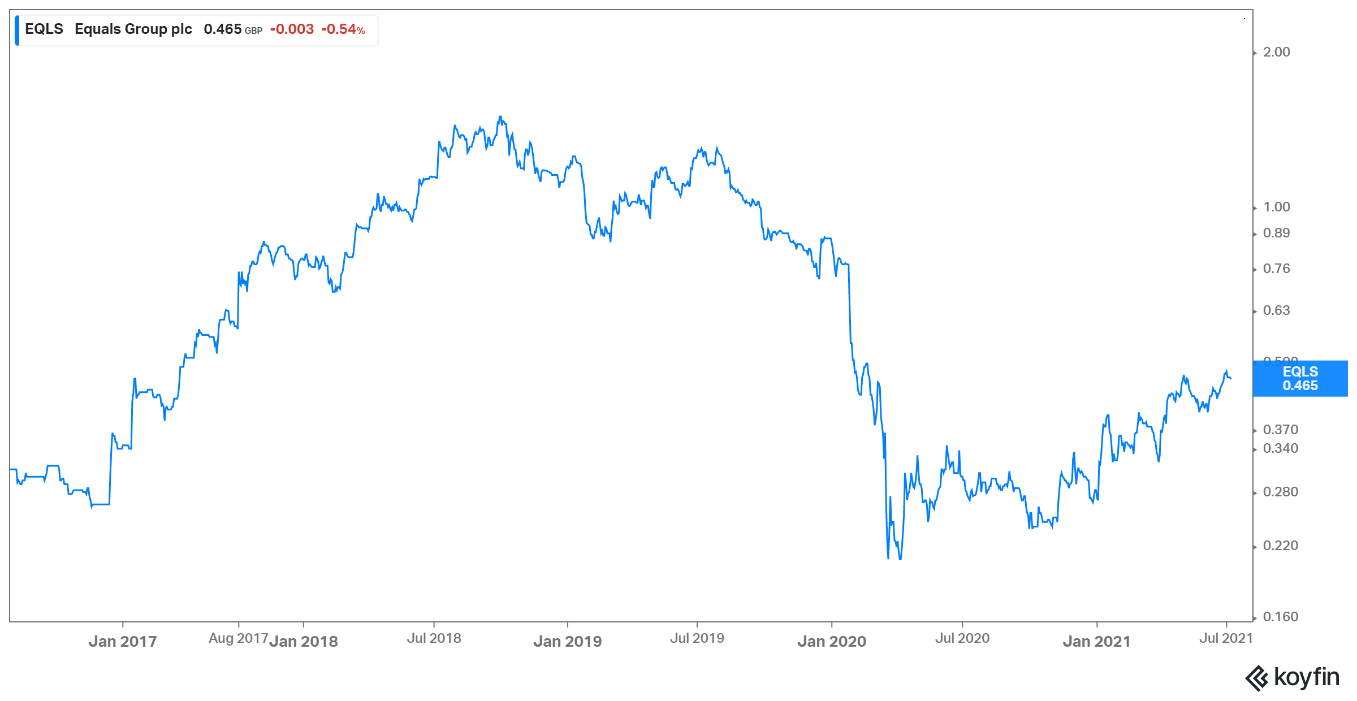
The growth of the company over the last year or so, and the share price performance since the beginning of 2021 (generally rising at a time that a lot of technology-related stocks have been weak) suggests to us that Equals really is far more than just another FinTech.
It is long established, and has several revenue streams – from both B2C and B2B products.
In this respect, it is very different from many “challenger” payments services providers, which are newer and typically focusing on either B2B or B2C business, but not both.
As a principally B2B operator, Equals’ management team is far less worried about the number of customers than are their counterparts at mainly/totally B2C payments providers.
Equals is also unusual in the sense that it looks to regularly acquire competitors – in order to boost its market share, and growth.
The last acquisition came in October 2020, when Equals acquired Effective FX.
That company specialises in international payments and e-banking services. The deal was valued at £1.6 million.
Of course, Equals’ products have been entirely centred around the “old money” system – involving established financial institutions and financial markets infrastructure…
…until now.
And the fact that that is changing is another positive element which sets Equals apart from most, if not all, of its competitors.
Equals equals convergence…
And now, Equals is converging this system with the “new money” system of cryptocurrencies.
On 1 March 2021, it announced a partnership with Tap Global Limited, a crypto-exchange company.
The partnership will allow Equals’ customers to convert into and out of cryptocurrencies against fiat currencies.
Like the Medicis in Renaissance-era Florence, Equals is taking a positive approach that will make cross-border payments easier for its clients.
To us, this is exactly the kind of deal that will advance the cause of cryptocurrencies as mediums of exchange.
To date, excitement around the company has been based on its skills and capabilities in the old money world of fiat currencies.
Looking forward, the excitement may well be based on Equals’ involvement in the new money world of cryptocurrencies.
Financials, risks and action to take
The most recent financial information that Equals has published shows losses after tax of £6.9 million during the fiscal year, ended 31st December 2020 (FY-2020).
This was a 27.8 percent increase on the losses of the previous corresponding period (FY-2019).
Revenues fell from £30.9 million in FY-2019 to £29 million in FY-2020, or by 6.1 percent.
In essence, the impact of the near closure of its B2C travel money business was largely offset by a 51 percent rise in revenues from Equals’ B2B business.
Aside from achieving strong growth in that part of the company, Equals has no bank debt.
In addition – and as noted above – the company has performed very well in what has been a volatile period for stock markets. Since February 2021, investors’ appetite for risk has largely fallen.
Specifically, the company’s share price has risen from 33.25GBp on 1 February 2021 to 44.05GBp at the time of writing, or by roughly 32 percent.
That said, it’s important to understand the current risks that the business faces.
Firstly, Brexit poses a threat to the profitability of the business.
With it, there may be a reduction in international trade, as many businesses are faced with uncertainty and complex bureaucracy.
A report by Euro News in March of this year highlighted that the UK had experienced a record fall in trade with the EU in the first month (January 2021) since the end of the transition period.
Exports sunk 41 percent, whilst imports reduced by 29 percent.
As a result, there may be less of a demand for international payments services amongst UK businesses.
In addition, Equals must ensure that it maintains the highest level of regulatory compliance at all times.
Being an international payments provider, it is simultaneously involved in regulatory landscapes across a number of different countries.
Failure to comply with regulations, that are indeed ever-changing, may lead to fines and sanctions.
Another aspect that Equals must consider is its available liquidity. Offering foreign exchange capabilities means that it must have sufficient currency reserves to execute conversions and payments.
As the business grows, it must suitably adapt its currency reserve requirements so that more payments can be settled.
If it doesn’t have the available liquidity, then less payments will be executed, meaning that it makes less revenue from foreign exchange transactions.
Further, we would note that the payments industry is a competitive one – with many players looking to gain market share on the basis of better service, broader range of offerings and/or price.
Finally, there is the risk that Equals does not leverage the new crypto aspect of the business.
It could, by all accounts, drop the idea if it doesn’t bring the company sustained profitability.
This would cause us to reassess our long-term position in the stock.
With this, it’s very early days, with the announcement only coming in March 2021.
Currently, it’s fairly unclear as to how/which cryptocurrencies will be made available on the platform, and how the business will leverage its use.
If it does, the cryptocurrencies will be prone to volatility, as is a common feature of them.
This may deter customers from using them, particularly if it provides wild, yet unfavourable exchange rates vis-a-vis fiat currencies on the platform.
In spite of these risks, we believe Equals has excellent upside potential – within both the old money world and the new money world.
We think that the Medicis would be impressed.
Buying instructions
Equals (LSE: EQLS) is listed on the London Stock Exchange. It has a market cap of £78.73 million and a current share price of 44.05GBp.
Average volume in the stock is around 405,000 per day. That works out to around £178,400 per day in value traded.
We recommend that you stick to our buy limits. If the stock trades over the limit, we suggest you wait for a suitable entry point below the buy limit.
We will also be using a 40 percent hard stop loss on this position. This means that we likely won’t be stopped out along the way should volatility in the market increase.
Action to take: BUY Equals plc (LSE: EQLS). Current price 44.05GBp. Buy up to 55.80 GBp. We will be setting a hard stop/loss position at 27.9GBp (40 percent below the previous close price).
Name: Equals plc
Ticker: EQLS. L
Price as of 08.07.21: 44.05GBp
Market cap: £78.73 million
52-week high/low: 58.00GBp/22.00GBp
Buy up to: 55.80 GBp
 Source: Koyfin

Sam Volkering
Editor, Frontier Tech Investor

Elliott Playle
Junior Analyst, Frontier Tech Investor