Stock Alert: The office isn’t dead, but it’s about to radically change
11th December 2020 |
A couple of weeks ago, during the second national lockdown I was needed in the Southbank Investment Research office in central London.
I dutifully jumped on a train and headed in.
As I arrived into central London from the train, I had a couple of choices to get across town to the office. Head underground to the Tube, or get a taxi.
Sure, there are other options these days, like bikes, scooters, etc. But it was also drizzling and cold so neither of those was going to be much of an option.
Also, I’m usually not a huge fan of getting the Tube to cross London at the best of times. Even when the world was operating normally, I prefer a black cab because I much prefer to soak up the scenery and sights of London as I get across the city.
Perhaps that’s one of the eternal lingering aspects of being an immigrant to this country. Cities like London have a “beauty” for us foreigners that never fades.
I also where possible try and get one of those new EV black cabs. Not because of their impact on the air quality levels of central London (a nice bonus though) but due to them having large panoramic transparent roofs.
This way as the cab meanders through the winding routes of the streets of London I can see everything that’s going on.
Only problem was that a couple of weeks ago… nothing was going on.
In days gone by even on an early Sunday morning as some people are getting in from the night before and some are just getting going, London is typically bustling with activity.
Not during a national lockdown.
The typical hive of activity was a lull of inactivity. Barely any cars or trucks on the roads. Next to no pedestrians. I think I saw one person dollying along with a suitcase – they must have really missed the bulletin…
For all the inactivity I’m used to, there was still something that hadn’t changed. Yet, due to the lack of everything else, this stood out far more than it perhaps usually would.
Blinding hi-vis
One thing that I couldn’t miss as I looked out the window of the black cab was the immense numbers of people walking around wearing bright yellow, orange and reflective “hi-vis” clothing.
In other words, all the construction workers that were still cracking on with their work. I’m not just talking about a few either. At every set of traffic lights, and every other corner was a gathering of hi-vis.
There were still cranes lifting giant steel girders up the sides of construction sites. There were concrete trucks still getting around. There were streets blocked off for construction, temporary lights, traffic management and the grinding of power tools on building sites.
While London may have been a dearth of the usual populous, it was still bursting with construction.
Of course these aren’t typically construction sites for residential housing. These are all commercial buildings. These will be offices and office space for the ever increasing number of central London workers.
According to most recent data from 2017, GLA Economics forecasts that by 2041 employment in London will reach 6.907 million workers. That’s an annual average rate of growth of about 50,000 workers. It’s also a figure that’s roughly the entire population size of Bulgaria.
To manage and ensure all those people can work and contribute to the economy as intended, you need to put them somewhere. Considering the City of London is just 2.9km2 that’s a heck of a lot of people to fit into one area.
Which is, of course, why London is building up and there are more and more skyscrapers and commercial office space being built in London.
Currently the estimates are that there is around 300 million square feet (27.87km2) of office space in London. There’s at least another 2.7 million square feet currently under construction. And with the employment growth predicted, that’s set to increase even more.
It’s easy to see why it’s such a vital part of the British economy, but also a vital part of the global economy.
However… and we must address the giant elephant in the room here… all of that growth, all of that construction… all of the potential for London to continue to become a bustling hub of employment and workers…
… is utterly and completely under threat.
Post-Covid working
There’s no doubt the impact of the Covid-19 crisis will have a ripple effect on the world, long after mass vaccines roll out.
After we’ve forgotten about social distancing, after we can walk into a shop or a pub without a face mask, we will still remember what happened this year.
Lingering in the backs of everyone’s mind will be the simple question, what do we do if this happens again?
Now that precedent has been set, it’s a fair assumption to think with the next global pandemic, we might once again be in for a rough ride. However, there’s also an upside to what’s happened in 2020.
The upside is it’s reconfigured how employers and employees think about the traditional concepts around the office, office space and where and how workers work.
The idea of remote working isn’t new. Thanks to the ever increasing connectivity of our world people can effectively work in a number of industries from a number of locations around the world.
I’m a great example of this. I’ve worked effectively from home now for over seven years. I’ve been able to travel around the world to conferences, expos, conducting research and interviews on just about every continent and yet still not disrupt my output.
Australia, Singapore, Dubai, the US, Europe, all over the UK, it doesn’t matter where I am, the ability to connect and ensure workflows and deadlines are met is easy now. It wasn’t like this 15 years ago. It wasn’t even really as easy as it is now ten years ago.
I’d even say within the last five years things have really only reached a point where the remote worker has become a truly viable concept for most people in more “white collar” industries.
What the crisis of 2020 has done is reinforce to people that perhaps there’s a greater capacity for more people to work from home.
However, what this year has also done is reinforce how important human contact and collaboration is. While the concept of remote working is fine and will work for some, I’m of the view that it’s not going to materialise in a huge revolution as many expect.
I don’t believe we’re going to see a mass exodus from central employment hubs like London. I don’t think it’s going to radically stunt the growth in major cities and their working populations.
A big part of this is the fact that most people don’t have the capacity to work full time from home. For a lot of people the way housing is set up and traditionally configured is not designed for a world of remote workers.
Also, people miss face-to-face interaction with other people. And while there are ideals around productivity gains in working from home, the reality is often far different to the reality of an office place.
What I’m saying is that there will be some changes to how and where we work, but not a radical overhaul.
Still, what the likely outcome is, is a hybrid of the two extremes. There’s a middle ground that we’re likely to set upon first. A situation where people will be given greater flexibility to work from home perhaps a couple of days per week.
But there will also be access to office space and working spaces for the days in which getting into the office is needed, desired or preferred.
Add to all this is the need then for offices and office spaces to be more in tune with how to manage a shift from a traditional office space to an office space with average reduced numbers, yet still providing the infrastructure and resources to manage a team and a business in an effective way.
The idea of everyone having a designated workspace and desk that no one else can access or function at is inefficient. To have vacant meeting rooms and vacant space is a waste of money. Why pay for office space for 100 employees when at any given time at most only 70% of them will be in the office?
Of course, how does a business know when people will be in, when they won’t be in, where they will be, when they’re in and how to ensure they’re safe, healthy and productive when they are in?
This is where new technologies in how we manage offices, buildings and cities is going to be one of the biggest and most important tech trends to come off the back of the Covid-19 crisis. The idea of “smart cities” and “smart buildings” while not new, is now something that’s quickly become of huge importance to businesses and commercial building operators around the world.
And it’s why this month we’re recommending a UK-listed technology company that’s moving fast in rolling out its “smart building” technology not just in the UK but across the world.
Introducing your latest Frontier Tech Investor recommendation…
SmartSpace Software Plc (LSE:SMRT) is a small-cap UK-listed software company that develops software and hardware solutions for workspace (office) management.
The group is made up of three divisions: Space Connect, SwipedOn and Anders & Kern (A&K). Each of these tackles different aspects of smart workplace management from workers to visitors and analytics of the workspace.
The company itself has a long history dating back 20 years when it was first a telecom and IT infrastructure provider. Over the last 20 years, however, it’s pivoted from telco, IT and IT managed services to software around space management.
Its first foray into this space came in 2014, then more aggressively in 2016 and 2017. Only in 2018 was the company renamed to SmartSpace Software when it also acquired the SwipedOn business to push harder into what was clearly a fast evolving opportunity.
While the company is 20 years old, the way I view it is more of a new company as its efforts into workspace management software is really only about four years old. And considering two of its major business arms, SwipedOn and Space Connect, were acquired in 2018 and 2019 respectively, it’s really at the early stages of its growth story as I see it.
What exactly do each of these business divisions do? And why is it important when it comes to the future of work?
Let’s start with Anders & Kern (A&K) as it’s the biggest contributing division to its financials.
A&K carries the bulk of the hardware offerings that SmartSpace provides. While it also offers the Space Connect software, it predominately works in the offering and installation of devices such as display (visual) and audio technologies as well as sensors to detect occupancy.
For example, these might be digital signage for meeting rooms to indicate occupancy, and information about the space and when it will be in use or not. Sensors that are located at desks to feedback data on what is or isn’t available in an office space, environmental sensors that can pick up everything from CO2 in a space to daylight levels, and visual sensors and cameras to pick up headcount and see where workers are (or aren’t) in a space.
Even more relevant and something that we’ll likely see more of in the next couple of years is thermal imaging technology that can detect a person’s temperature, helping to indicate their relative safety in terms of spreading any illness.
The importance of these kinds of technologies for office spaces has never been more relevant. It’s also the kind of technology that I believe we’ll see far more ubiquitous as offices not just try to ensure safety of their workers from something like Covid-19 but going forward all kinds of even more common illness.
For example, how many times in the past (before Covid-19) have workers come to the office, likely carrying and spreading the general flu? All of a sudden, you end up with multiple workers at less productivity because someone came into the office when they really should have been home.
These kinds of behaviours I believe we’ll see change as new technologies come into office spaces. You might be carrying a fever, and denied access to an office space.
While that might sound somewhat authoritarian, all it means is that you need to work from home. But thanks to the flexibility of office spaces and the ability to work more remotely, it won’t be a problem.
That also means a business can work towards maintaining a more productive workforce due to less sick days when illness is spread between co-workers.
Of course, there are other benefits to these kinds of hardware, mainly around the energy efficiency of office spaces. If the data indicates that the bulk of the employees are concentrated in one particular part of an office, the environmental controls (blinds, a/c, heating, etc) can be optimised to serve those employees while saving energy in other locations of the space.
It’s easy to see why the hardware piece, and A&K, is so important to SmartSpace and why they serve an important function for offices in the future of a post-Covid-19 workforce.
The second business that’s a significant contributor to its financial position is SwipedOn. This is a remote, touchless, contactless way for workers and visitors to enter a workspace and to enable businesses to know who’s there, and who’s not.
Workers and visitors can access and enter building with a simple QR code that can be scanned with their personal mobile devices.
Again, this data all feeds back to ensure that workspace is optimised, workers and visitors are safe and secure and that buildings can optimise the environments and energy efficiencies.
This has benefits in the current climate around ensuring that visitors, for example, can answer certain questions about their health before gaining access. Also in a more “normal” world this helps to manage workers in an emergency situation, knowing who’s on site and who’s not at any particular time in the event of a situation like an evacuation.
This is primarily a software offering that again enables a more intelligence office space in the management of their workers and visitors. SwipedOn is also primarily aimed at the US market, claiming to be the “USA’s leading visitor management system”.
Finally, there’s Space Connect, an end-to-end management software from visitor management to meetings, desk bookings and data analytics.
This includes things like interactive floor plans that can guide workers to available desks when “hot desking” in an office. It also enables meeting scheduling and alerts to workers.
One of the more recent additions it’s enabled with this software is even cleaning alerts for desk and spaces that have been in use from workers, who have subsequently “checked out” from a space.
Therefore, available desks can be marked as “clean” and others that haven’t been cleaned, marked unavailable.
What makes these kinds of software systems so necessary in a Covid-19 world and later in a post-Covid-19 world is the speed in which these sorts of features can be rolled out and utilised.
When you look at these three business arms and how they’re relevant today and in a more health-aware work environment, I see significant growth potential in the company and all three of their business divisions.
The company too foresees a rapid uptake in these technologies, noting in recent results announcements,
We expect working practices will change at a faster rate than pre Covid-19 with staff expecting to work from home more regularly, while businesses will see the productivity benefits of flexible working. This will allow workspaces to become more dynamic environments where management of space and analytical information will become key to taking advantage of the reduced overhead available through these changes.
Growth comes at a cost
In my view the data and intelligence of an office space using these technologies will become standard practice in all office spaces around the world. The importance of contactless access, hot desking, maintaining a clean and environmentally safe work space, organisation of people in the building, knowing who’s in, who’s out and what spaces are available or not is a significant driver of productivity for businesses who still will need to use and utilise office space effectively.
The office is not dead. It will never die. But how we use these spaces and interact with them will only get more high tech, analyse more data and provide more user-friendly experiences in the coming years.
It’s a sweet spot that SmartSpace is perfectly positioned in and which I see there being tremendous growth potential in the company.
That said, it’s still relatively small, and when you look at its financials, it is a loss-making company – but with the growth potential of its divisions and the overall company, it’s a financial position I think is acceptable for the growth stage it’s at.
Its latest financial information is interim results for six months to 31 July 2020. This is taking into account the first round of lockdowns and the first peaks of the Covid-19 crisis.
Encouragingly, group revenues were up 6.5% to £2.32 million. Its software and software maintenance revenues alone were up 39% to £1.046 million.
Gross margins were also up at a healthy 51% and the company was sitting on a decent net cash position of £1.14 million.
However, it also recently sold (August 2020) one of its former enterprise software divisions bringing in £4.6 million plus another £0.4 million deferred payment.
That puts the company in a position that gives it plenty of runway to weather the current storm, and move forward into a post-Covid-19 environment.
However, it’s also worth noting the company makes a loss. Total comprehensive loss for the six months to 31 July 2020 was $592,000. For the year ended 31 January 2020, total comprehensive loss was $10.4 million.
There’s every likelihood that short term, losses will continue. But also I expect that with a focus on smart technologies and software as business returns to some normality post Covid-19, the opportunity to grow and become profitable is a pathway I expect SmartSpace to head along.
What’s also been a significant part of its success during this period is its ability to rapidly offer Covid-19 friendly offerings through its software, some of which have been mentioned earlier.
Speaking about the current situation, CEO Frank Beechinor said,
It is our belief that our strategy of not being overly dependent on any one geographic market, vertical market or customer will allow us to build a robust SaaS business. There are considerable opportunities for growth – increasing ARPU [average revenue per user per month] by upselling additional subscriptions and multiple locations and cross selling other products to those existing customers and entering new geographic markets.
The sale of our Enterprise software division means we believe we have sufficient financial resources to execute on these organic plans without further recourse to shareholders.
Risks
Of course, with all this is the element of risk that needs consideration here too. For a start, software-as-a-service and smart technology is a crowded space globally.
There are multiple companies offering multiple solutions like these in all locations, be it the US, Australia, the UK, Europe… everywhere.
Hence, it’s a competitive area to operate in. What’s crucial to the success of companies like SmartSpace is their ability to win new contracts, continue to see growth in revenues, maintenance (at least) of healthy margins, and of course a move towards profitability.
The technology and software itself in crucial, in terms of its functionality, its effectiveness in useful data for office spaces and of course its user friendliness. However, what’s also equally as important is getting user numbers growing and more businesses taking on board their products.
The “litmus” test for SmartSpace will be how it operates in a post-Covid-19 environment. It’s one thing to see an uptick in business this year and likely next year as offices begin to populate again. But I see the period from the middle of 2021 through the following 12 months as the period which will prove (or otherwise) if SmartSpace has as much growth potential as I anticipate.
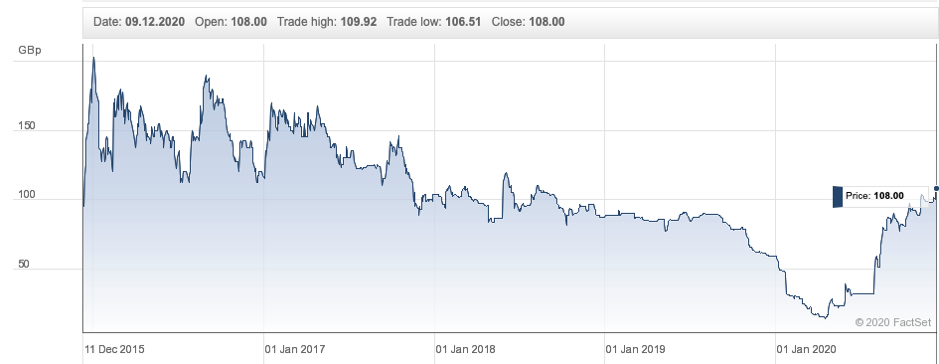
If the company can’t continue growth through the next 18 months, then we have misjudged its position in the market, and we may see the stock price ease back to levels seen last around mid-2019.
The company is also still being impacted by the current Covid-19 crisis. Its A&K division is still feeling the impacts of that, and considering that it is a major contributor to the business, it’s something to be aware of short term, that ongoing Covid-19 restrictions will still pull on the company. As it explains,
Whilst Anders & Kern (“A+K”) continues to generate revenue, they have not yet returned to pre-Covid 19 levels, as many end-users’ offices in the UK are yet to fully reopen. The Company continues to maintain tight cost control and a number of the staff have been returned to furlough, at least until the end of the year. In the meantime, A+K continues to refocus the business from selling solely Audio-Visual hardware products to becoming a supplier of choice for Smart Building and Space Management technologies.
Aside from the A+K team, our UK and US staff have continued to work remotely during the second Lockdown, with no negative impact on productivity whilst in New Zealand, where SwipedOn is based, it is very much business as usual with the office being fully open since late summer.
With that considered, you’ll also see from its chart that the company had been in somewhat of a downtrend through to the end of 2019. Then git ot hammered in the March crash this year. It has strongly bounced since, and the appreciation of the importance of software and technology it’s offering is being realised.
It now trades at levels around 109GBp which is about where the company was in mid-2019. If it can deliver in a post-Covid-19 world, the upside for this £31 million company is boundless.
Failure to capitalise on what are effectively ideal market conditions for a business with its offering, may see the previous downtrend continue.
Buying instructions
SmartSpace Software Plc (LSE:SMRT) is traded on the London Stock Exchange AIM sub-market. It is a small-cap company with a market capitalisation around £31 million.
Volumes trade in the stock are relatively low, averaging just 45,000. But some days can be as low as just a few thousand trading hands.
Hence we’d classify this as an illiquid stock for our purposes. That means there’s a likelihood of the stock taking a sharp turn higher after our recommendation. We’re setting a wide buy limit as we think the company has great potential to deliver for holders long term.
Of course it’s important to remember, this is a small-cap stock that has seen tremendous volatility this year, and short term may continue to see such volatility.
The buy limit is to ensure you’re not overpaying for a stock. We recommend it not as the price to enter at, but a price that realistically is one that allows you to gain a position and still open long-term potential gains.
Action to take: BUY SmartSpace Software Plc (LSE:SMRT) current price 108.50 GBp. Buy up to 130GBp. Set a trailing stop-loss 50% below your entry price.
Name: SmartSpace Software Plc
Ticker: SMRT LN
Last close price (as of 11.12.20): 108.50 GBp
Market cap: £30.64 million
52-week high/low: 111p/13p
Buy up to: 130 GBp
Regards,

Sam Volkering
Editor, Frontier Tech Investor