The dance between housebuilders and banks
16th October 2020 |
In my work for my other venture – Property Sharemarket Economics – I recently gave a talk on the property cycle to the “Next Level Mastermind Group”, a group of investors in the US. The first part involves a 20-minute overview of the 18-year cycle and where we are presently. This was followed by a question and answer session. You can find a link to the talk here.
I’d encourage you to watch the talk, even if you’re familiar with the cycle. We got into some interesting issues during the Q&A bit.
The UK property market continues to surge
UK lender Halifax released an update in early October confirming what I set out in last month’s update: that the UK housing market is experiencing robust growth due to all of the pent-up demand that appeared at the start of the year and was then stymied by the Covid-19 crisis, cuts to stamp duty and low interest rates.
According to Halifax’s data, prices are over 7% up on where they were last year and over 3% this quarter.
Now, clearly the strength of this surge is in part a reaction to the opening up of the economy and people getting to bring forward delayed plans. And to a certain extent, once this burst of interest is satisfied, there may be a tapering of this level of growth as the effects of the recession we are currently experiencing continue to be felt.
But unlike the surge that took place at the start of the cycle, around 2011/12, which was concentrated in London and the South East and a few other major cities, this spurt seems to be taking place all over the country. I was recently interviewed about the “property boom” taking place in Scotland for Scottish TV channel, STV. You can find a link to the story here, with my current take on what the property market will do from here.
Make no mistake: now and in the next 12 months will be as good a time to buy a property as you’ll get this decade. We are now swiftly moving into the second half of the cycle.
Here is one indication of that.
Housebuilder stocks point the way through the second half of the cycle
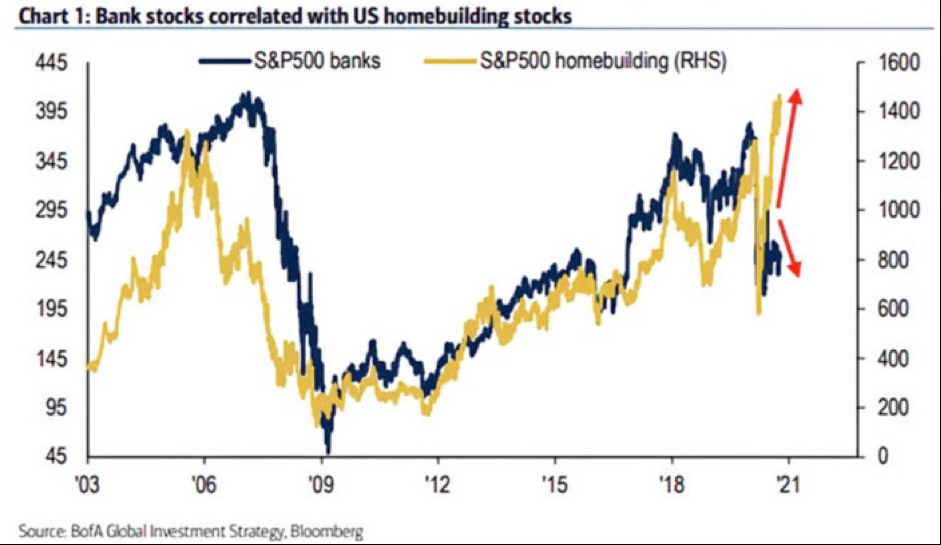
Take a look at the following chart, which compares the performance of US bank and homebuilding stocks since 2003.
 Source: Bank of America Global Investment Strategy
The chart was produced by the Bank of America and the title of the chart was “Bank stocks [are] correlated with US homebuilding stocks”.
That’s about as meaningless an observation as you’re going to get. Both sectors are what is known as “pro-cyclical” which means that they are correlated with overall growth in the economy. So obviously they’re going to be correlated with each other.
But we can delve a bit deeper into the chart to get some more insight.
On the right side of the chart, it’s clear that US housebuilding stocks have rebounded far faster than banking stocks off the lows in March of this year.
This can mean only one thing: the market is anticipating renewed demand and growth in earnings of homebuilding stocks.
Why should that be the case? Because the market is forecasting a large surge in home building, sales of new homes and a robust market. And why is this happening? Because in every second half of the cycle there is a major land boom.
This is the real estate cycle, repeating like clockwork, after the mid-cycle recession.
Often this boom takes place on the back of major public investment – exactly what we are seeing now. Not just in the US, but in the UK, EU, China and other parts of the world. Because of all this, home building stocks are rising.
The land boom of the second half of the cycle is also built upon, eventually, very easy credit. But the chart above is suggesting that we have not quite got to that point yet. US bank stocks are currently not yet seeing a major increase in earning power – which means that there is not yet a lending boom. This is why bank stocks are lagging homebuilding ones.
But easy credit conditions will arrive. On this side of the pond, the government is pushing for higher loan to value mortgages and it’s only a matter of time before banks start to loosen their current income verification processes (which is currently a major barrier to borrowing).
For the time being, housebuilders are leading bank stocks. But bank stocks will eventually catch up as the second half of the cycle gets underway.
And the opposite is true at the peak of the cycle., which I have forecast to be in around six years’ time. Here we can use a bit of history to show us what will happen, by looking at the past cycle peak between 2006 and 2008. As you can see on the left of the chart, home building stocks peaked first, well before banking stocks (and the broader market, though this is not shown in the chart).
This is because at the peak, one of the first signs that we are getting to the top is a slackening off of activity levels in the real estate market because prices have risen too far.
It’s worth quoting Homer Hoyt here. It was Hoyt’s analysis of the Chicago land market for a book published in the 1933s that first established the existence of an 18-year cycle. His observation was (emphasis added):
Soon after the peak of real estate activity, while the underlying factors – population growth, rent increases, and new construction activity – that generated the boom are preparing to reverse their trend, the land market enters into a dull phase. The property-owning community is still permeated with the rosy dreams that filled the air on the great upswing in land values, financial institutions still make loans freely on the peak level of prices, and nothing has happened to disturb the public confidence in the stability of the values that then prevail. It is generally observed, however, that the period of rapid advance in land prices is over and there is no rush on the part of new investors to buy land before it rises higher…
– Homer Hoyt, One Hundred Years of Land Values in Chicago, p. 398
In other words, investors in housing development (or in the case we are discussing, in housing stocks) note the drop off in activity in the development of new housing and can see that there will not be further growth in prices. This is even though prices remain high and banks are prepared to lend against high house prices for completed dwellings.
Housing stock investors anticipate lower earnings growth, while investors in banking stocks still see strong earnings because banks are still lending and earning interest.
So housing stocks drop and bank stocks continue to go up. This is also true of the broader index. As the stockmarket as a whole is still going up, people are still investing and unaware of what is to come next: the peak of the cycle, followed by the crash.
This is about as good an advance warning of the peak of the cycle as you’re going to get. Prior to the global financial crisis, US housing stocks peaked a good 12-15 months before the S&P 500.
So, the divergence between banking and home building stocks is important. Right now, it signals that the second half of the cycle will soon be underway and there is a boom to come. At the peak it will signal that we are getting close to the end and that a crash is on the cards, followed by a major land-led recession, banking and financial crisis, deep economic recession (if not depression) and all of the disruption and emotion that goes along with that.
The peaking of housing stocks gives you the final warning to put your financial affairs in order.

Akhil Patel
Editor, Frontier Tech Investor