The headline-grabbing IPO
22nd December 2020 |
As usual, below is Akhil Patel’s monthly Frontier Tech Investor update. In it Akhil covers some of the key events in the markets that he thinks is most relevant to investors around his view that markets move in very distinct cycles, which if you know how to read properly, can help develop a much deeper understanding of how assets move in value.
Akhil’s views are his own and are designed to provide you with a more rounded, comprehensive view of the markets and investment assets.
If you’re new to Akhil’s work, you can find previous monthly reports from him within your Frontier Tech Investor subscription. But on with his latest December update which you can now read below.
Regards,

Sam Volkering
Editor, Frontier Tech Investor
The headline-grabbing IPO
As the sun sets on this strangest of years, it’s remarkable to observe where the markets are now compared to just nine months ago. American markets are into all-time highs, particularly the Nasdaq, and despite the many economic issues that the world is facing over the next year or so the sentiment among investors is pretty ebullient.
Nothing quite signals this as the headline-grabbing IPO. And we’ve had a couple of big ones in the past week or two. The recent flotations of AirBNB and DoorDash topped off a record year for listings in the US (which in total raised over $80 billion according to barchart.com).
Such events, particularly where they relate to large and well-known tech companies, generate a lot of excitement and euphoria. With such stocks, it is tempting to want to jump in and get a piece of the action. After all, we all want to own part of a company that may, in ten years’ time, be worth 10 to 20 times as much. We all wished we had bought Amazon shares when they were trading for $5 or Google shares when they were trading at $50. They are now worth many multiples of that.
A lot of investors have taken this view; they jumped into the offerings for Airbnb and DoorDash. There was a lot of comment on the “surge” in share prices on the first two days of trading. Airbnb was priced at $68 per share but such was the demand that it opened at over twice that price at $145 and at one point traded at $165.
This puts the company valuation at almost $100 billion (which incidentally is over five times what it was deemed to be worth in April of this year). It is worth more than the combined value of the three largest US hotel groups (Marriott, Hilton and Hyatt).
Headlines like this can make you want to jump in, just in case the shares go up even further. But I would suggest to be cautious buying any stock at the IPO.
To understand the dynamics at play with an IPO listing, I am going to refer you back to someone I have quoted before: W. D. Gann. While he wrote these words almost 100 years ago, in 1923, they are still relevant to today’s market action (bold added for emphasis):
When companies are first organised and their stocks are listed… they are held by insiders or people who form the companies and sell the stocks in order to carry on the business. Therefore, they are distributed to the public.
While they may advance for a short time after they are first bought out, the man who buys and holds them is sure to have big losses, if not suffer the loss of his entire capital before he sees a profit….
… Always bear in mind that new securities are floated in boom times when everybody wants to buy and they are put out at high prices so that they can be sold all the way down.
Gann is saying that listings are deliberately hyped up to allow those who want to sell shares to realise a maximum gain. Hence the prevalence of IPOs during boom times. Also, in a rising market there is an initial euphoria surrounding these new shares.
But the reality is that many companies float, the public buys in, and then the share prices can often head south. Gann even suggested that the original pre-flotation owners of the shares would also be looking to short the stocks on the way down.
I generally use a rule of thumb to expect a fall of around 50% of the initial high established after flotation which I illustrate with a few examples below. Buying in too soon can potentially lead to a reduction in your capital.
Once that low is in place I would then, and only then, look for an entry point to buy in. The shares of good stocks that are worth holding often take several months to be absorbed before they can go on a run. But once that happens, some of these stocks can make excellent additions to a portfolio, with the right analysis, as they can run and run.
After the initial hype from their IPO, both Airbnb and DoorDash are trading lower than a week or so ago. I expect them to quietly go down, maybe not immediately, but as soon as the public is focused on the next piece of news.
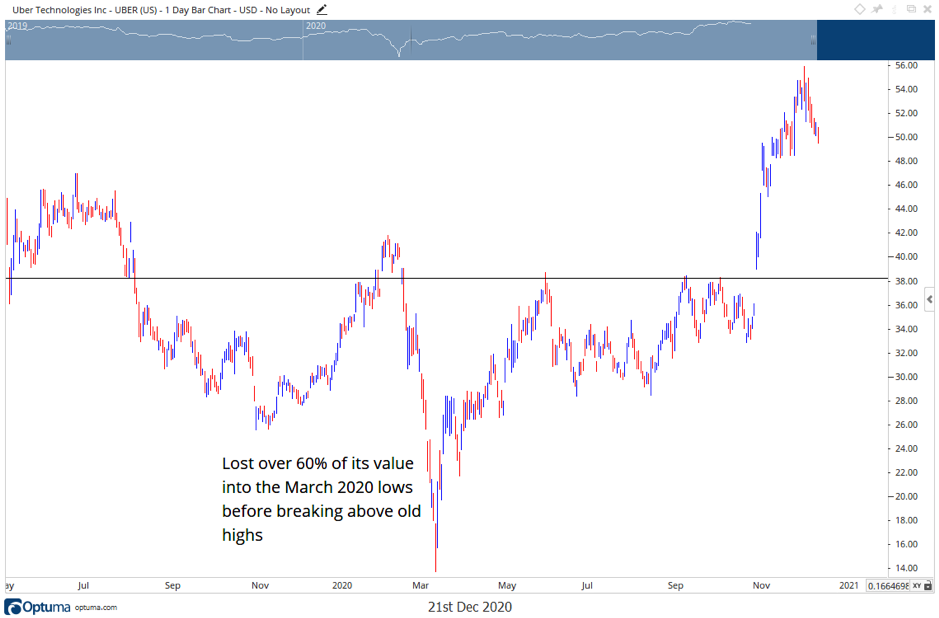
Let’s illustrate this point with a couple of examples from much-heralded flotations in recent years. Uber floated last year. This garnered lots of news and it traded for a month or two above its opening price of just above $40, but then started moving down to a low of $14 (a fall of over 60% from its opening price).
 Source: Optuma
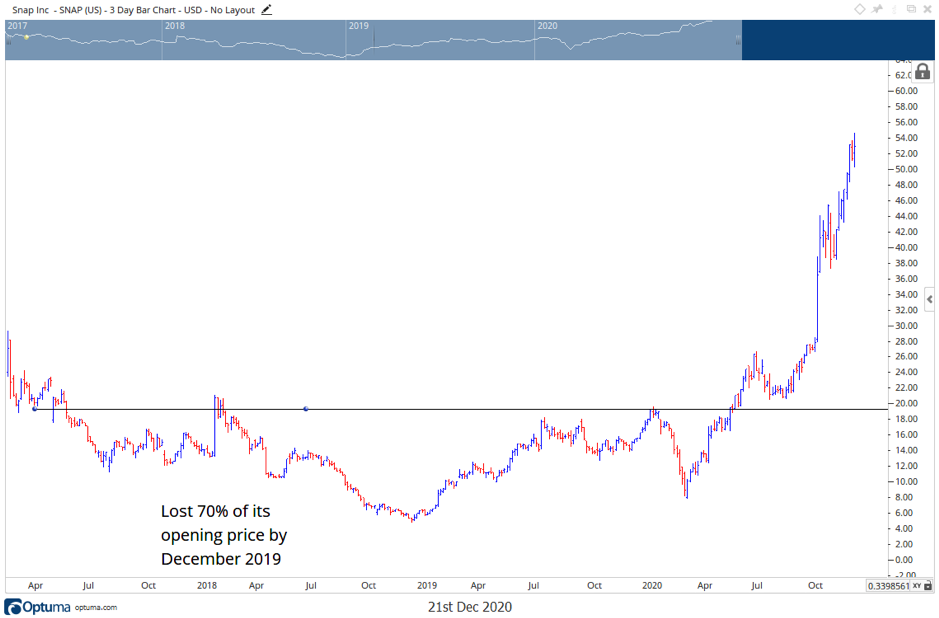
Similarly, Snapchat, which debuted in 2017. It was initially offered at $17 a share, but opened at around $24 before moving up to almost $30. Thereafter it fell to $5 in 2019.
 Source: Optuma
My view is: don’t jump into a newly floated stock, no matter the hype or your desire to be part of the action. If you like the look of a company, you are quite likely to get an opportunity to buy a stock at a lower price some weeks or months down the line while the stock trades sideways as large investors absorb supply of shares at low prices.
Determining a suitable entry point depends on your trading or investing style. My preference is to wait as the stock is absorbed at low prices and then breaks back above prior highs. Doing so means that I won’t buy the stock at the lowest possible price; but the breakout gives me an indication that the price is going higher because the market is pricing in greater earnings to follow.
Remember, it is not a given that a newly floated stock will go on a run: many stocks never make it. Those that do are the ones to buy into.
One of the key lessons I’ve learned from my study of trading, particularly of Gann’s writings, is that there’s absolutely no point in trying to buy cheap stocks. Buying stocks is not like going to the supermarket in search of a bargain. Cheap stocks are cheap for a reason. It is true that sometimes stocks are undervalued. But your chances of finding the stocks that are undervalued compared to those that are duds are, realistically, not very high.
In my view you should consider stocks that are breaking out above highs, particularly all-time highs. This can indicate a signal of quality. Buy high and sell higher is a motto I believe in. But the key point is to look for the break.
A final word on US and other stock markets in general. Markets continue to be strong because there has been a spate of positive news in November and December, starting with the election of Biden (the resolution of the uncertainty and a more stable US government is good for markets in general), the news about vaccines, the possibility of the passage of a large US stimulus package, the resolution of Brexit uncertainty and the news that China and other Asian economies are now almost fully back to normal.
However, while the news is currently positive it’s important to recognise that there is much uncertainty surrounding the economic situation, in particular in Western economies. This means that as we enter 2021 there is going to be significant volatility and market uncertainty.
But that’s for next year. In the meantime, I wish you and your families the happiest and healthiest of holidays and all my very best wishes for a brighter and lighter 2021.
Best wishes,
Akhil Patel
Frontier Tech Investor