We need China to keep banning bitcoin
27th September 2021 |
Here we go again…
China has “banned” bitcoin transactions, declaring them illegal.
According to the BBC,
China is one of the world’s largest crypto-currency markets. Fluctuations there often impact the global price of crypto-currencies. The price of Bitcoin fell by more than $2,000 (£1,460) in the wake of the Chinese announcement.
Apparently, the People’s Bank of China declared that all virtual currency-related business transactions were illegal.
In my premium crypto advisory service, Crypto Profits Extreme, I’ve covered this before.
In fact in October… 2019, I wrote the following,
China can’t control bitcoin. It can’t control most truly decentralised cryptocurrencies. And that’s why it’s petrified of them.
We know that bitcoin and crypto have been a tremendous avenue to repatriate money. In China you can go back as far as the earliest days of bitcoin to find that’s the case.
That’s why China banned bitcoin several times stretching back to 2013. It decided late 2013 that banks weren’t allowed to handle bitcoin transactions. China loosened those stops not too long after. But then it decided to crack down on it again, banning exchanges and trading of crypto.
This wasn’t the first time I’d covered China and its flip-flopping on crypto.
In another of my services, Revolutionary Trend Investor, I covered China and crypto in September… 2017!
You may have seen a few articles around about a “crypto crash”. This is utter nonsense. What happened is bitcoin’s fiat equivalent price has fell from a high of US$5,000 to around US$4,000. And in the last day or so has rebounded to about US$4,500.
That’s no crash, that’s called “Monday” in crypto.
This kind of volatility is expected. And all the talk of crashes is nothing more than an overreaction by the mainstream and people who simply don’t understand what’s going on. I can’t blame newcomers for their views. You have to have lived through all this before to really understand it all – most people haven’t.
There was of course a catalyst for the recent dip. And you can narrow it down to China. This week China decided to blanket-ban initial coin offerings (ICOs).
We’re not worried about this one little bit.
I went on to write:
… in late 2013, China’s government decided that bitcoin was great and everyone in China could benefit from it. Then weeks later, it decided to ban all financial institutions from dealing in bitcoin. This was a tumultuous time for bitcoin, and its price jumped all over the place. See for yourself…
Source: Cointelegraph
You’re looking at a chart that shows bitcoin at a value of around US$140 in October to over US$1,200 in December and back to US$100 by February 2014.
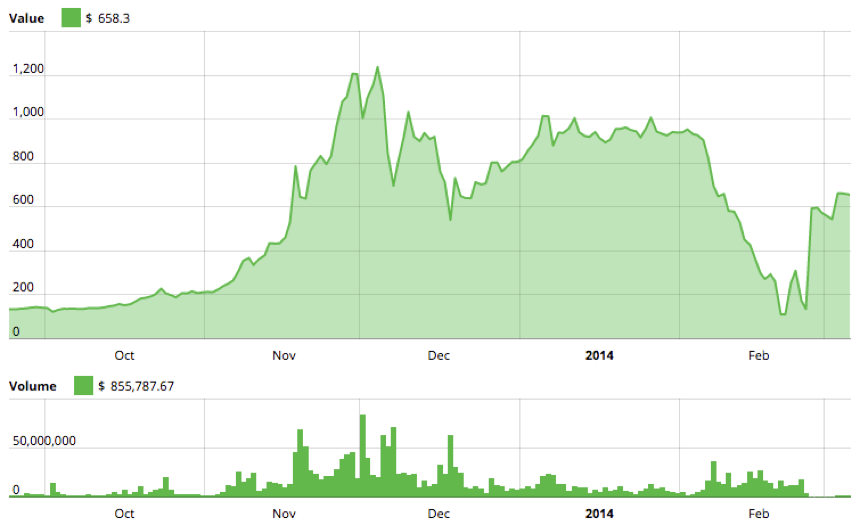
You can see when China banned bitcoin early on the fiat-converted value was around $140, then $1,200, then $100.
And then later on, in 2017, the values were around $5,000, then $4,000 then $4,500.
And in 2019 when China banned it again… or was it the same ban… or whatever China banned this time… bitcoin’s value was around $8,000 then $9,000.
This time around in 2021, with China banning bitcoin (again? We’ve lost track now…) the values are around $45,000 or perhaps down to about $41,000.
Are you noticing something here?
Are you seeing how big an impact China really has on bitcoin?
Actually, according to our data, covering the period that we’ve lived through since China first decided to “ban” bitcoin, we really want the authorities in China to keep banning bitcoin. It appears the more China bans it, the healthier it is for bitcoin’s value.
Really though, take this news with a big old pinch of salt. I am.
And it is worth noting too that, on the same day China bans it, Twitter embraces it.
Twitter in partnership with Strike (a bitcoin payments company) is integrating bitcoin Lightning payments and tipping into Twitter’s platform.
It’s yet to roll out globally, but it will eventually.
As Twitter explained in its announcement,
… people can now seamlessly tip with Bitcoin using Strike – a payments application built on the Bitcoin Lightning Network that allows people to send and receive Bitcoin. Strike offers instant and free payments globally…
We want everyone on Twitter to have access to pathways to get paid. Digital currencies that encourage more people to participate in the economy and help people send each other money across borders and with as little friction as possible – help us get there.
While the Chinese authorities are banning a digital currency that allows everyone to participate in an economy, get paid and do so across borders and with little friction, one of the world’s biggest tech companies is embracing it.
So, ask yourself what’s the real important announcement of the day?
Crypto to Know
Below is our “Crypto to Know” list where you’ll find several cryptos that we think you should be taking the time to learn and understand.
They each form an important part of the burgeoning crypto ecosystem.
Several of these cryptos are doing very different things to others.
What’s key is to learn that every crypto has its own use cases, its own guiding principles, and its own particular potential.
Each crypto is to be judged and assessed on its own merits.
Our aim here is to help you understand these cryptos and the wider crypto world.
These aren’t specific recommendations but a guide to help you learn and build your confidence in operating in this space.
We will add more names to this list over time. However, if you’re new to the world of crypto, these are the names where we think you should start your education and learning.
We’ve also added links to each one.
The links are to what we believe, in each case, is the best resource for learning about that crypto.
“Crypto to Know” watchlist
- Bitcoin – bitcoin.it/wiki/Main_Page
- Ethereum – ethereum.org/en/what-is-ethereum
- IOTA – docs.iota.org
- Tezos – https://tezos.com/learn/getting-started/
- Uniswap & 1inch – uniswap.org/faq & help.1inch.exchange/en
- Filecoin – docs.filecoin.io
- Cosmos – v1.cosmos.network/intro
- Binance – binance.com/en/about & research.binance.com/en/projects/bnb
- FTX – ftx.com & help.ftx.com/hc/en-us
Sam Volkering
Editor, Sam Volkering’s Crypto Network