A world-class cluster in one company
ISSUE 18th May 2021 |
One way of looking at the global economy is as a series of clusters.
The clusters are where a lot of the action really occurs, thanks to the advantages that they have.
Those advantages include: high-quality lifestyles that attract successful entrepreneurs; an abundance of capital; world-class infrastructure; and a sophisticated and positive environment for business.
London has been, is, and probably will always be a cluster for financial services. The same is true of Hollywood for the entertainment industry and of Silicon Valley for technology.
Among much else, Switzerland is a world-class cluster for the biopharma sector.
Having lived, worked and relaxed at Crans-Montana (the famous ski resort in the canton of Valais) in the 1990s, I have been well acquainted with the cluster for a long time.
It was at that time that I founded my second consulting company.
The cluster was developing – mainly around Basel – as a number of start-up companies were spun out of the Novartis and Roche groups.
Many of these start-ups were involved in drug discovery and development.
As is always the case in clusters, this was made possible by easy access to money from sophisticated investors.
In Switzerland, those investors are the numerous wealth managers and equity portfolio teams based (mainly) in Geneva and Zurich – two cities in which I transacted a lot of business.
From the early 1990s, the Swiss cluster has produced a number of specialised investment funds, which focus on biopharma, the development of specific drugs and medical technologies.
Some of these funds – such as BioMedPartners and Novartis Venture – are well known as having achieved stellar performance from private equity (PE) and venture capital (VC) investments.
Others are widely respected as open-ended funds that manage billions of (mainly) listed investments. Examples include the offerings of Bellevue Group, HBM Partners and Pictet. Since my time in Switzerland, I have always kept my eyes on these healthcare funds, being careful to maintain friendly relationships with several of the portfolio managers.
That leads me to my latest recommendation for you…
Introducing BB Biotech AG (SIX: BION)
Based in Zurich, BB Biotech AG is the longest established and largest equity fund that specialises in the biopharma sector.
It is listed on three major European stock exchanges and is closed-end. The number of shares on issue is generally fixed, and you have to buy or sell through one of the exchanges – with the assistance of your broker or trading platform, of course.
BB Biotech also has outstanding long-term performance.
Through this fund, you can gain exposure to a focused equity portfolio of predominantly US small-to-mid-cap biopharma companies. These companies are developing innovative drugs, and are involved with gene, cell and RNA-based technologies.
The fund has a 27-year record of strong outperformance of major and relevant benchmarks such as the Nasdaq Biotechnology Index.
More importantly, it has provided investors with a total return of around 15% annually, including a significant dividend yield. At its current price, the dividend yield is over 4%.
Since its inception in 1993, BB Biotech has been managed by Bellevue Asset Management, a Swiss investment company based in Zurich, New York and London. Since 2010, the fund has been headed by Dr Daniel Koller, an investment manager/analyst with over 20 years’ experience.
To learn more about BB Biotech and its team in their own words, please watch the video below. (NB a corporate presentation is also available here):
 Source: YouTube
The fund has a board of directors with a strong track record in the biopharma industry. They include Dr Erich Hunzikers, a former CFO of global pharma major Roche, as well as Dr Susan Galbraith, who headed oncology research and early development units at AstraZeneca.
BB Biotech shares are listed on the Swiss SIX market (SW: BION) and also on the Frankfurt (GY: BBZA) and Milan (IM: BB) exchanges.
Currently, the fund has assets under management (AUM) of around CHF 440 billion ($4.88 billion). The portfolio includes 35 holdings in biopharma companies.
A proven approach which targets 35 innovative biopharma companies
BB Biotech’s approach is to find the most fast-growing biopharma companies that are developing and marketing innovative drugs.
The investment rules of the fund require that at least 90% of its worldwide shareholdings are listed companies. At least 50% of AUM must be invested in equity positions.
The fund is allowed to use bonds and/or options for liquidity and risk/return profile management. However, it rarely does so.
Historically, the portfolio of BB Biotech has included 20 to 35 companies. This includes five to eight stocks with large market capitalisations (over $10 billion). No single stock position is permitted to account for more than 25% of portfolio investments.
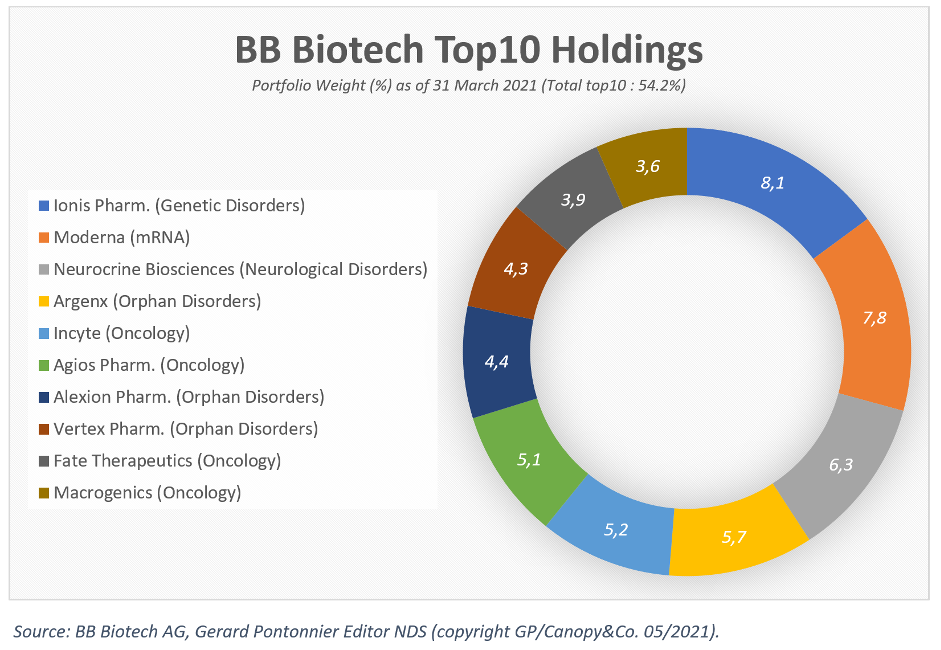
The portfolio structure is therefore split roughly 50-50 between core holdings – large companies that generate sales and income – and smaller companies. The smaller companies are often players with promising drugs that are still in research and development (R&D).
As a risk control measure, initial stakes in small- and mid-cap companies range from 0.5% of AUM to 4%, but never more.
BB Biotech can over time build on initial positions as those companies advance through clinical development.
In other words, stakes in small companies can and sometimes do become core holdings according to their success in reaching key clinical and regulatory milestones.
The portfolio is diversified in terms of the drugs that it has exposure to. In Q1 2021, 41% of holdings addressed drugs based on small molecules, 22.5% on antibodies, 20% on RNA drugs and 12% as gene and cell therapies (see figure below).
In terms of therapies, most of the portfolio is focused on neurological disorders, rare diseases and cancer.
In other words, BB Biotech provides broad exposure to those parts of the biopharma sector where medical needs are still being unmet.
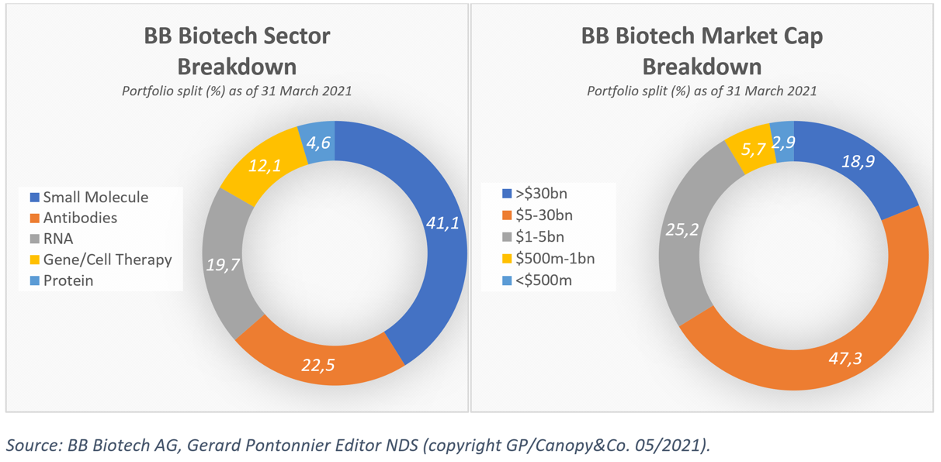
A complete list of portfolio holdings data is available here and you can read recent holdings details here.
What are the exciting new positions in the portfolio?
BB Biotech always makes a small number of new investments each year. In 2020, for instance, there were seven new investments that were mainly involved with oncology and genetic diseases:
- Generation Bio, (gene therapy)
- Fate Therapeutics (oncology)
- Black Diamond Therapeutics (oncology)
- Beam Therapeutics (genetic disorders)
- Mersana Therapeutics (oncology)
- Biogen (neurological disorders)
- Relay Therapeutics (oncology, genetic disorders)
By contrast, only four holdings were added in 2019: Molecular Templates (oncology), Arvinas (oncology), Homology Medecines (gene therapy) and CRISPR Therapeutics, one of my favourite stock recommendations in New Drug Speculator.
Biogen, a large-cap stock, joined the portfolio last year as a regulatory event occurred. The United States Food and Drug Administration (FDA – the regulator) is currently reviewing aducanumab, a monoclonal antibody developed in treatment of Alzheimer’s disease.
In January this year, Biogen and its partner Eisai announced that the FDA needed three additional months to review the Biologics License Application (BLA) before potential approval.
Data supporting the aducanumab filing are complex and controversial. As a result, the FDA’s internal staff is divided about the prospect of this approval.
At the moment, I think that Biogen could be the most interesting positions in the portfolio of BB Biotech. If the company win its approval for its Alzheimer’s treatment, it could be one of the most rewarding holdings for BB Biotech, as well.
In Q121, the investment team added two smaller cap companies to increase its exposure to oncology – Essa Pharma and Revolution Medicines. The last one is also a buy recommendation that we have made in New Drug Speculator.
In the recent past, the fund has sold four positions. BB Biotech accepted Bristol-Myers Squibb’s takeover bid for Mycardia in May 2020. Intercept, G1 Therapeutics and Sangamo were dropped in favour of other opportunities.
BB Biotech also realised profits on its holding in Moderna, which had been the second-largest position in its portfolio.
In February 2021, Moderna’s stock price surged to its highest level ($185.98 – 08/02/21), as it competed alongside BioNTech with messenger RNA (mRNA) vaccines against Covid-19.
As a reminder, BioNTech is currently the best-performing open recommendation of New Drug Speculator with a 357% gain (as of 18/05/2021).
This challenging Covid-19 vaccine market offers excellent long-term worldwide sales prospects. I am confident that New Drug Speculator subscribers could gain from exposure* to these two leading mRNA competitors: BioNTech and Moderna through a BB Biotech participation.
*BioNTech: 230% versus Moderna: 97% (1Y performance, as of 17/05/2021).
The largest position in BB Biotech’s portfolio, Ionis Pharmaceuticals, has an exciting solution named antisense technology which could revolutionise drug discovery, especially in rare disorders.
In short, antisense drugs change the process of producing a protein before it even begins. Cells use messenger RNA (mRNA) to manufacture proteins. The mRNA transports instructions to the part of the cell where proteins are manufactured.
Antisense therapies are designed to specifically destroy an mRNA, so that the amount of disease-causing protein is dramatically decreased.
Ionis has already three approved drugs targeting rare diseases: Spinraza, Tegsedi, and Waylivra.
In my view, antisense candidates are very promising for a broad range of therapeutic markets. This surely explains why Ionis is ranked as the largest equity investment in the BB Biotech portfolio.
After reaching new highs early in Q121, biopharma stocks were sold off, erasing most of their gains in March.
Despite being considered as a defensive sector, biopharma returned minus 0.55% in Q121 as a whole.
I remain confident that the fundamental strengths and attractions of the sector remain intact.
A note on the pandemic
The Covid-19 pandemic remains a mixed blessing for biopharma. On one hand, there is a frantic race to develop and produce vaccines. On the other, there are negative impacts on timelines for other R&D programmes, on logistics for clinical trials in other areas and for global supplies of chemical materials.
The rollout of vaccines worldwide and the first mass vaccinations in the United States, Israel, and the UK will hopefully bring the pandemic under control, by dramatically reducing the infection and intensive care rates.
Unfortunately, most other countries are moving too slowly with their vaccination programmes to avoid the emergence of mutant viral strains, and potential new epidemic waves, in the coming months.
Vaccine makers Moderna and BioNTech/Pfizer could take advantage of annual booster shots – similar to those used to control the flu – to keep Covid-19 at bay, or at least manageable.
The business of booster shots could generate multi-billion dollars in worldwide sales.
It’s important to remember that Moderna remains the second-biggest equity investment of BB Biotech. The Bellevue investment team was visionary as it bought into Moderna when it was a private company – and prior to the initial public offering (IPO) in December 2018.
How has BB Biotech performed over time?
Despite mixed conditions in stock markets, BB Biotech’s stock performed well in Q121, returning 15.4% in CHF and 14.3% in euro terms.
However, the performance was mainly driven by the US dollar appreciation as the portfolio’s investment return was only 5.5% in CHF (2.9% in euro).
A dividend of CHF3.60 per share has been approved in March, staying in line with the regular dividend policy of around 5%. It adds an excellent yield to the share.
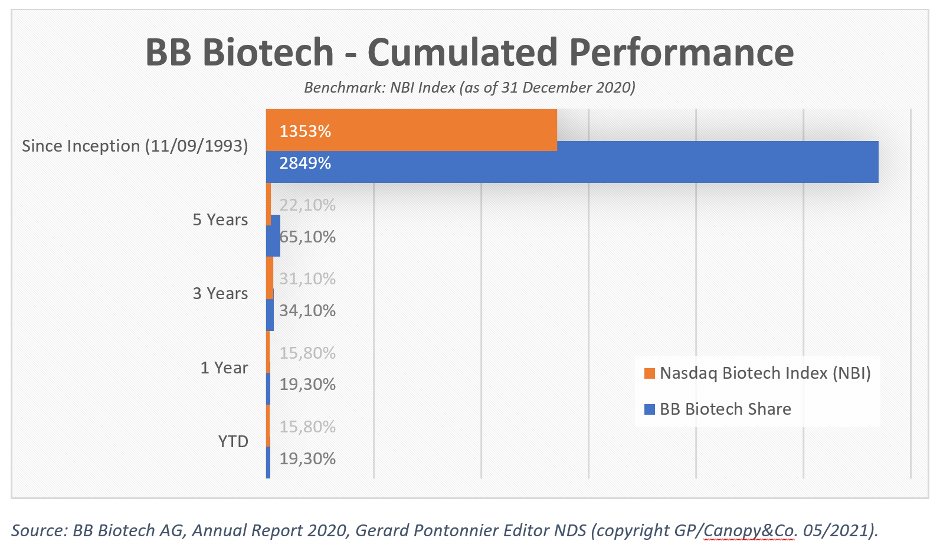
Last year, the share return was 19.3%. This compares with the annualised performance of 13.3% since 1993.
Since the inception that year, BB Biotech’s fund has gained 2,849%. Over time, the fund has always outperformed it main benchmark index, the Nasdaq Biotech Index (see figure below).
The long-term performance of the portfolio comes partly from numerous merger and acquisition (M&A) transactions.
I have identified over ten M&A transactions where BB Biotech holdings have been targets over the last five years.
The Bristol Myers Squibb/Myocardia deal mentioned above is a good example. The Servier/ Agios and AstraZeneca/Alexion transactions are more recent examples.
Premiums over prevailing stock market prices that are paid in such M&A transactions are generally in a range of 20-100% – to deliver a substantial cash return on portfolio holdings. Of course, the cash must then be reinvested.
The skill of the BB Biotech team in finding new opportunities in which to reinvest the cash is a part of the reason for the excellent performance.
Sage Therapeutics and CRISPR Therapeutics, both of which are holdings in the BB Biotech portfolio, are widely seen as M&A targets.
The attractions of a listed vehicle
BB Biotech is a listed fund, you can buy or sell through the three exchanges on a daily basis.
The fund itself gives you immediate access to a portfolio of 35 promising biopharma companies.
The UK Association of Investment Companies (AIC), as a trade body for closed-ended investment companies, compares the performance of BB Biotech with that of its peer group.
The figure below highlights how BB Biotech is one of the best performing equity funds in the biopharma sector over the recent past and is and undoubtedly the best one over the long term, with a 2,849% total return since its inception in 1993.
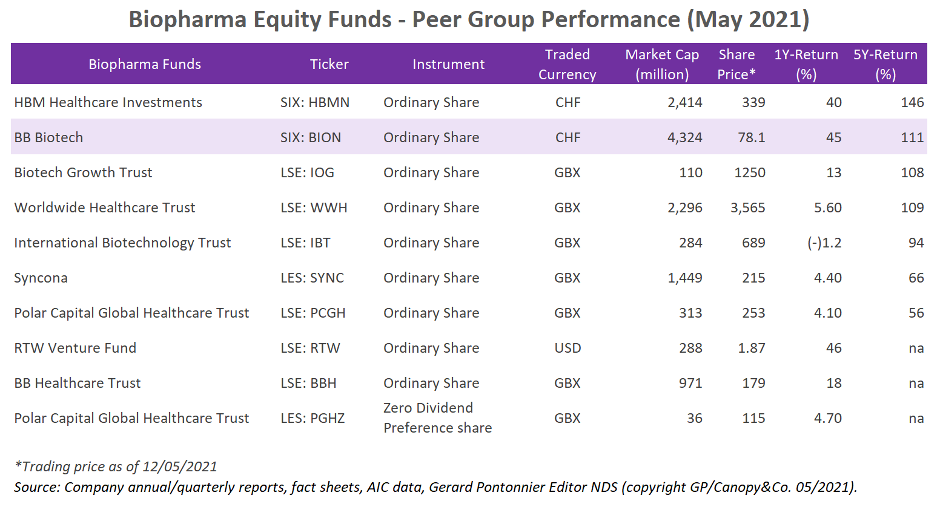
Note: BB Biotech and HBM Healthcare Investments are not AIC members as their primary listings are in Switzerland.
For more data, you have access here to AIC data.
BB Biotech is a perfect investment vehicle for private investors who start investing in the biopharma sector and want to mitigate risk and maximise rewards.
Questions of risk and reward
As noted, BB Biotech is one of the largest biopharma funds with an excellent track record since its inception in 1993.
With a dedicated portfolio always staying in a range of 20 to 35 holdings, the Swiss investment company Bellevue Asset Management has successfully achieved strong capital growth for BB Biotech’s shareholders over these last 27 years of the fund’s existence.
The BB Biotech portfolio is primarily focused on mid-cap companies that have more significant growth potential. The very largest blue-chip pharma companies generally do not feature in the portfolio. At least 90% of the holdings are public companies that are mainly listed on the Nasdaq market.
BB Biotech investment strategy intends to mitigate the risk and maximise rewards with a well-balanced portfolio. It mixes companies with already marketed drugs and those with promising advanced drug candidates in clinical stages.
The investment strategy targets innovative drug technologies addressing medical fields with substantial unmet needs like genetic diseases, neurological disorders and cancer.
That’s the rewarding face side of this investment vehicle. So, what about the risks?
On the reverse side, you must know that BB Biotech is legally a Swiss company. So, its reporting currency is the Swiss franc (CHF).
The investments being mainly listed on the Nasdaq market are exclusively made in US dollars without using financial instruments to hedge the relevant currency risk (i.e. of a fall in the US dollar versus the CHF).
As an investor, you must be aware that Forex market fluctuations can have a notable impact on the net asset value (NAV)* of the portfolio and subsequently on the share price.
*Net asset value (NAV) represents the fund’s share market value = (total value of all the cash and securities in the portfolio) – liabilities)/number of shares outstanding. The NAV computation is undertaken at the end of each trading day based on the closing market price of all the portfolio’s securities. It’s usually slightly different from the market price of a listed fund such as BB Biotech, as the market price is determined by the supply and demand of shares on the trading floors of the exchanges on which the fund is listed.
Euro- and pound-based investors in BB Biotech are also exposed to currency risk – specifically of a fall in the CHF against their home currencies.
BB Biotech has a risk profile that is broadly similar to a single, larger, biopharma company with at least one blockbuster drug. This is because BB Biotech’s portfolio is broadly diversified across companies that are selling drugs and companies that are developing them.
The underlying investments in BB Biotech’s portfolio can be very volatile. It is possible (but not probable) that the stock market values of most or BB Biotech’s holdings fall sharply at the same time.
For all these reasons, BB Biotech may be too risky for some investors.
In short, though BB Biotech is a specialist, listed fund with an excellent track record that has come out of Switzerland’s biopharma cluster. The portfolio is, in its own right, a “cluster” of proven and prospective biopharma investments.
Action to take: BB Biotech AG (SIX SW: BION), current market price CHF 79.50. Buy the share up to CHF 93.00. If the share is trading above our recommendation buy-up-to price, DO NOT BUY. Remember to use a limit order.
Name: BB Biotech AG
Ticker: BION
Market: SIX (Main Market)
Current price (as of 18/05/2021): CHF 79.50
Market cap: CHF 4.40 billion
Avg. volume (10 days): 73.82k
52-week high/low: CHF 93.45/CHF 56.50
Buy up to: CHF 93.00
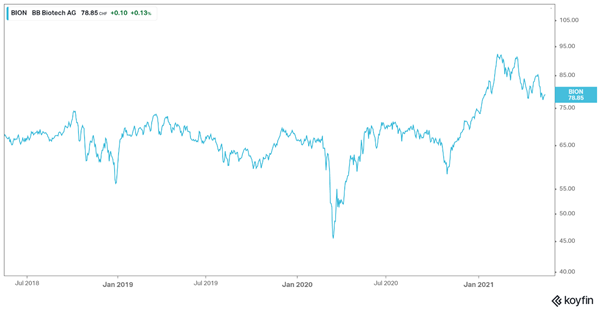
Source: Koyfin
Have a nice week,

Gerard Pontonnier
Editor, New Drug Speculator