|
The AI Lynchpin
One company every chipmaker depends on. No matter who wins the AI race, this one wins with them.
Everyone wants to argue about who wins artificial intelligence. Nvidia or AMD. TSMC, Intel, or Samsung. Micron or SK Hynix. It’s the wrong question.
The better question, and a far more useful one, is who do all of them depend on?
Answer that and you find the closest thing the market has to a toll booth on the entire AI build-out.
That company is ASML.
It’s the ultimate pick-and-shovel play, and it sits squarely inside Law Two from the live stream. It’s a real business with real profits, not a promise. Furthermore, it isn’t on a pathway, it owns the pathway to better, smarter AI.
It’s the only company in the world that’s more or less running a fully legal monopoly.
No chips without the chip-making machines
Designing the most advanced microchips is one thing.
Building them is another thing entirely, and you cannot do it without lithography machines, the tools that print circuit patterns onto silicon. You have probably heard of Moore’s Law, the idea that the number of transistors on a chip roughly doubles every couple of years. More transistors mean more power, which is why the phone in your pocket runs circles around a 1980s computer.
The problem is that most chipmakers have hit the physical wall. They cannot make the patterns any smaller.
The way through is ASML’s extreme ultraviolet light, and now its next-generation High-NA EUV, which lifts the numerical aperture from 0.33 to 0.55, shrinks the smallest feature from 13 nanometres to 8, and packs in roughly 2.9 times the transistor density. ASML is the sole supplier of EUV and controls around 80% of the lithography market.
These are the most complex machines ever built. A standard EUV system runs to around $150 million to $200 million.
A new High-NA machine costs roughly $380 million to $400 million each, and Intel is the launch customer, installing the industry’s first production High-NA system in December 2025 for its 14A node.
Even Taiwan Semiconductor Company (NYSE: TSM), the biggest and best-funded chipmaker on earth, has balked at the price and is holding off on High-NA.
When the company that prints most of the world’s advanced chips says a tool is too dear, yet there is no alternative supplier anywhere on the planet, you understand who really holds the cards.
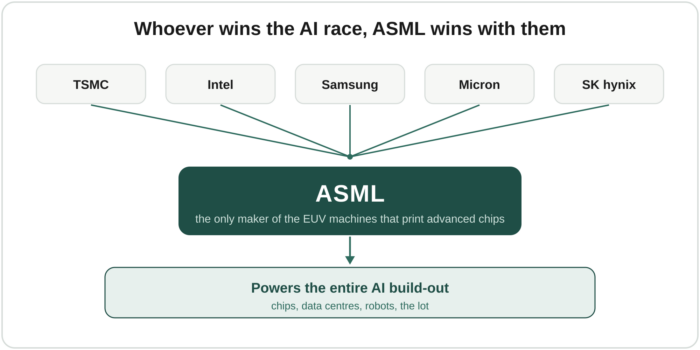
Every chipmaker funnels through ASML, so it gets paid whoever wins the AI race.
A toll booth on the whole industry
Whoever ends up winning the AI chip race, they place their orders with ASML.
That is what makes it so powerful.
The numbers back it up. In 2025 ASML reported €32.7 billion of sales and €9.6 billion of net income at a 52.8% gross margin, took €13.2 billion of orders in the final quarter alone, and ended the year with a €38.8 billion backlog.
It guided 2026 sales to between €34 and €39 billion, launched a new €12 billion buyback running to 2028, and raised its dividend to €7.50 a share. The wider industry, on ASML’s own reckoning, is set to pass a trillion dollars of annual revenue by 2030. This is cash flow and earnings, a money making machine not hype, not hope, a genuine plan and strategy to dominate the chip making industry.
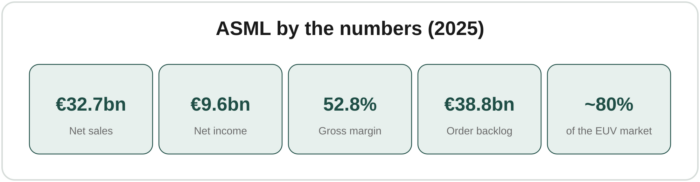
Real profits, not promises. ASML’s 2025 in five numbers.
The shares have responded in price too. ASML traded around $1,795 on the Nasdaq in late June 2026, up roughly 125% over the previous year, having set an all-time high near $1,929 on 18 June.
It also lists in Amsterdam in euros. If you buy the Nasdaq line, file a W-8BEN first, which the taxation bonus walks you through. But if available through your broker you can also get the Euro listed ones, all the same company, same plan of attack, same profits, same potential.
The risks, and do not skip these
No recommendation is one-way, and this one carries real risks.
The first is valuation and the cycle. The stock has doubled in a year and trades on a full forward earnings multiple at around 49-times earnings.
The equipment business is cyclical, and bookings are lumpy… especially considering the capital outlay needed, so a few delayed machines can swing a quarter.
If the AI build-out cools or turns out to be over-built, and over hyped, and goes through a heavy correction, orders soften and expect it to erase a lot of the gains from the past year.
The second is geopolitics. China was about a third of sales in 2025 and is guided down to roughly 20% in 2026, and a proposed US law, the MATCH Act, would extend curbs to ASML’s older DUV machines and even the servicing of installed tools. ASML has never shipped an EUV machine to China, but any further tightening would dent revenue.
The third risk is customer concentration. A handful of buyers account for most demand, and the High-NA buyer base is tiny, so a single capital expenditure cut at TSMC, Samsung or Intel quickly becomes a big deal.
The fourth is adoption. High-NA is so expensive that even TSMC is delaying it, which pushes part of ASML’s next growth leg out to the back end of the decade and makes Intel’s execution on 14A even more important to this product.
And the fifth is the supply chain itself. Yes, ASML has an almost monopoly on EUV machines, but… ASML leans on Zeiss for its optics and Trumpf for its lasers. Without those, then ASML all of a sudden suffers from supply chain issues too.
None of these risks breaks the long-term view that ASML will likely only grow as the demand for more advanced chips for AI grows exponentially, but you should make sure you’re aware that it’s no slam dunk either, and there are risks to always consider before investing.
Action to take
ASML is the closest thing the market offers to a levy on the entire AI build-out. It doesn’t need to pick the winner of the chip war, because it sells the essential equipment to every contender.
Buy ASML Holding N.V. (NASDAQ: ASML) up to US$2,000. Treat it as a long-term hold as the AI intelligence revolution takes hold.
ACTION TO TAKE: Buy ASML Holding N.V. (Nasdaq: ASML) up to US$2,000.
Until next time,

Sam Volkering
Investment Director, Southbank Investment Research