The subtleties of stock market taxation
How to keep more of what you make, using wrappers like ISAs and SIPPs, and how to fill in the one form you will need to trade US stocks.
There is a truth about investing that nobody in traditional finance really wants to tell you. The tax you avoid paying, entirely legally, is the most reliable return you’ll ever earn.
A good year in the market might hand you 15%. Sheltering that same money from tax can be worth almost as much, year after year, with none of the risk.
The Road to Financial Freedom covered the three taxes a UK investor faces. This bonus report goes deeper on the wrappers that switch those taxes off, and on the one form you need for American shares.
A quick recap
Outside a shelter, three taxes can land on your investing.
The first is capital gains tax (CGT), charged on your profit when you sell.
You get a £3,000 tax-free allowance for 2026/27, then pay 18% as a basic-rate taxpayer and 24% as a higher-rate taxpayer.
The second is dividend tax.
You get a £500 dividend allowance each year. After that, a basic-rate taxpayer pays 10.75% and a higher-rate taxpayer pays 35.75%.
The third is stamp duty, which is 0.5% on the purchase of UK shares, with AIM shares and foreign shares exempt.
None is terrible on its own and in isolation. But compounded over 20 years, together they can eat a serious chunk of your wealth.
Here’s a CGT example…
Say you’re a basic-rate taxpayer. You bought shares for £10,000 and sold them for £25,000. That’s a £15,000 profit.
Knock off the £3,000 allowance and £12,000 is the taxable amount. So at 18%, your bill is £2,160.
Now suppose you also held a dud you could sell at a £5,000 loss. Realise that loss in the same year and your net gain drops to £10,000, leaving £7,000 taxable after the allowance and a bill of £1,260 instead.
Although losses are painful, they can also be useful, because they offset your gains.
Stamp duty deserves a quick word because it’s the one tax you cannot wrapper away.
You pay 0.5% on UK shares even inside an Individual Savings Account (ISA) or a Self-Invested Personal Pension (SIPP). AIM-listed shares are the exception and have been exempt for years. Shares in US or other overseas companies carry no UK stamp duty at all.
(Remember, AIM stands for Alternative Investment Market.)
From 2027, the government plans to fold the old stamp duty rules into a single self-assessed securities tax, but the headline 0.5% rate is expected to stay and your broker will still handle it, so for you very little changes.
The ISA, your first move
The stocks and shares Individual Savings Account (ISA) is the single most useful thing the taxman has ever handed a British investor.
Anything you hold inside one grows completely free of capital gains tax and dividend tax. No reporting, no calculations, no bill.
You can put up to £20,000 into ISAs in the 2026/27 tax year, a limit frozen until 2030. It resets every 6 April and you can’t carry unused allowance forward. An allowance you don’t use by 5 April is gone for good.
Again, while the ISA shelters you from CGT and dividend tax, you still pay the 0.5% stamp duty when you buy UK shares inside it.
There is a change worth knowing about, though it barely touches share investors. From April 2027 the amount you can put into a cash ISA each year falls to £12,000 for the under-65s, while the stocks and shares allowance stays at the full £20,000.
If anything, the government is nudging people out of cash and towards investing.
For most people, most of the time, the rule is simple. Fill your ISA first.
If you already hold shares outside a wrapper, you don’t have to start from scratch. A move called “Bed and ISA” sells those holdings and rebuys them inside your ISA in a single linked transaction, bringing all their future growth under the tax-free umbrella.
It can trigger a capital gain on the way through, so keep an eye on that £3,000 allowance as you do it. But over time it moves your money to where the taxman cannot follow.
The SIPP, for the long game
The Self-Invested Personal Pension is the ISA’s heavier cousin, built for retirement, and it works on a different and rather generous principle.
When you pay into a SIPP the government tops it up with the tax you already paid. Pay in £800 and the provider automatically adds £200 of basic-rate relief, turning it into £1,000. If you’re a higher-rate taxpayer you can claim back more through your self-assessment return, which can bring the effective cost of that £1,000 down towards £600.
Like the ISA, everything then grows free of capital gains and dividend tax inside the pension.
The catch is access. You cannot touch a SIPP until you are 55, and that minimum age rises to 57 in April 2028.
When you draw on it, a quarter can usually be taken tax-free, currently capped at around £268,000, and the rest is taxed as income. You can put up to £60,000 a year into pensions for 2026/27, or 100% of your earnings if that is lower, though most people pay in far less.
Think of it this way…
The ISA gives you tax-free money you can reach at any time. The SIPP gives you a bigger upfront boost in return for locking it away. Plenty of investors run both.
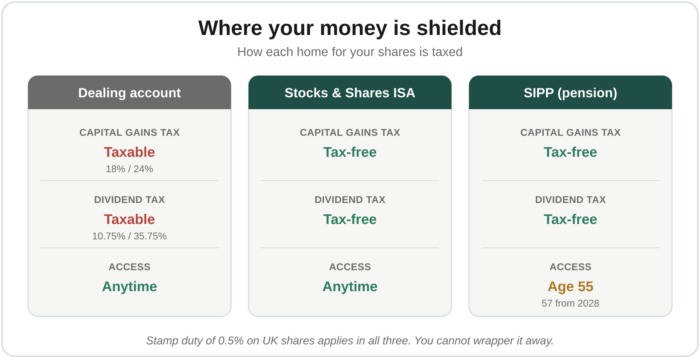
Three homes for your shares, and how the taxman treats each one.
The one form for US stocks: The W-8BEN
If you want to buy American shares, and given where many of the most exciting companies are listed you probably will, there is one piece of paperwork to deal with first.
America charges a 30% withholding tax on dividends paid to foreign investors, so left alone, nearly a third of any US dividend disappears before it reaches you.
The W-8BEN is a short form that tells the US taxman you live in the UK and qualify for the lower rate under the long-standing UK-US tax treaty, cutting that withholding from 30% to 15%.
The good news is your broker does most of the work.
When you go to trade a US share the app prompts you to complete the W-8BEN, often pre-filling the treaty details. You confirm your name and country, sign, and it usually validates within minutes.
It lasts until the end of the third year, then needs renewing.
Two details to know here though.
Hold US shares in an ISA and the UK leaves your gains and dividends alone, but the US still takes its 15%, so you still want the form filed.
Hold them in a SIPP and it gets better again, because the US recognises UK pensions and the withholding drops to zero, with no W-8BEN needed at all.
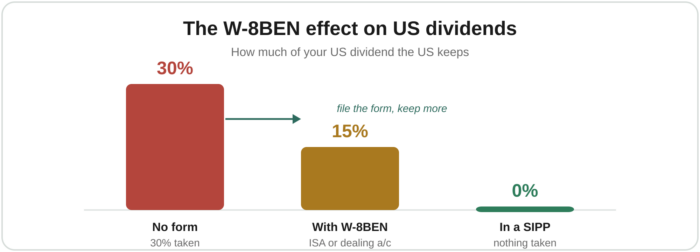
One short form cuts US dividend tax from 30% to 15%. A SIPP takes it to zero.
One more thing that surprises people…
Keeping more of what you make
The US does not tax a non-resident’s capital gains on US shares, so your growth on an American holding is only ever a UK matter.
It’s the dividends the US wants its slice of, which is exactly what the W-8BEN deals with.
Inside an ISA or a SIPP, that growth is tax-free in the UK too, so the only leakage left on a US holding is that 15% on dividends in an ISA, and nothing in a SIPP.
You don’t need to become a tax expert to invest well.
You need to do a few simple things in the right order.
Fill your ISA.
Consider a SIPP for money you’re happy to lock away for many years.
File your W-8BEN before you buy American shares.
Keep half an eye on your gains as you approach the £3,000 capital gains allowance, spread big disposals across two tax years to use two allowances, and remember that gifts between spouses are free of CGT, which gives a couple two allowances instead of one.
The market decides your returns.
The wrappers decide how much of those returns you actually keep.
Get them working from the start and you have done one of the most valuable things an investor can do, before you have even picked a single share.
Until next time,
Sam Volkering
Investment Director, Southbank Investment Research