How stock markets work
July 7, 2026 11:32 am
If you have never bought a share in your life, this report shows you, step by step, exactly how it is done. By the end you will be able to place your first order with total confidence.
The first time you open a trading screen it can feel like the cockpit of a plane. Buttons everywhere, numbers flickering, words like “limit,” “fill,” and “spread” that nobody explained at school.
But, the truth is that buying a share is far closer to booking a flight online than it is to flying the plane. Once you understand what each part does, you’ll wonder why anyone made it sound complicated.
During the YouTube event, I asked you to make a pact with yourself to take one small action. For some of you that’s opening an account so you’re ready. For others it’s buying a single share.
This report is the practical bit that makes both of those easy. So let me walk you through the whole thing.
What sits behind the buy button
A share is a slice of ownership in a company. When you buy one share of Rolls-Royce, for example, you own a tiny piece of the business. Shares are bought and sold on a stock exchange, which is really just a giant marketplace where buyers and sellers meet. In the UK that is mostly the London Stock Exchange or LSE. In the US it is the New York Stock Exchange (NYSE) and the Nasdaq.
You don’t walk onto the exchange yourself. You go through a broker, which these days means an app or a website such as Hargreaves Lansdown (HL), AJ Bell, interactive investor (ii), or Trading 212.
There’s usually a search function where you can search for the stock you’re after. And then once you get to the screen with the stock information, you’ll find a trade or buy button that steps you through everything.
For example the image below is the interactive investors (ii) trade screen. You’ll see at the bottom of the page a search bar with “quote” by it. I searched for Nvidia as an example. And then on the data screen you’ll see a big “Place an Order” button. If your account has cash to trade, you just follow that button.
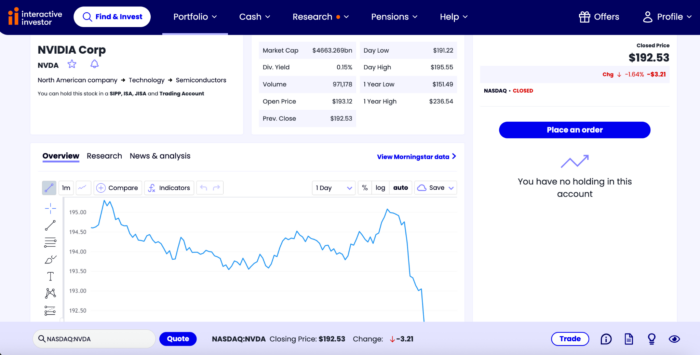
Other platforms will look different, but fundamentally follow the same process.
You tell it what you want, it finds someone selling the share, and it matches you up… all in less than a second.
When placing a trade, understand that you’re buying it from someone else. So, every share has two prices at any moment. There is the price you can buy at, called the offer, and the price you can sell at, called the bid.
The gap between them is the spread. That’s a real cost you pay.
On a big company like BP, for example, the spread is small so it’s a penny or less. On a small AIM-listed minnow barely anyone has heard of the spread can be much wider. (AIM stands for Alternative Investment Market.)
So, if you place a trade on a stock and immediately see it in your account at a one or two percent loss, don’t worry. That’s the the spread, and typically the cost of admission, so to speak.
Market orders and limit orders, in plain English
Two order types matter most, and almost everything you ever do will be one of them. The only question they answer is whether you care more about speed or about price.
A market order says buy this now, at the best price going.
Picture a share quoted at 248p to 250p. On the London Stock Exchange, prices are quoted in pence. The lower number, 248p, is the bid – what you would get if you sold. The higher number, 250p, is the offer – what you pay to buy.
Place a market order and you buy at 250p, right now, done.
For a big, heavily traded company that’s usually exactly what you want, because the price barely moves while you click. The only real risk is on smaller, jumpier shares, where the price can shift in the second between seeing the quote and the order going through.
A limit order says “buy this, but only at the price I decide or better.”
Take that same share at 250p. You decide you won’t pay more than 245p, so you set a limit order at 245p and the order waits. If the price drifts down and the offer touches 245p, your order gets filled. If the share climbs away instead, you simply don’t buy, and your cash stays in your account.
In this case, you’re trading certainty for control. You might get a better price, or you might not get the shares at all.
When you’re starting out, a limit order on anything other than the very largest companies is a sensible default, and it’s the only safe way to place an order outside market hours, when a share can open the next morning at a very different price.
For megacap stocks that are highly traded, a market order is perfectly fine to use.
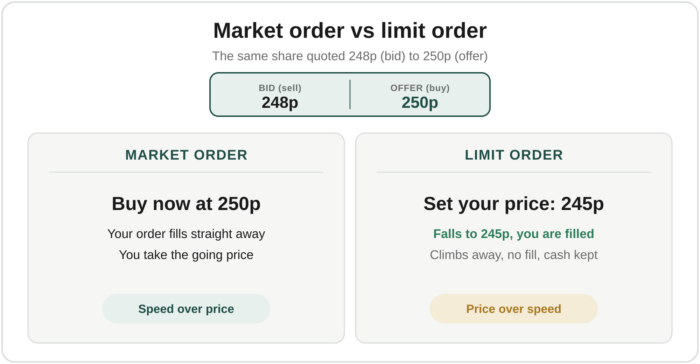
Market orders trade price for certainty. Limit orders trade certainty for control.
Doing it for real, step by step
As I’ve said, every broker’s screens look a little different. Hargreaves Lansdown, AJ Bell, interactive investor (ii), and Trading 212 each have their own layout, their own colours, and their own button names.
Underneath, the mechanics are identical everywhere. You find the share, choose how much, pick market or limit, and confirm.
I will walk through Hargreaves Lansdown here, because it’s one of the most widely used platforms in the country, but read it as the shape of the job rather than a script tied to one website. Whatever you use will ask you the same handful of questions.
Start with the simple version, buying at the going price.
You log in to your Hargreaves Lansdown account, choose the account you want the shares to sit in, and select “Deal now” from that account’s actions.
You search for the company by name or ticker, pick it from the list, and the screen shows the live price and the estimated cost including charges.
On your internet browser, it probably looks like this,
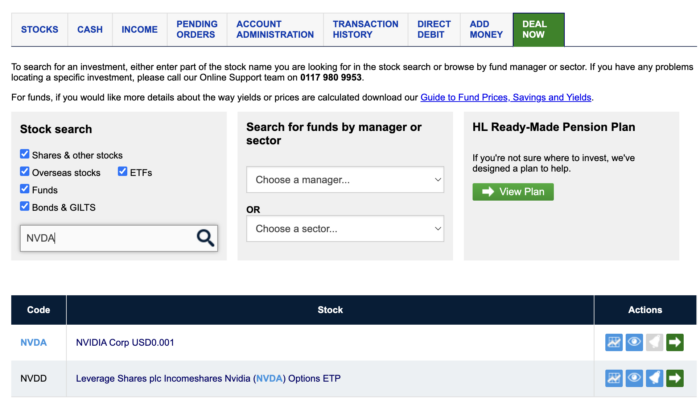
You enter how much you want, either a number of shares or a cash amount, and select “continue.” Up pops a live quote with a 15-second countdown. That’s 15 seconds to accept this price.
Confirm before the clock runs out and the trade is done.
If the price moves too far in those 15 seconds the quote can lapse, which is harmless. You just ask for a fresh one. Then you get a contract note, which is simply your receipt.
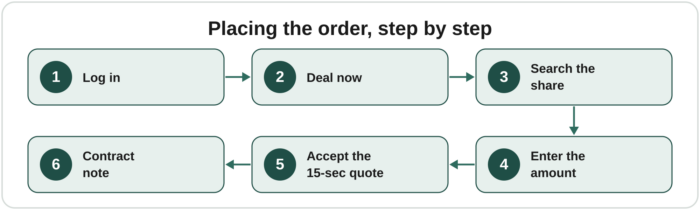
The same six steps sit behind every broker, whatever the buttons are called.
Placing a limit order is much the same, you just take a different turn.
After you select “Deal now” and choose your share, you pick “Stop losses and limit orders,” then “Buy limit.”
You type in the price you’re willing to pay (remember, it’s in pence) and the number of shares, and you choose how long the order stays live, which can be anything up to 90 days.
Confirm it, and it sits in your Pending Orders, waiting.
If the share reaches your price, Hargreaves Lansdown attempts to buy for you. If it never does, the order simply expires.
One honest caveat the platform makes itself: A limit order is not a cast-iron guarantee. If the price gaps straight past your level in a fast-moving market, it may fill at a different price or not at all. For everyday buying that is rarely an issue, but it is worth knowing.
Now let me put real numbers on a first trade so there are no nasty surprises.
Say you buy 100 shares of a company priced at 250p, a £250 order. Hargreaves Lansdown’s online share dealing charge is £6.95 a deal, and stamp duty adds 0.5%, which is £1.25 in this example.
Your total comes to about £258.20. That’s a bit over 3% in costs on a small £250 trade, which is exactly why it pays to deal in sensible sizes rather than firing off lots of tiny trades, each one carrying its own flat fee.
Put £2,500 to work instead and that same £6.95 becomes a rounding error.
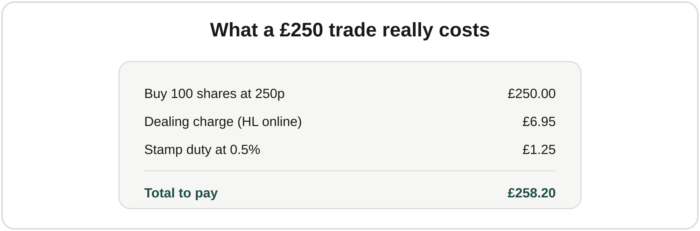
Costs on a small £250 trade. Deal in sensible sizes and the flat fee shrinks to a rounding error.
The orders that get you out
Two more orders are worth knowing, because they’re about getting out rather than in.
A stop-loss order (or stop-exit order as we sometimes call it here at Southbank) tells the broker to sell automatically if the price falls to a level you set.
Buy at 100p, decide you’re not willing to lose more than 20%, so you set a stop at 80p. If the share drops below 80p, your shares are sold and the damage is capped.
This is the backbone of Law Three from the live stream: knowing your exit before you enter. And it’s why from time to time in our analysis we will use a stop alongside the buy price.
It makes the decision in advance, when you are calm, rather than in the heat of the moment when you’re not.
On Hargreaves Lansdown you place your level in that same “Stop losses and limit orders” menu, so it’s no harder to set than a limit order.
One wrinkle to know…
A standard stop becomes a market order once it triggers, so in a fast-falling market you might be sold a little below your stop. A stop-limit fixes the price but risks not filling at all if the price gaps straight past your level.
For most beginners a plain stop-loss is the right tool. Just treat it as a seatbelt, not a force field that completely protects you 100% on the downside.
When the market is open
For UK shares, the London Stock Exchange runs continuous trading from 8 am to 4.30 pm GMT, Monday to Friday, with an auction at each end.
Put an order in after 4.30 pm and it waits until the market reopens at 8 am the next working day, which is exactly when a limit price earns its keep against an overnight move.
If you want US shares, most UK brokers offer them, although some only cover the larger end of the market, not all US stocks. The US market opens at 2.30 pm and closes at 9 pm GMT during British Summer Time, shifting by an hour in winter.
A last word on costs
The trade example earlier covers the two costs you can see, the dealing fee and stamp duty.
But there are two more you need to know. The spread, which we talked about earlier, is the hidden one, baked into the gap between the buy and sell price, and it’s wider on small AIM-listed shares than on the blue chips.
And if you buy US shares, you will pay a small foreign exchange fee to turn pounds into dollars, plus you’ll need to complete one tax form first. That form, the W-8BEN, gets its own write-up in our taxation bonus report.
One bit of good news to finish up. S hares listed on AIM, and shares in US or other overseas companies, carry no UK stamp duty at all.
After you click
Owning the shares and having the cash fully settled are two slightly different things.
Settlement is the back-office process of officially swapping your money for the shares.
In the US, that now takes one working day, known as T+1. In the UK, it currently takes two working days, with a move to one day due on 11 October 2027.
In practice you own the shares the moment the order fills and you can sell them again straight away. Settlement is just the plumbing of traditional finance catching up behind you.
So there it is. A share is a slice of a company, a broker is your way in, a market order buys now, a limit order buys at your price, and a stop-loss gets you out if things turn. The first trade might feel like a leap. But by the third, it’s muscle memory.
Now go and take that one small action.
Until next time,

Sam Volkering
Editor, Southbank Investment Research