The Fast-Track Solution to Argentina’s Energy Revolution
20th March 2025 |
- From Dystopia to Energy Powerhouse: Golar LNG and Argentina’s Path to Prosperity
- Buy List update
- What we’ve been reading and looking at this month
From Dystopia to Energy Powerhouse: Golar LNG and Argentina’s Path to Prosperity
In November 2022, I found myself in Buenos Aires, confronted by a financial reality that felt more like a dystopian novel than a modern economy.
I had just wrapped up a work trip to Paraguay and stopped by Argentina to visit friends before flying back to London.
Inflation was so out of control that prices for everyday goods changed on a whim. I watched as a restaurant owner erased the chalkboard menu, replacing yesterday’s prices with higher ones. It was a strange, surreal dance with rising costs.
Two exchange rates ruled the city: the official one, set by the government, and the “blue dollar”, the black-market rate that revealed the true value of the peso. If you had US dollars, you could stretch your money further, but for locals trapped in the peso economy, savings seemed to disappear overnight.
Navigating this chaos became an art form.
My friends and I exchanged money through an unmarked car service – an odd and clandestine process where a man would hand us stacks of pesos in exchange for dollars and disappear into the night.
One dinner cost us 80,000 pesos – paid in 800 individual bills. It was as surreal as it sounds, like something straight out of an economic fever dream.
Yet, despite the turmoil, Argentina is far from a poor country. It’s a land of immense natural wealth—fertile farmland, abundant minerals, and perhaps most importantly, one of the world’s largest untapped natural gas reserves. Few outside the energy world realize that Argentina sits on the second-largest shale gas deposit in the world: the Vaca Muerta formation.
Often compared to the Permian Basin in the United States, Vaca Muerta holds incredible potential. The big difference? While the US had the infrastructure and capital to drive a shale revolution, Argentina has been stuck at the starting line. The challenge? Infrastructure. The country lacks the pipelines, liquefaction plants, and export terminals to get its gas to global markets.
Without these critical assets, Argentina’s vast reserves remain trapped underground, like an economic treasure chest waiting to be opened. Building traditional onshore liquefied natural gas (LNG) plants would cost tens of billions—a price tag Argentina simply can’t afford amidst financial instability.
But what if there was a faster, cheaper way to unlock this goldmine? A solution that bypassed Argentina’s infrastructure bottlenecks and transformed Vaca Muerta’s potential into real economic power? Enter floating liquefied natural gas (FLNG)—a game-changing technology that could change everything for Argentina.
The Floating Solution: Golar LNG at the Forefront
Unlike traditional LNG plants, FLNG units are massive floating factories that extract and liquefy gas offshore. By eliminating the need for expensive land-based terminals and pipelines, FLNG offers a faster, more flexible and cost-effective solution – precisely what Argentina needs to transform its energy landscape.
And at the forefront of this revolution is Golar LNG (NASDAQ:GLNG).
In mid-2024, Golar secured a groundbreaking 20-year FLNG contract in Argentina, a deal that could generate up to $500 million in annual EBITDA (earnings before interest, taxes, depreciation, and amortization). But this is just the beginning.
With the Argentine administration promoting LNG expansion, more contracts are likely to follow. The opportunity here isn’t just about Argentina – it’s about a global energy shift.
Remember, Europe is still searching for alternatives to Russian gas. Asian demand for LNG is surging. And in regions where traditional LNG infrastructure is too costly or politically fraught, FLNG is proving to be a game-changer.
No wonder the global FLNG market is revving up. According to a report by Wood Mackenzie, 8.5 million tonnes per annum (MTPA) of FLNG capacity were sanctioned in 2022, and by August 2023, an additional 10 MTPA of FLNG projects were under construction.
Global LNG demand is projected to grow at a steady 2-3% CAGR, driven by Asia’s rising energy needs and Europe’s shift away from Russian gas. This structural imbalance creates an ongoing opportunity for FLNG to bridge the supply gap.
Unlike traditional land-based LNG plants, which take years to construct and require massive upfront capital investments, FLNG units can be deployed much faster and at a fraction of the cost. This makes them an attractive option for countries looking to quickly monetize their natural gas resources while maintaining flexibility in an evolving energy market.
Golar LNG is at the forefront of this revolution.
Golar isn’t just another LNG player – it’s positioning itself as the leader in this rapidly evolving space. Those who recognise this shift early, before the rest of the market catches on, stand to benefit the most.
Argentina’s economic history may be volatile, but its energy future is starting to look a lot more promising. And for investors, the potential upside is hard to ignore.
Golar LNG: A Pioneer in FLNG
Founded in 1946 as a traditional shipping company, Golar pivoted to LNG in the 1970s and made history in 2018 with the first FLNG conversion. Today, the company specialises in floating LNG production, leveraging its expertise to provide the lowest-cost, fastest-deployment solutions in the industry.
With costs per MTPA less than half those of traditional LNG projects, Golar’s approach gives it a distinct competitive advantage.
Over the past two decades, Golar has transformed itself from a shipping company into a pure-play LNG infrastructure firm.
Instead of simply transporting LNG, it now plays a crucial role in the production and monetisation of natural gas through FLNG. This shift has allowed the company to secure long-term contracts with global energy majors, positioning it as a key player in the evolving LNG landscape.
Its focus on FLNG sets it apart from traditional LNG exporters like Cheniere Energy. Instead of investing in massive onshore facilities, Golar offers a turnkey, mobile solution that can be deployed wherever gas is available.
This is its secret sauce. Golar is the only company offering FLNG as a service. Competitors like Shell and Petronas build FLNG units for their own gas fields, but Golar lets countries and companies tap into this technology without having to fork out billions upfront.
The company currently operates two FLNG units, with a third under construction and a fourth expected to receive a final investment decision (FID) soon. These units are backed by long-term contracts that provide predictable, high-margin revenue streams.
Each FLNG project has the potential to generate hundreds of millions in annual EBITDA, and with new projects on the horizon, Golar’s earnings could grow significantly in the coming years.
Golar’s FLNG fleet consists of three key designs:
- Mark I: The original blueprint, used for Golar Hilli and Golar Gimi (see below). These converted LNG carriers have a liquefaction capacity of 2.4 MTPA. Solid, but not record-breaking.
- Mark II: The upgraded version, currently under construction (Fuji project). This one jumps to 3.5 MTPA and comes with better economics.
- Mark III: A behemoth capable of producing 5 MTPA, designed for giant gas fields. It’s in the concept stage but could be a game-changer for the next decade.
With these designs, Golar is positioning itself as the go-to FLNG provider worldwide.
But it’s in Argentina where things are really exciting for Golar at the moment.
Argentina: The LNG Boom Begins
You see, for years, Argentina’s vast Vaca Muerta shale formation has been an untapped goldmine of natural gas. But with a new pro-business government in place, the country is finally pushing hard to become a global LNG exporter. Enter Golar.
In July 2024, Golar signed a 20-year contract with Pan American Energy (PAE), a BP-backed Argentine oil and gas giant. The contract will see Golar Hilli – one of its proven Mark I FLNG units – relocate from Cameroon to Argentina in 2026. The numbers are staggering:
- 90% utilization rate, meaning this won’t be an idle asset – it’ll be running full throttle.
- $298 million annual EBITDA from a fixed price of $2.6/MMBtu.
- Extra upside from LNG price exposure, meaning Golar shares in the profits if global LNG prices spike.
- 10% stake in the marketing company, similar to how Cheniere handles LNG sales.
But this isn’t just a single deal – it’s the start of something much bigger. In fact, the FLNG contract signed by Golar is expected to be just the first of what could become a large-scale FLNG project.
The state-owned company YPF has confirmed its participation in the project Golar signed in the summer of 2024 and is now seeking partners – major utilities – to export natural gas from Vaca Muerta. This could lead to Golar signing one or two more FLNG contracts in Argentina this year – most likely using its upcoming Mark II Fuji unit.
Upcoming Catalysts: A Major Rerating Opportunity?
In fact, recent statements from YPF’s CEO suggest that a major LNG announcement could come next month, in April. YPF has already confirmed that two FLNG ships – totalling 6 MTPA capacity – are expected to receive a final investment decision (FID) for the Vaca Muerta LNG project.
Let’s connect the dots:
- Golar owns 10% of the Vaca Muerta JV alongside YPF (15%) and Pan American Energy (40%).
- Its Hilli FLNG unit is already contracted for Vaca Muerta, but the second FLNG unit has not been publicly confirmed.
- The Hilli FLNG can store 2.45 MTPA and the MK II Fuji (currently under construction) has a 3.5 MTPA capacity, which perfectly aligns with the recent YPF announcement.
What is clear is that, if the Mark II unit is officially confirmed for Argentina, Golar’s earnings potential would increase by $500 million annually, locked in for a 20-year contract. Given that Golar’s entire enterprise value is just $4 billion today, this would be a game-changer.
Saying that, Golar LNG has other eggs in its basket outside Argentina.
Golar is also in advanced discussions in Nigeria, where it signed a Project Development Agreement (PDA) with the Nigerian National Petroleum Corporation (NNPC) for a 400-500 mmcf/d FLNG project. This project, expected online by 2027, could serve as another major earnings driver.
The Republic of Congo is another promising frontier. Trident Energy, a major player in the region, has discovered significant offshore natural gas reserves, and discussions with Golar regarding potential FLNG deployment have gained momentum.
If these negotiations progress as expected, Golar could secure yet another lucrative contract, further cementing its position as the leader in floating LNG production.
With multiple opportunities on the table and demand for LNG soaring worldwide, Golar is well on its way to securing even more high-value contracts – and proving that floating LNG is the future of natural gas.
The Bottom Line: A $1 Billion EBITDA Powerhouse?
Golar LNG isn’t just growing – it’s on track to double or even triple its EBITDA in the coming years. With a solid pipeline of FLNG projects and a disciplined financial strategy, the company is well-positioned for long-term success.
Right now, Golar’s FLNG fleet is already generating steady cash flow:
- Golar Gimi (BP/Kosmos – Mauritania & Senegal): After years of delays, Gimi is finally set to start commercial operations in Q2 2025. While the contract lacks commodity price exposure, its $151 million annual EBITDA provides a stable, long-term revenue stream.
- Golar Hilli (Perenco – Cameroon to Argentina): The company’s first FLNG unit turned into a cash machine when gas prices spiked, but with reserves in Cameroon dwindling, Golar is moving Hilli to Argentina. This new 20-year contract offers higher utilisation rates, exposure to LNG prices, and a stake in LNG sales – translating to a significantly stronger financial upside.
- Mark II Fuji (Under Construction): Golar’s first next-gen FLNG unit, bigger and more efficient than its predecessors, is expected to be ready in late 2027. Still awaiting a contract, Fuji is primed for deployment in Argentina, Nigeria or Congo. If Argentina locks in a second FLNG deal (which looks increasingly likely), this could add another $500 million in annual Ebitda.
Certainly, Golar is not your typical capital-intensive energy company. Unlike others that drown in debt to fund growth, Golar has taken a measured, strategic approach:
- Strong Cash Flow: Existing FLNG contracts provide predictable, long-term earnings, ensuring stability even in volatile markets.
- Low Debt Levels: Compared to industry peers, Golar maintains a relatively clean balance sheet, giving it flexibility for expansion without financial strain.
- Smart Capital Allocation: The company has strategically repurchased shares, signalling confidence in its future and creating value for investors.
- Efficient Financing: By leveraging long-term contracts and attractive debt structures, Golar minimizes risk while funding its expansion.
With Hilli shifting to Argentina and Fuji soon to be contracted, Golar’s EBITDA is on track to exceed $1 billion by 2028 – more than double today’s ~$450 million. And that’s without factoring in additional FLNG contracts, which could push earnings even higher.
This expected surge in earnings translates into a compelling valuation shift. As things stand, Golar LNG’s enterprise value (EV) to EBITDA ratio is relatively high, reflecting current earnings levels.
However, if EBITDA expands as projected, the company’s valuation multiple would compress significantly. With $1 billion in EBITDA by 2028, Golar’s EV/EBITDA ratio could decline to approximately 5.6x using today’s EV – a bargain in the LNG space.
Why focus on EV/EBITDA over P/E? Simple: Golar is a capital-heavy business with big upfront costs and long-term contracts. P/E can be skewed by accounting quirks like debt and tax effects, whereas EV/EBITDA gives a clearer read on real cash flow and profitability, which is key for a company in rapid expansion mode.
For investors, the setup is compelling: locked-in, long-term contracts fuelling earnings growth, a falling valuation multiple and a market that hasn’t fully priced in what’s coming. If Golar executes as planned, today’s stock price could look like a steal in hindsight.
Laying the Groundwork for Big Growth
Certainly, Golar LNG’s 2024 financial results tell a story of a company in transition—fine-tuning its operations, making strategic moves and setting itself up for a major earnings expansion in the years ahead.
Revenue for the year came in at $260.4 million, down 13% from 2023, which might look like a step backward. But the real headline here is the turnaround in profitability.
After reporting a net loss the previous year, net income bounced back to $49.7 million, a clear sign that Golar’s focus on operational efficiency is paying off. Adjusted EBITDA landed at $241 million, reinforcing the company’s ability to generate steady cash flow even in a fluctuating LNG market.
One of the biggest moves of the year was Golar’s full acquisition of FLNG Hilli in December. By buying out the remaining minority interests for $60 million in cash and $30 million in additional debt, Golar now has complete control over this cash-generating asset. That’s a big win, adding around $500 million to its adjusted EBITDA backlog and strengthening its financial foundation.
Meanwhile, progress on FLNG Gimi – which has faced its fair share of delays – is finally picking up speed. With commissioning now underway and first LNG production expected in early 2025, this project is a game-changer.
Over its 20-year lease, it’s expected to contribute a massive $3 billion in EBITDA.
Looking further ahead, Golar’s Mark II FLNG conversion project is on track for delivery in late 2027. This next-gen FLNG unit is designed to boost production capacity and take advantage of rising global LNG demand.
Golar also sent a positive signal to investors by declaring a quarterly dividend of $0.25 per share – a sign of confidence in its financial health. While the revenue dip might raise some eyebrows, the bigger picture is clear: Golar is securing long-term contracts, strengthening its balance sheet and expanding its FLNG fleet. The real growth story is just getting started.
Please Consider these Risks
While Golar is well-positioned, there are risks to consider.
LNG prices are volatile, and geopolitical uncertainties – especially in emerging markets – can create unexpected challenges. Delays in signing contracts or developing infrastructure could push revenue timelines back. However, Golar’s global reach and flexible FLNG model provide a solid buffer against these risks.
Project execution and financing are also key concerns. FLNG is a cost-effective alternative to traditional land-based liquefaction, but it still requires significant upfront capital. Fortunately, Golar’s low debt levels and ability to secure long-term contracts help keep financial pressure in check.
Of particular note is the refinancing of Gimi that’s expected in the coming months. Although this could unlock $500 million in liquidity, ensuring cash reserves cover a $190 million bond due in October, tapping credit markets for extra liquidity could pressure the stock in the short term.
Then there’s the question of growth expectations. Some might argue that Golar’s projections are ambitious – after all, its Mark II FLNG unit won’t be operational until late 2027, more than three years away. However, that concern will likely fade quickly if a major contract is announced sooner rather than later.
What’s more, investor sentiment has been volatile, with Golar’s stock dropping 25% from January’s peak due to fears of lower European gas prices and a potential return to Russian gas. However, this dip has made the stock more attractive, especially with key contract announcements on the horizon.
Additionally, Europe’s floating LNG terminals, especially in France and Germany, have faced operational challenges due to high costs, leaving some units idle. If this trend continues, it could affect demand for Golar’s FLNG units in Europe.
Despite these risks, the overall opportunity remains strong. With multiple projects in play and alternatives beyond Argentina, Golar has plenty of flexibility to navigate challenges.
An Opportunity to Get in Ahead of the Crowd
Despite the risks, Golar LNG is positioned to capitalise on the booming LNG market like few others.
Although Argentina has spent decades struggling under economic mismanagement, its natural gas reserves could finally provide the country with a path to economic stability. The government knows this, and it is prioritising LNG exports as a key pillar of its recovery strategy.
Golar LNG is uniquely positioned to profit from this shift. With Argentina pushing to become a major LNG exporter, Golar’s FLNG technology offers the fastest, most cost-effective way to monetize its gas reserves.
For investors, this represents a rare opportunity to get in ahead of the crowd—before the market fully prices in Golar’s potential. Argentina’s energy revolution is underway, and Golar LNG is set to be one of its biggest winners.
Indeed, with multiple growth opportunities on the horizon and a rock-solid financial foundation, Golar isn’t just floating – it’s scaling up to become a dominant force in the LNG industry.
Action to take: Buy Golar LNG
Ticker: NASDAQ:GLNG
ISIN: BMG9456A1009
Market cap: $3.86B
52-week high/low: $44.36/$23.45
Buy up to: $43
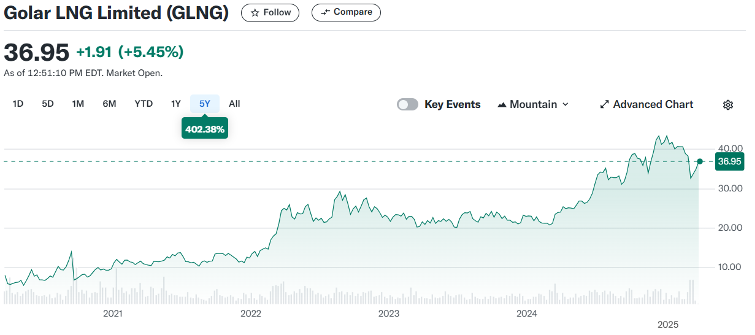
Source: Yahoo Finance
Buy List update
Global X Lithium & Battery Tech UCITS ETF (LON:LITG)
The Global X Lithium & Battery Tech UCITS ETF has dipped by around 5% to £5.76 at the time of writing – 36% below our £8.96 entry price.
This ETF gives investors broad exposure to the lithium and battery sector, tracking the Solactive Global Lithium Index. It holds a mix of lithium miners, battery producers, and EV manufacturers, covering multiple stages of the lithium supply chain.
Of course, perhaps the major factor behind the ETF’s weakness is lithium prices themselves, which have been struggling. Demand for electric vehicles, especially in China, hasn’t quite bounced back as strongly as hoped, and that’s putting pressure on lithium miners and battery producers – the companies that make up a big chunk of LIT’s portfolio.
On top of that, some of its biggest holdings, like Albemarle and Tesla, have had a rough few weeks. Albemarle has been hit particularly hard, and Tesla’s ongoing stock price volatility hasn’t helped the overall sentiment around the battery tech space.
Market mood also plays a role here. Investors have been pulling back from clean energy and tech stocks, spooked by broader economic concerns. Higher interest rates and global uncertainty don’t make things easier for sectors that rely on long-term growth stories, and lithium stocks are caught in the mix.
But the good news is that there are signs we might be near the bottom. Deutsche Bank analysts recently pointed out that while lithium stocks still face headwinds, the worst of the downturn could be behind us. They’re watching for an EV demand recovery in China and a stabilisation in battery material inventories, both of which could set the stage for a rebound.
It’s too early to call a full recovery just yet, but for long-term investors, this might be a moment to keep a close eye on the sector.
For now, the ETF remains a HOLD while the market continues to find its footing.
Central Asia Metals (AIM:CAML)
Central Asia Metals has gained 6% over the past month to sit at around 159.60p, leaving it about 42% underwater in the model portfolio.
The company runs two key operations: the Kounrad copper mine in Kazakhstan and the Sasa lead-zinc mine in North Macedonia. Kounrad, in particular, remains a standout, ranking among the world’s lowest-cost copper producers with C1 cash costs of just $0.78 per pound.
There’s good reason for the momentum – strong earnings and a bullish copper market have given investors plenty to cheer about.
Let’s start with CAML’s 2024 results. The company delivered a solid performance, reporting an Ebitda of $102 million and a healthy net cash position of $67.6 million.
Earnings per share came in slightly ahead of expectations at $0.29, and while free cash flow was a bit lower than forecast at $53 million, the dividend payout more than made up for it. CAML declared a final dividend of 9p per share, bringing the total for the year to 18p – well above its typical payout range.
Then there’s copper. Prices have surged to five-month highs, recently topping $10,000 per tonne. The catalyst? Growing fears that the US could slap a hefty 25% tariff on copper imports due to national security concerns. That’s sent traders scrambling to stock up, pushing prices higher and boosting sentiment around copper producers like CAML.
Between its strong financials and the tailwind from copper’s rally, CAML has found itself in a sweet spot. Investors are clearly taking notice, and if copper prices keep rising, this stock could have more room to run.
As such, let’s reinstate the stock as a BUY.
Volt Lithium (TSXV:VLT)
Volt Lithium has slipped about 3% over the past month to around $0.33, 11% down in our model portfolio, but don’t let that small dip fool you – this company is making big moves in the lithium space.
In early March, Volt announced a major milestone: its Generation 5 Field Unit in Texas’ Permian Basin has been delivering lithium extraction rates of up to 99%. That’s a huge win for its Direct Lithium Extraction (DLE) technology, which has been put through over 90 tests since deployment in February.
The company is now fine-tuning the process and stockpiling lithium concentrate in preparation for commercial demand. In other words, they’re getting ready for the next stage.
And it’s not just Volt saying this is a game-changer. Analysts at Chimera Research Group recently called Volt a “lean, swift challenger” that’s outpacing the industry giants. While larger lithium companies require massive capital and long lead times, Volt’s modular DLE system has already scaled to over 10,000 barrels per day and aims to reach 100,000 barrels per day by the end of the year. This could give Volt a real edge as it commercialises its technology.
With Volt’s extraction tech proving itself in the field, this looks like a company with serious upside – despite the recent stock wobble.
Volt remains a BUY under C$0.50.
Newmont Corporation (NYSE:NEM)
Newmont Corporation has been hovering around $48, still about 27% below our entry point. It’s been a slower recovery than hoped, but the company has been making some important strategic moves that could set it up for stronger performance down the line.
A key development was Newmont’s recent sale of three non-core assets – Musselwhite and Éléonore in Canada, plus Cripple Creek & Victor in the US – for $1.7 billion in cash. This isn’t a sign of distress; rather, it’s part of a plan to streamline operations and focus on the company’s most profitable assets. With a clearer strategy and a stronger balance sheet, Newmont is positioning itself for long-term stability.
Newmont is also maintaining its lead in gold production, producing around 6.7 million ounces last year. The company’s leadership continues to emphasise stability and future growth, pointing to a project pipeline that should bring in more low-cost ounces and improve cash flow over time.
While the stock price hasn’t yet reflected these positive developments, Newmont’s strategic decisions and improving financials suggest it remains well positioned for the longer term. If gold prices hold firm, the patience could be rewarded.
Newmont remains a BUY under $100.
Prysmian Group (IL:0NUX)
Prysmian has had a rough last month, with the stock down 14% to around €58.22. But it’s currently still 23% above our entry price, and the bigger picture remains very much intact.
The drop came after the company’s latest earnings report, which, despite delivering a record EBITDA margin, didn’t quite hit revenue expectations. Adding to the cautious mood, there are concerns about potential US tariffs on copper and aluminium, which could impact costs across the industry.
But beyond the stock price, Prysmian has been making some big moves. It was just named the preferred supplier for a massive 1 GW subsea cable project between Singapore and Malaysia. This project is a big deal – it’ll help bring green electricity from Sarawak to Singapore, reinforcing Prysmian’s dominance in the high-voltage subsea cable space.
The company also recently signed a multi-year deal with Edison Energia and just delivered the industry’s first 245 kV cable system to accelerate floating offshore wind projects.
So while the stock has taken a hit, the business itself is still going well. The short-term wobbles don’t change the fact that Prysmian is at the centre of some of the most important infrastructure projects of the next decade.
The stock remains a BUY up to €85.
Ashtead Technology Holdings PLC (AIM:AT)
Ashtead Technology Holdings has been quietly ticking upwards, rising about 2% over the past month to around 550p. That’s still about 7% below our entry price, but considering the stock has been moving without much news flow, it’s holding up well.
It’s been a relatively quiet period for the company, with no major announcements in recent weeks. But that’s about to change – Ashtead is set to release its full-year results for 2024 on Tuesday, March 25, and that could provide a fresh catalyst for the stock.
Investors will be watching closely for updates on revenue growth, margins, and any commentary on market conditions in offshore energy and subsea services.
Given Ashtead’s strong positioning in the sector, there’s plenty of potential for solid numbers. The company has been benefiting from increased demand in offshore renewables and oil and gas inspection, maintenance and repair (IMR) work. If the results confirm continued growth and profitability, we could see renewed interest in the stock.
For now, it’s a waiting game—but with results just around the corner, things could get interesting soon.
The stock remains a buy under 700p.
AirJoule Technologies (NASDAQ:AIRJ)
AirJoule Technologies has drifted down about 3% over the past month, now sitting at $7.86 – just below our entry price of $7.92.
Although the company hasn’t released much in the way of big news, it has published a fresh investor presentation ahead of upcoming conferences, offering a deeper dive into its cutting-edge “water-from-air” technology.
As you might know, AirJoule’s system pulls pure, distilled water straight from the air using waste heat – an innovation with huge potential across industries like HVAC, data centres and even water security. And with heavyweight partners like GE Vernova and BASF on board, it’s clear that major players are paying attention.
The company rebranded to AirJoule Technologies last November to better reflect its focus, and it’s now positioning itself as a serious player in the $450 billion market for water and energy efficiency solutions.
While the stock has been treading water recently, it’s worth keeping an eye on those investor conferences. If AirJoule can generate some buzz and land more commercial deals, it could be the spark that gets things moving again.
The stock is still a buy below $11.
Solaría Energia Y Medio Ambiente SA (XMAD:SLR)
Solaria Energia has dipped about 2% over the past month, now sitting at €7.58 – less than 1% below our entry price. But under the surface, the company continues to make progress.
First off, Solaria just reported an Ebitda of €201 million for 2024, up slightly from last year despite a few headwinds like falling power prices and Spain reinstating its 7% generation tax.
Even with those challenges, the company still managed to increase energy production by 12% to 2.54 TWh. Looking ahead, Solaria is feeling confident, forecasting Ebitda of up to €255 million in 2025 and aiming to have more than 3,000 MW connected by year-end – on its way to doubling that capacity by 2026.
But the real story here is Solaria’s growing role in powering data centres. The company just secured 130 MW of capacity to connect two new data centres in Madrid, and it has now locked in a huge 1 GW of demand for data centres across Spain. That includes a recent 225 MW authorisation in the Basque Country, reinforcing its leadership in renewable energy for high-tech infrastructure.
So while the stock has been a bit sluggish, Solaria is quietly building an even stronger position in the fast-growing intersection of clean energy and digital infrastructure. If it keeps executing on these projects, the share price may not stay quiet for long.
The stock remains a buy up to €9.
Couer Mining Inc (NYSE:CDE)
Coeur Mining (NYSE: CDE) has been on a bit of a roll lately, climbing 8% over the past month to $6.56. This uptick coincides with its recent acquisition of SilverCrest Metals, a move that has now positioned Coeur Mining within our portfolio.
Based on the terms of the deal, our adjusted entry price stands at $5.72, giving us a comfortable cushion as the stock trends upward.
The SilverCrest acquisition is a significant play for Coeur. By bringing the Las Chispas mine in Mexico under its wing, Coeur is ramping up its silver production capabilities. Not only does this enhance their asset portfolio, but it also strengthens their foothold in the Mexican mining sector.
Analysts are taking note, too. TD Cowen recently initiated coverage on Coeur Mining with a “Buy” rating and set a price target of $7, which reflects growing confidence in Coeur’s strategic direction and operational potential post-acquisition.
In short, Coeur Mining’s recent performance and strategic moves suggest a promising trajectory. With the successful integration of SilverCrest’s assets and positive analyst sentiment, the company looks very well-positioned for continued growth in the mining sector.
The stock remains a BUY under $7.
Helix Exploration PLC (AIM:HEX)
Helix Exploration, which we first recommended at 15p in the last issue of Southbank Growth Advantage, has edged up to 15.25p – a small but promising move in the right direction. But beyond the share price, what really matters is how the company is progressing on the ground.
Our main reason for backing Helix was its natural hydrogen discovery at Ingomar Dome – a rare and potentially game-changing asset. Natural hydrogen, or “gold hydrogen”, is attracting growing attention as a clean and cost-effective energy source. But it has also been making big strides in helium, another critical and high-value gas.
Helix recently doubled its production capacity in Montana with a low-cost acquisition at Rudyard Field, picking up the Weil #1 well and an additional 640-acre lease for just £230,000. That’s a fraction of what it would have cost to drill a new well from scratch, making this a smart and efficient expansion.
More importantly, Helix is gearing up for a busy period of drilling and development. The company is preparing to re-enter the Clink well at Ingomar Dome to test its production potential. Meanwhile, it has two additional wells scheduled for drilling in Montana, including the Linda #1 well, which sits just a mile from the successful Darwin #1 well. If these prove productive, Helix could be looking at a serious boost in output.
With production at its flagship helium project set to kick off this summer, Helix is entering an exciting phase.
While we’re still keeping a close eye on any updates around its natural hydrogen play, the progress in helium shows that the company is steadily building value. If things continue on this trajectory, Helix could have plenty of room to run.
The stock is still a buy below 23p.
Nano Nuclear Energy (NASDAQ:NNE)
As of the February 28, 2025, Nano Nuclear Energy is now included in the MSCI USA Index, showing its growing importance and relevance in the nuclear energy sector. That also helps any index based passive funds to direct investment into the stock.
The company also submitted four new patent applications to the US patent office, “related to NANO Nuclear’s Annular Linear Induction Pump (ALIP) technology.”
These little wins have helped the stock bounce back off the falls down to around $24 from their highs over $45 in late January. We’re still expecting the stock to return to a triple-digit profit position from here, however again, prudent risk management is warranted in case the market does capitulate in the short term.
With that in mind we’re going to raise the stop exit on Nano Nuclear to our entry price of $16.80. That way if the stock tanks unexpectedly, we’ll exit without massive damage to the position.
Bear in mind, that if the stock rises again breaking through $33.60, then we’ll lift the stop exit again to $25.20 which locks in at the worst, a 50% gain on the stock.
Hut 8 (NASDAQ:HUT)
Hut 8 recently provided an operations update for February 2025, highlighting the acquisition of 592 acres in Louisiana for their upcoming River Bend campus. The development of their 205 MW Vega project is also progressing on schedule, with completion anticipated in the second quarter of 2025.
Further to this, they reported full year net income of $331 million and a total “strategic reserve” of bitcoin now at 10,171 roughly equal to $855 million.
Year to date, bitcoin miners have taken a whack in the market. Hut 8 is down around 36% year to date. But the long-term view is they will rise in line with bitcoin’s rise in price as this cycle unfolds. No action to take on Hut 8, we stick with the position.
Strategy (formerly MicroStrategy) (NASDAQ:MSTR)
Not a great deal of change with Strategy. Other than the announcement of a $21 billion at-the-market program for its perpetual strike preferred stock (STRK) and then the launch of its $500 million Series A Perpetual Strife stock (STRF) program – all designed to add more bitcoin to their corporate holdings.
They now hold 499,226 bitcoin acquired for $33.1 billion and worth around $42 billion.
Michael Saylor also presented the “21 Truths of Bitcoin” at the Digital Assets Summit this week in New York. You can see his full presentation here.
In short, Strategy remains a long-term hold in the portfolio for their exposure to bitcoin and our view of the long-term price appreciation of bitcoin, and of Strategy stock.
What we’ve been reading and looking at this month
China’s stock market is booming again
If you’d given up on Chinese stocks, you’re not alone. After years of regulatory crackdowns, a collapsing property sector and sluggish economic growth, China’s market had become a no-go zone for many investors. But here’s something you might not have expected – it’s now leading global stock market gains.
The CSI 300 Index, which tracks China’s biggest stocks, has roared back to life and is now outperforming the US market for the first time in years. And it’s not just a random bounce – this rally might just have legs.
The turnaround comes as the Chinese government finally starts supporting its own stock market, rolling out policies to boost private businesses, stabilise real estate and reignite growth in its high-tech sectors.
This Business Insider article digs into what’s driving the rebound, but what really caught my eye was the psychological shift happening in China’s economy. For a long time, Beijing seemed more focused on reining in big tech and curbing speculation rather than fostering growth. Now, the tone has changed: policymakers are actively encouraging innovation, backing domestic consumption, and lifting restrictions that had been choking businesses.
Does this mean Chinese stocks are a screaming buy? That’s the big question. The rally could keep running if the government follows through on these pro-market measures – but risks still remain, especially in the real estate sector.
If you’re someone who’s been avoiding China, this is one of the biggest market pivots in years and well worth paying attention to. It might not be time to go all-in just yet, but at the very least, it’s a market that deserves a second look.
Read the full article here.
How a ski resort became a data powerhouse
Skiing might seem like the ultimate outdoor escape, but behind the scenes, the industry is becoming incredibly data-driven – and no one has mastered this quite like Vail Resorts in North America.
In the past 17 years, Vail has expanded from just five ski resorts to 42, including legendary spots like Whistler, Park City and Breckenridge. But here’s the really interesting part: they’re not just buying up ski resorts – they’re completely changing how people pay for and experience skiing.
Once upon a time, most skiers bought single-day lift tickets, meaning resorts made money only when people showed up. But that’s a risky business model when snowfall is unpredictable. So Vail flipped the script with the Epic Pass, a prepaid, multi-resort season pass. Today, 75% of Vail’s customers use it, locking in revenue before the season even starts. It’s like Netflix for skiing – get customers subscribed, and they’ll keep coming back.
But there’s a flipside – single-day lift tickets have skyrocketed. A walk-up lift ticket at Vail or Breckenridge now costs up to $295 on a weekday – almost triple what it cost in 2010. This isn’t just inflation; it’s part of the business model. The high single-day price manufactures a sense of value around the Epic Pass – making a full-season pass seem like a bargain in comparison.
For frequent skiers, this strategy makes sense. But for occasional visitors or families who only want to ski for a day or two, it means skiing at a Vail-owned resort is becoming increasingly out of reach.
So on one hand it’s a masterclass in business strategy – Vail figured out how to lock in revenue, create customer loyalty and dominate the ski industry. But, on the other, it also raises questions about accessibility. If skiing becomes a sport only for season-pass holders or the ultra-wealthy, what does that mean for the future of the industry?
Either way, this is a fascinating example of how pricing strategy shapes consumer behaviour – for better or worse.
Check out the full post here.
A titanium solar panel that could transform solar energy
For decades, silicon has been the go-to material for solar panels, but it has limits – many panels convert only about 20% of sunlight into electricity and struggle in low light. Now, scientists have developed the first-ever titanium-based solar panel, and it could be a game-changer.
According to this Earth.com article, the key breakthrough is the use of nanoantennas, which allow the panels to capture a wider spectrum of sunlight, including infrared radiation. This could make them far more efficient than traditional silicon panels, potentially working better in cloudy conditions and even at night by absorbing residual heat.
Why titanium? Well, titanium is more durable, corrosion-resistant, and lightweight than silicon, meaning these panels could last longer and perform better in extreme conditions. Unlike conventional panels, which gradually degrade, titanium panels could maintain high efficiency over time.
The challenge now will be scaling up production – silicon dominates the market because it’s cheap and established. But if titanium panels prove commercially viable, they could improve solar energy storage and adoption, making renewables more practical across different environments.
Read the full article here.


James Allen and Sam Volkering
Editors, Southbank Growth Advantage