Your August issue of Southbank Growth Advantage
30th August 2024 |
- The most exciting area of AI is deep in the world of drugs
- Big breakthroughs
- Buy List update
- Inside the lives of James and Sam
- Crypto Corner
- What else we’ve been looking at this month
The most exciting area of AI is deep in the world of drugs
Google’s DeepMind division, its artificial intelligence research arm, launched AlphaFold in 2021 – an AI protein structure database that predicts protein structures.
For all the work in AI that Google is pursuing, this is one in which it thinks it can tap into a potential $100 billion-plus market opportunity.
DeepMind CEO Demis Hassabis explained that its AlphaFold AI program has “enormous commercial value” when it comes to the potential of making breakthroughs in biology and drug creation using AI.
Nvidia is another mega-cap tech giant that is aiming squarely at using generative AI in the pursuit of drug discovery.
Its Nvidia Bionemo platform,
“… provides drug discovery researchers and developers a fast and easy way to build and integrate state-of-the-art generative AI applications across the entire drug discovery pipeline, from target identification to lead optimization. The platform offers workflows for 3D protein structure prediction, de novo design, virtual screening, docking, and property prediction.”
And when CEO Jensen Huang unveiled Bionemo earlier this year at the huge Nvidia GTC conference, he said,
“It turns out that we’ve digitized a lot of things: Proteins and genes and brainwaves. Anything you can digitize, so long as there’s structure, we can probably learn some patterns from it. And if we can learn the patterns from it, we can understand its meaning. If we can understand its meaning, we might be able to generate it as well. And so therefore, the generative revolution is here,”
So why are two of the world’s most valuable companies typically not associated with medical technology or research both taking aim at using AI in medicine and drug development and discovery?
To put it simply (and as Google points out) it’s a huge commercial opportunity and also an industry where AI can make monumental improvements.
The potential of AI in the development of drugs has been within reach for a few years, but now with the speed of AI’s acceleration and improvements in AI models and the speed and power of AI models (much in part thanks to Nvidia) we can use AI in a way that we never have before.
A good example of the real-world application of this came recently when research was published in Nature relating to the discovery of a structural class of antibiotics with explainable deep learning.
According to AI expert Bindu Reddy,
“Researchers used graph neural networks to predict the toxicity of over 12M compounds. This would have been impossible to do in a wet lab. They then used these results in antibiotic discovery. (link in alt) This directed approach makes sense and is an excellent example of deep learning, and AI can help in the real world.”
So, you’ve got a huge market opportunity, Big Tech scrambling to get a foothold in the door, and now real-world research to support the ongoing investment into and development of AI in drug discovery.
But what if there was a British way to play this investment opportunity? Something grown out of the “golden triangle” (Oxford, Cambridge, London) of British innovation?
A company based in Oxford that’s been pursuing AI drug development not for a minute like Nvidia and Google, but for over a decade now.
It is one of the pioneers of AI drug development, and might just be one of the most exciting, British-based stocks in the world. The only catch is… it’s not going to stay the way it is for long…
Let me explain some more…
Pioneering AI – straight outta Oxford
Exscientia (NASDAQ:EXAI) is a UK-based biotech company that’s developing new drugs using artificial intelligence.
Its headquarters are in the “golden triangle” biotech cluster of London, Oxford and Cambridge. More specifically at The Schrodinger Building in the Oxford Science Park.
It is a British biotech and AI pioneer – typically not something you’d expect to hear, at least not in today’s economic climate. But it should be noted, although Exscientia is British, and based in the UK, its stock is actually listed on the Nasdaq.
When researching AI, you look at all kinds of industries that AI will impact. One of those areas is medicine and drug discovery. For example, in February this year I wrote a piece in my free e-letter, AI Collision, about the stocks that Nvidia has ownership in.
One of those companies, which at the time Nvidia held around $95 million in its stock, was called Recursion Pharmaceuticals. At the time I wrote,
Recursion is an interesting drug-discovery company that no doubt is leveraging the power of Nvidia’s compute power to help model and discover new, novel approaches to developing drugs.
I looked deeper into AI drug discovery companies, and Exscientia popped onto the radar. Now Exscientia appealed to me because of its long and successful experience in AI drug development.
But an announcement just this month, tipped it over the edge as to why I wanted to recommend the company to you today (sort of). More on that in a moment.
Exscientia’s experience in AI drug development goes all the way back to 2012. Spun out of the University of Dundee in 2012, by Professor Andrew Hopkins CBE, it began using machine learning and automated computer algorithms, a version of AI, to develop novel drugs over 12 years ago.
The company achieved a world-first in 2020 when it announced the start of human tests with its obsessive-compulsive disorder treatment which was entirely designed by AI.
That means its models have a long runway of learning, development and success development already under its belt. Importantly with Exscientia, there’s a strong pipeline of activity and partnerships with large pharma that holds a potentially valuable pipeline of prospective drugs for the company.
These include a partnership with Bristol Myers Squibb on an inflammatory disease drug, the development of cancer drugs with Apeiron, and two wholly owner drugs focusing on leukaemia and other haematological cancers (like lymphoma and myeloma).
In short, Exscientia is a fantastic British stock story with huge potential. Except that’s all about to change…
When two become one
On 8 August, Exscientia made an announcement which explains,
Recursion and Exscientia Enter Definitive Agreement to Create a Global Technology-Enabled Drug Discovery Leader with End-to-End Capabilities
Yes, that Recursion from earlier.
In short, Recursion and Exscientia are going to merge and become one, market-leading company in AI drug development and discovery.
They say the new company will have:
- Industry-leading portfolio of pharma partnerships with the potential for approximately $200 million in milestone payments over the next 24 months, and over $20 billion overall before potential royalties over the course of the partnership
- Well-capitalized balance sheet with approximately $850 million in cash and cash equivalents between the two companies as of the end of Q2 2024
- Operational complementarities expected to yield annual synergies in excess of $100 million
According to the deal, “Exscientia shareholders will receive 0.7729 shares of Recursion Class A common stock for each Exscientia ordinary share they own, with fractional shares paid in cash.”
Based on a stock price of $7.38 for Recursion stock that puts a value of Exscientia shares at $5.70. Which is around the price Exscientia now trades at.
Again, we think this tie-up is huge. With Recursion’s ties to Nvidia, we think the potential and commercial delivery of AI drugs to market as the new company will be huge.
However, the recommendation today is still Exscientia and not Recursion. This is simply due to the fact that there’s no guarantee the deal will complete. If it doesn’t, we think the better stock to hold is actually Exscientia.
We do expect the deal to complete, and the share conversion to take place, and if it all does as is expected, then your EXAI stock will become Recursion stock long term. But we think moving on this now while it’s still EXAI is the better way forward.
Risks
Risks here are deeply entrenched in technology risk. AI drug development is still early stages, developmental and there are no guarantees of getting a drug designed and commercialised.
However, the efficiency that AI can bring to the length of time taken to analyse, develop and simulate drug creation is far greater today than it’s ever been. Which is why Google, Nvidia and others are pouring money into this area of AI research and development.
However, should an AI drug prove to be ineffective, or that AI can’t commercialise new drugs longer term any better than traditional methods, we may see a slowdown in interest and funding for these companies.
Should the deal complete, and Nvidia decides to divest away from Recursion, then we would also expect to see the new company stock price fall.
Likewise, if the business merger doesn’t complete, for whatever reason, we may see a pullback on the Exscientia stock price, as the market reacts to the deal falling through. We don’t expect that, but it’s a consideration as the deal has not yet been finalised, approved and voted for by relevant parties.
Wider market factors in play, as we saw at the start of August, will also see ongoing volatility in stocks like these that are high-growth, with minimal revenues and that are developmental in nature. Expect high volatility.
Action to take: BUY Exscientia (NASDAQ:EXAI). Current price $5.67. Buy up to $5.95.
The expectation is the merger with Recursion takes place whereas per the announcement, Exscientia shareholders will receive 0.7729 shares of Recursion Class A common stock for each Exscientia ordinary share they own, with fractional shares paid in cash. Consider this when purchasing EXAI stock.
Big Breakthroughs
James:
Something big is cooking at the Laboratory for Energy Storage and Conversion (LESC) in the US: an anode-free, all-solid-state, sodium battery.
The LESC’s findings, detailed in Nature Energy, demonstrate a new sodium battery architecture with stable cycling for several hundred cycles, bringing the reality of inexpensive, fast-charging, high-capacity batteries for electric vehicles and grid storage closer than ever.
“Although there have been previous sodium, solid-state, and anode-free batteries, no one has been able to successfully combine these three ideas until now,” said UC San Diego PhD candidate Grayson Deysher, first author of the paper.
The LESC – a collaboration between the UChicago Pritzker School of Molecular Engineering and the University of California San Diego’s Aiiso Yufeng Li Family Department of Chemical and Nano Engineering – said that by removing the anode and using sodium instead of lithium, this new battery will be more affordable and environmentally friendly to produce.
Through its solid-state design, the battery will also be safe and powerful.
To achieve a sodium battery with energy density comparable to that of a lithium battery, the team had to develop a novel sodium battery architecture.
In traditional batteries, the anode stores ions during charging. When the battery is in use, these ions travel from the anode, through an electrolyte to a current collector (cathode), powering devices and cars along the way.
Anode-free batteries, on the other hand, store ions by depositing alkali metal directly onto the current collector, bypassing the need for a separate anode. This method allows for higher cell voltage, lower production costs, and greater energy density but also introduces challenges.
“In any anode-free battery there needs to be good contact between the electrolyte and the current collector,” said Deysher. “This is typically very easy when using a liquid electrolyte, as the liquid can flow everywhere and wet every surface. A solid electrolyte cannot do this.”
Liquid electrolytes, though, tend to form a solid electrolyte interphase over time, consuming active materials and reducing the battery’s lifespan.
To address this issue, the team designed a current collector made from aluminium powder, which behaves like a liquid, to encase the electrolyte.
During battery assembly, the powder was compressed under high pressure, forming a solid current collector while retaining liquid-like contact with the electrolyte. This innovation enables efficient and cost-effective battery cycling.
“Sodium solid-state batteries are often considered a distant technology, but we hope this paper will stimulate more interest in sodium-based solutions by showing they can work effectively, and in some cases, outperform lithium batteries,” said Deysher.
Deysher has filed a patent application for the battery, along with senior author Professor Ying Shirley Meng from the University of Chicago.
Although this battery design is only in the lab for now, it truly has the potential to be the holy grail: dirt cheap materials, lightweight, energy dense and safe (no fire risk), all while offering fast charging.
Almost every day brings advances in battery tech, be it with commercial sodium batteries, lithium sulfur or flow batteries.
For those keeping count, it’s clear the battery revolution has barely even started.
Buy List update
European Metals Holdings (AIM: EMH)
At the time of writing, European Metals Holdings is trading around 11p, 17% down over the last month, with the stock now 68% underwater in the model portfolio.
European Metals part owns the Cinovec lithium asset in the Czech Republic, one of very few advanced-stage, large-scale lithium projects in the European Union with a mineral resource of nearly 7.4 million tonnes of contained lithium carbonate equivalent.
The project is being developed by Geomet, a joint venture between EMH and Czech-state-owned CEZ.
Shareholders continue to wait for news of the publication of the delayed definitive feasibility study (DFS) for the Cinovec project, which was originally slated for release in the first quarter.
In a release at the end of July, European Metals Holdings said it was again adjusting the timeline for completing the DFS and, subsequently, the construction of its Cinovec Lithium joint venture.
This adjustment follows the relocation of the Czech-based lithium processing plant from Dukla to Prunéřov.
Due to the change in location, additional geotechnical work is being conducted to determine the best construction method and layout for the new site, with results expected by the end of September.
Following this, DRA Global will provide a detailed timeline and commence the DFS finalisation programme.
A significant focus has been on enhancing the Front-End Comminution and Beneficiation (FECAB) process flowsheet.
European Metals has evaluated a shift from magnetic separation in beneficiation to a combined process of magnetic separation and flotation, resulting in a total FECAB lithium recovery of over 87%.
Further testing suggests the possibility of eliminating the magnetic separation step entirely while enhancing flotation performance, potentially boosting lithium recovery to over 94%.
The Lithium Chemical Plant (LCP) process has also been refined.
The company has removed sodium sulphate as a reagent, leading to lower operating costs and increased overall lithium recovery in the LCP circuit by recycling the mixed sulphate waste stream.
Alongside technical advancements, European Metals has submitted an initial application for support from the Just Transition Fund (JTF), seeking approximately €31 million for preliminary mine portal area work.
European Metals’ executive chairman Keith Coughlan stated: “Whilst it is disappointing to not be able to provide a completion timeline for the Definitive Feasibility Study at this time, it is very pleasing to see the positive outcomes of the recent testwork optimising our processing plant, in particular in respect to reductions in capex and opex.”
Of course, lithium prices languishing around three-year lows are hardly helping EMH’s share price either.
The Platts-assessed spodumene concentrate FOB Australia price plummeted by 15.6% in August, reaching $760 per metric tonne, the lowest level since June 2021.
The decline in lithium prices is being driven by growing demand headwinds and a persistent market surplus.
With that in mind, the stock remains a HOLD while we wait for news of the DFS.
Global X Lithium & Battery Tech UCITS ETF (LON: LITG)
Global X Lithium & Battery Tech UCITS ETF has fallen by 6% over the month to trade last at around £5.06 at the time of writing, putting it around 44% below our £8.96 entry price.
LITG is designed to capture the full lithium cycle, encompassing activities from mining and refining lithium to the production of batteries, reflecting its comprehensive investment strategy within the evolving battery technology and electric vehicle (EV) market.
It seeks to provide investment results that correspond generally to the price and yield performance, before fees and expenses, of the Solactive Global Lithium Index.
The exchange-traded fund (ETF) maintains significant positions in major players within the EV and battery sector, including Tesla, BYD, LG Energy Solution, TSD and Samsung SDI.
By owning mining, refinery and battery production companies in the fund, Global X has its fingers in multiple parts of the lithium industry.
Of course, the ETF is expected to benefit from increased demand for the silvery-white metal from EV, renewable energy storage and mobile device industries.
However, increasing supply of the white metal, particularly in the China market, has caused lithium prices to fall since hitting record highs in 2022.
While some lithium supply projects are being deferred, the reduction in supply has so far been insufficient to offset weakening demand.
But according to investment bank UBS, low prices should will certainly lead to production delays and deferrals of growth projects. If spodumene prices remain at the current spot level of around $770 per tonne (for SC6, spodumene) for the next year to year and a half, further shutdowns are expected, the bank said on Monday this week.
With the ETF providing easy access to a secular growth trend that’s nowhere near ending, LITG remains a core position in the Southbank Growth Advantage portfolio. But let’s move it to a HOLD in the portfolio while the market finds its feet.
Central Asia Metals (AIM: CAML)
Central Asia Metals, a mining company with operations in Kazakhstan and North Macedonia, has fallen 2% over the last month to 188.80p at the time of writing, still leaving it 30% underwater in the model portfolio.
The group’s principal business activities are the production of copper at its Kounrad operations in Kazakhstan and the production of lead, zinc, and silver at its Sasa operations in North Macedonia.
Copper is increasingly back in favour amid emerging supply concerns, falling inflation and forecasts of lower interest rates that could see demand improve markedly in the months and years ahead
Copper prices rose to an almost six-week high earlier this week, supported by fresh investor demand and market optimism over the potential for imminent US interest rate cuts.
Copper for September delivery briefly touched $4.3065 per pound in New York on Tuesday, notching its highest level since 18 July, when copper traded as high as $4.4280.
This bright price outlook spells good news for Central Asia Metals. As such, CAML is a BUY under 310p.
Volt Lithium (TSXV: VLT)
Volt Lithium, which entered the Southbank Growth Advantage portfolio on 2 August at C$0.37, has subsequently gained 13.5% to trade last at C$0.42.
Volt is aiming to be North America’s first commercial producer of lithium from oilfield brine from existing hydrocarbon wells. This includes the production of lithium hydroxide monohydrate (LHM) and lithium carbonates.
The company’s flagship project – Rainbow Lake in Northwest Alberta, Canada – spans approximately 430,000 acres and has more than 1,300 fully permitted oil-producing wells with lithium-infused brine. A successful pilot programme and technical report estimate a lithium production life of approximately 100 years.
The shares rallied on 26 August after the company said it has deployed, installed and commenced function testing of its first field unit located in the Permian basin in Texas, paving the way for the first lithium production.
The project is a partnership with a major Permian Basin operator, following their previously announced strategic investment of $1.5 million, which was allocated for the construction and deployment of the field unit.
The company also noted that the field unit will have the capacity to process over 200,000 litres (1,250 barrels) of oil field brine per day, doubling Volt’s previous processing capability of 96,000 litres (600 barrels) per day, as stated in a press release on 17 July.
Located in West Texas, the field unit will produce lithium hydroxide monohydrate using Volt’s proprietary direct lithium extraction (DLE) technology, leveraging the advancements made at its permanent demonstration plant in Alberta.
“Our team is thrilled to share that we have successfully deployed, installed and commenced function-testing of the field unit on-site at our strategic partner’s Permian basin location in West Texas,’’ said Volt Lithium president and CEO Alex Wylie.
“The introduction of this initial field unit marks the achievement of another critical milestone of our strategy to become one of North America’s first commercial producers of lithium from oil field brine,’’ he said.
“Volt has reached a critical inflection point with this achievement and is well positioned to commence DLE operations in the field in the third quarter of 2024, which aligns with our previous guidance. We look forward to providing updates as we continue to progress.’’
In August 2024, Volt deployed and completed the installation of its field unit in the Permian Basin, designed at a 1:83 scale of future commercial production. Following installation, the company began function testing, setting Volt on a clear path toward full-scale commercialisation in the near term.
Volt’s field unit is modular, allowing the company to cost-effectively and efficiently scale up to process commercial volumes of brine through several methods, including adding modules to increase capacity, reducing lithium extraction time to boost output, and implementing larger extraction modules.
Drawing on detailed historical modelling by its engineering team, Volt plans to continuously scale up the initial field unit over the next year, targeting commercial production of 100,000 barrels per day. This strategy positions Volt as a near-market, low-cost, and full-scale commercial producer.
Let’s raise the buy limit to C$0.50 to enable any of you to add to holdings or take a new position.
Newmont Corporation (NYSE: NEM)
At the time of writing, Newmont Corporation, the world’s largest gold miner, is trading around $51.70, 9% up on the month. The stock remains 18% below our $65.39 entry point.
The stock has now gained 73% since it tumbled below $30 in late March.
Certainly, investors have responded well to the company resolving some of the production issues that plagued operations earlier in the year, as well expectations that production will improve sequentially over H2.
What’s more, the company’s recent acquisition of Newcrest now looks increasingly attractive, having been completed right before a major gold price rally.
Indeed, gold has surged over 20% this year, reaching a new record high last week, driven by expectations of rate cuts and strong buying from central banks. The precious metal has also benefited from safe-haven demand amid ongoing conflicts in the Middle East and Ukraine.
Traders are now focusing on inflation data due on Friday 30 August, which could provide insight into the pace of potential interest rate cuts. Federal Reserve chair Jerome Powell recently stated that the “time has come” to ease monetary policy.
The inflation report is expected to show the three-month annualised rate of core inflation falling to 2.1%, slightly above the Fed’s 2% target. Lower interest rates are generally favourable for gold, which does not yield interest.
Newmont remains a BUY under $100.
Stellantis NV (NYSE: STLA)
We recommended multi-car brand giant Stellantis at $22.84 in the January issue. At the time of writing, its shares are trading at $16.69, putting it 27% down in the model portfolio, after falling 2% over the last month.
The stock reached an all-time high at nearly $30 on 25 March but has since fallen back, with the company reporting weaker-than-expected financial results in the first half of 2024.
The adjusted operating income plummeted by 40%, primarily due to the North American market. Net revenues were down by 14% while the net profit decreased by 48%.
Stellantis, the world’s fourth-largest automaker, is certainly finding it difficult to manage so many car brands in an increasingly competitive industry.
In fact, its 14 brands could be streamlined in the future, according to Stellantis CEO Carlos Tavares who told Reuters that unprofitable brands will be discontinued.
“If they don’t make money, we’ll shut them down. We cannot afford to have brands that do not make money,” said Tavares.
The stock is going in the wrong direction but I want to give it a little more time. Let’s move it to a HOLD for now.
Prysmian Group (IL: 0NUX)
Prysmian Group, which entered the model portfolio at €48.13 in the March issue, now trades at €62.42, pretty much flat on the month. It still sits 30% up in the model portfolio.
In operational news, the cabling giant has now begun loading the cable destined for the UK section of the first direct energy link between the UK and Germany.
Prysmian is loading the cables for the UK section of the NeuConnect project onto the Cable Enterprise vessel at its Arco Felice factory in Italy, with installation set to begin later this summer.
The current load includes the first 56 kilometres of cable out of the more than 700 kilometres needed for the entire project, which will become one of the world’s largest interconnectors. Its subsea cables will traverse British, Dutch and German waters.
NeuConnect is on track to become operational by 2028.
In other news, the company continues to proceed with its share buyback programme that involves a maximum of 8 million shares, equal to around 3% of the company’s share capital.
As of 23 August, the company had purchased a total number of 2,037,743 shares for a total consideration of €120.6 million.
The stock remains a buy under its buy limit of €60.
SilverCrest Metals Inc (TSX:SIL)
SilverCrest Metals, recommended in the May issue of Southbank Growth Advantage at C$12.55, has fallen 11% over the last month to trade last at C$11.20.
In a market update on 7 August, the silver producer announced a solid second quarter that saw significant increases in sales and a solid financial position.
SilverCrest revised its 2024 annual sales guidance upwards to 10-10.3 million ounces, from the previous 9.8-10.2 million ounces.
The company reported record revenue of $72.7 million and mine operating earnings of $41.5 million for Q2.
The stock remains a BUY up to C$16.
Inside the lives of James and Sam

Sam:
Well, there’s no more point in holding this one back, but my wife and I are packing up the kids, the pets, the stuff and we’re moving again.
After a year in Portugal, we’ve made the call to live in another country.
Not back to the UK, but this time back to where it all began (for me and my wife): Australia.
Yep, we’ve gone from authoritarian state to socialist state to authoritarian state.
I guess you can’t always get the regime of choice, but at least we can be somewhere with good weather, loads of family, the beach still and a bunch of other stuff which I’ll go into at a later date when I’ve actually physically left Portugal.
Note: it’s quite easy to see why countries like Portugal were often referred to as one of the PIIGS (Portugal, Italy, Ireland, Greece and Spain) – and frankly, still are.
So, the last month has been an administrative nightmare of sorting out things from pet relocation across the world to one of the most highly protected biosecurity countries on the face of the earth, to movers and then cancelling and organising things to move people too…
It’s been busy, stressful, anxiety ridden… all on the hunt for great experiences and a good life for the boys. Really when you boil it all down, it’s a bit of a faff, but moving countries is actually a bit of fun too, and not too hard to do by yourself as I’ve now done three times.
But again, I’ll write a full expose on the British and Portuguese (European) immigration systems from the POV of a tax-paying, no-social-security-claiming legal immigrant another time…
For now, the picture below is where one adventure ends and another one starts…


James:
It’s one of the truisms of travel that you rarely leave a car rental desk feeling entirely happy with what’s just transpired – though I didn’t expect that a recent experience at Geneva Airport earlier this month would be the precursor to a pretty testing 36 hours.
My family and I had just enjoyed a fantastic week up in the mountains in Avoriaz in France, where we had belatedly visited for the first time in summer since purchasing an apartment there back in early 2020.
We had seemingly spent more or less our entire waking hours there outdoors, taking advantage of everything the resort and nearby Morzine have to offer summer visitors: swimming (both in an outdoor pool and in beautiful Lac de Montriond), canoeing, paddle boarding, mountain biking, climbing, horse-riding, golfing and even zip-wiring.
For a family holiday it had been remarkably stress-free. There had been none of the usual whining and squabbles that can be a hallmark of holidaying with children. The kids had loved every minute, which meant the two parents and a grandparent could do exactly that, too.
So it was a happy car that travelled back to Geneva Airport to catch our late afternoon flight back home. Before we could enter the terminal, we first had to park the car and drop the keys at the rental desk – which is where our problems began though certainly didn’t end.
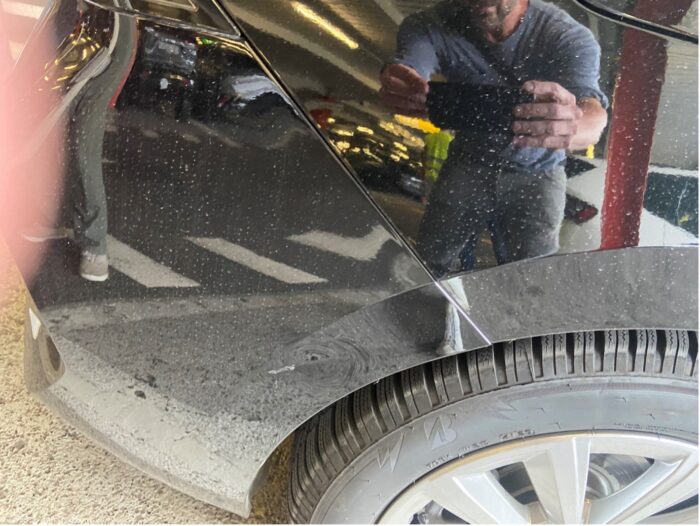
Just as we were about to leave the desk, a few workers for the car hire firm approached me to say there was an issue: they had found a small, almost imperceptible dent on one of the car’s rear wheel arch panels, which they were only too eager to point me towards and tut over.
This took me by surprise. We had barely used the car while in Avoriaz and certainly hadn’t had any incidents on the very few occasions it had been in use, including the two trips to/from the airport.
The car had spent most of the week parked in the exact same spot in an outdoor car park, though the position it had been parked in in relation to the dent and fact that the car park itself was hardly busy meant it was surprising to think our rental had been the subject of a hit-and-run, put it that way.
I had the distinct impression I was being done over. But in my hurry to get on the road when I picked up the car at the airport one week prior, I had completely forgotten to take any photos or videos of the car that could have put the matter to bed. As the chap behind the counter was quick to inform me, this meant I was completely bang to rights.
Luckily, I had taken out car hire insurance to cover the excess. I had done this before the holiday to avoid the inevitably aggressive sales tactics used by staff at the pick-up desk to sell damage waiver cover. The policies sold by the rental desk often cost more than the rental itself and can turn a bargain car hire into a rip-off.
The much cheaper policy I took out covered my excess but my credit card was still going to be pinged to the tune of four figures before I could even start the claims process.
If this was a blow, made worse by strongly suspecting the car rental desk had pulled a fast one on me, then my mood turned distinctly sour after boarding the plane itself.
After sitting on the plane for two hours with no real clue why we were being delayed, the pilot abruptly announced over the tannoy that the flight was hereby cancelled. There was a storm developing over Heathrow that meant it might be unsafe to travel, he declared.
We would all have to disembark and speak to the agents at the desk back inside the terminal to work out our new travel plans, the pilot said.
Cue the obvious mayhem as all the plane’s passengers looked to race back to the terminal to get in line as quickly as possible – a race that families with young kids such as ourselves were hardly likely to win.
Needless to say, four hours of queuing later, we were informed by one of only two agents dealing with all the claims that we had been put back on the next available flight back to London. Only in our case the next available flight wasn’t until 8pm the following evening and wasn’t even direct, instead involving a stop in Frankfurt.
Although more or less everyone else on our flight we spoke to had been put on a direct flight later the same night or the next morning, we had been put on an indirect flight around 24 hours later – despite us having both a four-year-old and a late 70s-year-old (my partner’s dad also holidayed with us) in tow.
Protests at the desk and to the airline on the phone proved futile. We would have to spend the night in a nearby airport hotel – mercifully organised and paid for by the airline, at least.
Of course, by the time we got to the hotel after midnight, they had stopped serving food, which meant another long wait for an Uber Eats delivery (all nearby restaurants had long since shut), meaning it was after 2am until we finally got to bed.
The next day we decided to explore Geneva, decamping in a small restaurant by the lake for much of the afternoon. And very pleasant it was, too, though I’m not sure anyone particularly relaxed with two evening flights ahead of us.
But this time, at least, our flights left more or less on time, though it wasn’t until the early hours of the following day until we finally got home.
Last year, we decided we could do without the inherent travel hassle of an overseas summer holiday, preferring to stay in the UK instead, and it’s fair to say that, more than once while holed up in Geneva, my partner and I looked back rather fondly at our staycation.
Maybe Blighty in the summer isn’t so bad after all.
Spot the dent
Crypto Corner

Sam:
There’s one simple thing on the subject of crypto I want you to do this month. And that’s to read one of our latest reports, “The Critical AI Component: A $25 Trillion Component”.
That’s because one of the most important things in crypto I want to highlight this month is why bitcoin miners like Hut 8 are turning to AI – and the reason the two can happily exist.
I also want to reiterate why a company like Hut 8, and our other bitcoin miners for that matter, are far more than just bitcoin miners. With a long runway we might actually be looking at the epicentre of AI infrastructure.
What else we’ve been looking at this month
James:
A new reason to invest in clean energy stocks
A recent study has revealed a surprising incentive to invest in clean energy stocks that isn’t related to addressing climate change. In short, clean energy stocks can act as a hedge against other portfolio losses, the study claims.
According to the study by researchers at Pusan National University in South Korea, clean energy stocks can provide a cushion during the bear markets that the broader stock market experiences from time to time.
Consequently, a stock portfolio with a substantial portion allocated to clean energy stocks may offer similar long-term performance to a broad-market index fund but with reduced volatility – a win/win combination.
“Investors seek to protect their portfolios from volatility by diversifying with assets that don’t follow the same trends as traditional stocks,” said professor Sang Hoon Kang from Pusan National University, who led the study.
“Clean energy assets are promising for this purpose because they are influenced by different factors, such as government policies and technological advancements in renewable energy.”
You can read Science Daily’s report on the study here and an abstract of the full findings in journal Energy Economics here.
China reports record levels of silver imports
Some commodity investors have an investment philosophy that goes something like this: let’s just front-run whatever China is buying.
Right now, China is buying silver hand-over-fist.
In fact, Chinese imports of silver are now at record levels, as this chart from Tavi Costa, a partner and portfolio manager at Crescat Capital, shows:
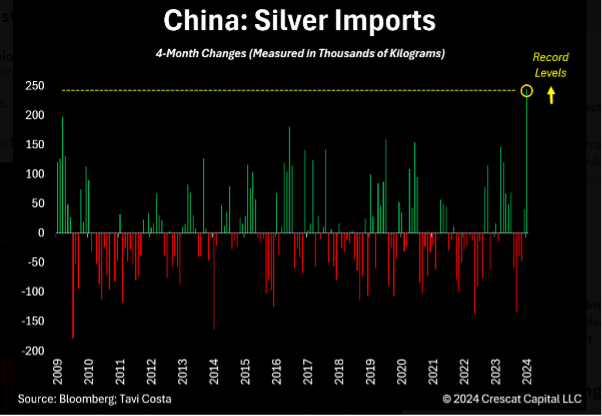
What China is up to, it’s hard to say. But it’s clear it has been strategically increasing its silver reserves. The Shanghai Metals Exchange has seen a significant rise in silver trading volume, with prices consistently higher than those on Western exchanges. This certainly suggests that China may be deliberately driving up the price of silver to drain the West’s resources.
Certainly, growing demand for silver coupled with limited supply could lead to a “silver squeeze” of the like last seen in 1980. If investors begin to panic and rush to buy silver, the price could skyrocket – good news for our holding of SilverCrest Metals for sure.
An outstanding presentation on batteries versus hydrogen
I’m hugely excited by the advancements in, and impacts of, battery storage. So I really enjoyed this recent presentation by Gerard Reid, a founding partner at Alexa Capital, on “Batteries versus Hydrogen” at Ecosummit Berlin 2024.
Gerard is a market contact who contributed to our Beyond Oil series at Southbank Investment Research a few years ago, so I can certainly vouch for his expertise on the topic.
Here, Gerard talks astutely on the impact of batteries’ declining costs, the lost decade in hydrogen and how all those “maybes” in the sector became “no” and the multiplication of innovation impacts (and scale) in battery storage. This is definitely worth 15 minutes of your time. Enjoy!
Sam:
Durov faces his day of reckoning
Where does the line exist for what a CEO or founder of a tech company is responsible for on the platform they created and run.
Ross Ulbricht is doing life for his role in The Silk Road.
Pavel Durov was recently arrested in France for a long list of things on Telegram.
Yet Mark Zuckerberg walks free, even though we know some of the atrocities that have taken place on Facebook.
Where does the line stand? Is there even a line, or is it more about who can bend the knee for those who pull the strings of the law?
Maybe what’s happening to Durov is the start of something far more sinister, authoritarian, and ultimately terrifying in Europe.
Ozempic’s poster town
I’ve been tracking the rise of weight-loss phenomenon Ozempic for a while now. And it’s transformed the fortunes of Novo Nordisk.
It’s also led me onto a bunch of stocks that are in the midst of developing the next Ozempic – stronger, more effective, easier-to-take compounds that work better, and are potentially even more beneficial for the treatment of obesity and related diseases.
Still, that’s another thing for another day.
But it all does start back with the rise of Ozempic, and in the US this article is one of the best illustrations of what’s going on, who’s benefitting from it all, and what the future could shape up like in an Ozempic-abundant world.
Dr Phil and Trump
Yep, it’s about as straight forward as it gets.
Dr. Phil and Donald Trump, head-to-head. Fascinating watch. Simple as that. Worth a watch regardless of your views on either of these two.


James Allen and Sam Volkering
Editors, Southbank Growth Advantage