Your November issue of Southbank Growth Advantage
28th November 2024 |
- The breakthrough tech tackling power-hungry AC and water scarcity
- Big breakthroughs
- Buy List update
- Inside the lives of James and Sam
- Crypto Corner
- What else we’ve been looking at this month
The breakthrough tech tackling power-hungry AC and water scarcity
The managers at China’s Yutong Bus Company were baffled.
They had started to notice that the power consumption of its buses would sometimes spike through the roof – even on days when its buses merely inched along Shanghai’s streets.
On other days, the buses’ power consumption would return to normal, seemingly for no reason at all. The spikes in consumption were having a material effect on costs, so the managers desperately searched for answers.
In their quest for help, they decided to look overseas, tasking a US engineering firm called Montana Technologies to get to the bottom of the mystery.
On arrival in Shanghai, the US team got to work.
One of the first things they did was to start clamping electricity meters onto different parts of a Yutong bus. When the engineers looked at the results, they noticed that power consumption would spike as soon as the driver of the bus turned on the air conditioning.
Montana discovered that the bus company hadn’t been monitoring their buses’ AC systems at all.
You see, the answer to Yutong Bus Company’s puzzling, inexplicable spikes in power consumption was entirely due to AC. In Shanghai’s hot and humid weather, air conditioning was causing massive energy spikes for Yutong Bus Company.
This eureka moment not only solved the Yutong Bus Company mystery, but also led to a breakthrough technology that is now taking on two separate hundred-billion-dollar industries.
Of course, in hindsight this must have seemed wholly obvious to the managers at Yutong Bus Company.
Every time someone adjusts the air conditioning to cool their room or lowers the temperature by a degree or two, energy consumption spikes – often significantly.
In humid conditions, air conditioners face an even greater challenge, with over half of their energy usage dedicated to dehumidifying the air rather than cooling it.
This is entirely inefficient, especially when put in context of cooling’s enormous impact on power consumption. Cooling consumes a staggering 10% of the world’s energy, accounting for 20% of all energy used in buildings.
What’s more, as the world warms, the demand for cooling is set to steadily increase. Indeed, the International Energy Agency predicts that demand for cooling will surge over the next 25 years, with air conditioners in two-thirds of the world’s households by 2050.
In some regions, of course, air conditioning is a necessity. In hotter climes such as China, for instance, cooling systems are crucial for daily life and work. However, many current air conditioning units operate at only about 20% of their theoretical maximum efficiency, highlighting the need for improvements.
It is, therefore, crucial to find ways to reduce energy consumption for air conditioning overall.
Observing buses grappling with China’s muggy weather sparked an idea for the team at Montana Technologies: if they could improve the efficiency of dehumidification, they could revolutionise air conditioning as a whole.
Inspired, they returned to the US, determined to find a solution.
This simple insight gained in China has led Montana to innovate a much more efficient dehumidification method that in turn makes air conditioning much more energy-efficient.
After years of research and development that followed the trip to China, Montana developed a breakthrough material, a highly porous substance called a metal-organic framework (MOF), used in its new dehumidifier system, AirJoule.
This moisture-loving material – which comes in a special powder – coats components inside the AirJoule module. The pores of the coating are sized so that they snugly fit around water molecules, meaning it can absorb up to 55% of its own weight in water vapour, making it a powerful drying device.
Behind the breakthrough tech
In the company’s words, “AirJoule utilises a Metal Organic Framework (“MOF”) and a dual-chamber vacuum system to produce dehumidified air and pure, PFAs-free, distilled water from ambient air, which are key inputs for a variety of industrial processes.”
This needs a little unpacking.
Firstly, MOFs. These are an exciting new material that’s been under development for years now. However, AirJoule is the first company to use it in a commercially viable product that we’ve seen.
They are essentially like custom metal sponges, where passing air or water though them, they have significantly greater surface areas exposed to the water/air stream for adsorption.
There are many applications for sorbent materials, which can extract desired or undesired chemicals from streams of a gas or liquid which pass over them.
For example, direct air capture (DAC) uses them to extract CO2 particles from the air or from waste gas streams. Or you might be familiar with direct lithium extraction (DLE) which tries to gather lithium from brines faster than evaporation ponds using a similar concept.
But MOFs are not a simple surface. Their sponge-like construction dramatically increases the surface area contact between the source fluid and the adsorbent material. This increased contact area means they can extract greater volumes of the desired molecules.
They are used to coat the contact surface, and their extraordinary surface area allows for very thin coating and high capacity of water vapor adsorption.
MOFs have been an exciting concept for a while, but one key hurdle held them back: heat. The process was generating too much of it, and this raised cost in the form of energy loss.
AirJoule’s key breakthrough was to combine the ad- and de-sorption functions (collecting and releasing the water), so that the heat generated by adsorption could be used to assist the desorption process. This is a key source of its technological edge.
Secondly, the quote above mentions PFAs-free water. PFAs are harmful chemicals that through industrial and consumer product use have seeped into the water cycle. It’s estimated that 50% of drinking water in the US is polluted with PFAs.
The fact that AirJoule’s process produces PFA-free water is a definite plus. It’s an issue that’s gaining recognition due to PFAs’ widespread harmful effects, cited by the EU’s Environment Agency as: liver damage, thyroid disease, obesity, fertility issues and cancer.
So the tech really is promising and technologically impressive, but how does it actually work?
The AirJoule system comprises two chambers, each equipped with surfaces coated in this specialised material designed for dehumidification.
These chambers operate in tandem, taking turns at dehumidifying a flow of air. While one chamber actively dries the air passing through, the other releases the moisture it previously collected.
A small amount of heat from the active drying chamber is applied to the saturated coating in the other, aiding in the removal of water. Every ten minutes or so, the chambers switch roles. It’s this combination of processes and reuse of heat that I described earlier.
Although this process doesn’t cool the air, it enables the delivery of dry air to a traditional air conditioning system, significantly reducing the energy required for cooling. By alternately dehumidifying incoming air, the system cuts overall energy consumption.
So through new materials and a key structural breakthrough, AirJoule’s tech is on the path to competing on efficiency with the biggest players in cooling systems.
Solving soaring demand for energy-hungry AC and water scarcity
But what’s exciting is that this transformative climate technology is solving not just one climate problem but two: soaring demand for energy-hungry air conditioning and water scarcity.
You see, the AirJoule generators isn’t just an energy-efficient system that dehumidifies air; it also harvests water from both humid and arid atmospheres to produce pure distilled water – and this is actually the first, immediate focus of the company.
That’s because the AirJoule uses MOFs to extract water from the air. This process produces pure, distilled water as well as dehumidified air, which could address global water scarcity issues by providing a sustainable source of water. To re-release that water, a vacuum pump is used to lower the pressure.
The company’s technology has recorded sufficient performance to work even in low-humidity environments.
The key metric is how much power a system uses to produce a litre of water.
According to AirJoule, it has a “very clear line of sight to reducing our energy usage to below 200 watt-hours per litre,” potentially reducing dehumidification energy needs by up to 80% compared to conventional methods.
Getting below the 200 mark is key in unlocking the markets the company wants to target, which we’ll talk about in more detail later.
In the company’s words:
Compared to desiccant-based systems, which are the current state-of-the-art incumbent technology for many water harvesting and industrial dehumidification systems, AirJoule uses significantly less energy…
AirJoule is more than twice as efficient as desiccant systems on a watt hour per litre basis. Further, AirJoule harvests pure distilled water, whereas conventional desiccant systems simply vent the humid air into the atmosphere. Our superior efficiency is driven by revolutionary sorption process that allows us to utilise internal heat from the system, eliminating the need for external heat.
As you might know, clean drinking water is increasingly scarce.
The World Resources Institute estimates that at least half the world’s population lives under highly water-stressed conditions for at least one month of the year. The UN forecasts that the global urban population facing water scarcity will double by 2050.
AirJoule technology turns the challenges of humidity into an opportunity by harvesting water from the air to produce pure distilled water. This distilled water is needed by a wide range of industries including semiconductors, pharmaceuticals, green hydrogen and, in the age of artificial intelligence, data centres.
It is this latter market that is increasingly exciting for AirJoule. In its latest quarterly call, it said, “At scale, our goal is to make data centres water positive”.
AI data centres send water demand soaring
You see, while discussions surrounding AI and technology often revolve around energy consumption, an aspect that warrants equal attention is water usage.
The operation of data centres, integral to the functioning of AI systems, relies significantly on water for cooling purposes. That includes for cooling towers, chillers, pumps, pipes, heat exchangers, condensers, and computer room air handler units.
The average data centre uses 200,000 gallons of water/day, roughly equivalent to water use in 100,000 homes.
Data centres source most of their water from municipal water systems, meaning they can cause stress on local water sources. In fact, about a fifth of data centres in the US rely on watersheds that are already under moderate to high stress from drought and other factors.
What’s problematic is that AI factories already need 3-4x the water of traditional data centres, especially as AI factories are growing in both size and volume around the world. OpenAI wants to build several 5GW data centres – each one as big as Microsoft’s entire data centre capacity currently.
That means a single data centre would use 13 billion litres of water a year.
According to UC Riverside, global AI data centres could use 6.4 trillion litres of fresh water by 2027.
No wonder data centre water consumption has already begun causing protests, especially in places with rising water scarcity.
A Google data centre in Uruguay planned to use 7.6 million litres of water a day – as much as 55,000 people. As a result, Uruguayans staged protests.
In 2023, Microsoft and Meta consumed a combined 10.9 billion litres of water – water that effectively evaporated from public supply.
All the while, these same Big Tech companies have announced commitments to be “water positive” – i.e. replenish more water than they consume – by 2030.
Microsoft’s data centre strategy targets reducing water intensity by 40% by 2030, replenishing more water than it uses and breaking the relationship between AI growth and consumption.
Meanwhile Google has a water replenishment target of 120% of water it consumes across its offices and data centres by 2030, while Amazon Web Services aims to achieve water positivity by 2030.
But it’s not clear how these same companies will be able to do that when there’s simply not enough water.
The deployment of AirJoule in data centres could certainly reduce stress on municipal water systems caused by data centres, providing cost effective and scalable water harvested from air.
That’s because the AirJoule system provides independent and reliable access to water, reducing dependency on existing infrastructure and addressing water scarcity.
According to the company, AirJoule’s water harvesting capabilities “far exceed” the performance of other competing technologies. It is now engaging with prospective customers on use cases where AirJoule can reduce costs or improve industrial processes through its water harvesting capacity.
Deploying Airjoule for water production
In August 2024, the company announced two agreements for the deployment of AirJoule for water production in water-scarce regions of the world.
Firstly, it signed a Memorandum of Understanding (“MOU”) with Dubai-based TenX to leverage AirJoule’s water harvesting capabilities to enhance water security and energy sustainability in the United Arab Emirates. The company and TenX will explore options to deploy AirJoule units with initial installations focused on critical infrastructure and community water needs.
The company is also collaborating with Australia-based CIC on the development of its solar-powered hydrogen production modules.
Using AirJoule to supply water, CIC’s modular hydrogen production units will seek to produce green hydrogen using Australia’s plentiful solar resources. This collaboration is the first step towards deploying AirJoule to support renewable hydrogen production in the medium term.
Additionally, the company is developing a military application of the technology for the US armed forces – designed to extract drinkable water from the air, a valuable resource for troops in desert environments.
HVACs are a bigger market, at $350 billion, but it’s in the $100 billion water opportunity that the company has seen the most immediate promise, with multiple available end markets identified even at this early stage.
Partnerships key to commercialisation
AirJoule has had an incredibly busy 2024 with a listing, a name change from Montana Technologies to “AirJoule Technologies Corporation” and a joint venture. It would be useful to quickly pause for a second and run through the key corporate milestones this year.
The company was only founded in 2019, and has just 38 employees, of which only 15 are full time, and many joined over the last 12 months.
2024 timeline:
January – partnership with Carrier. Carrier committed $10 million in growth equity to what was then a private company, Montana Technologies, to foster commercialisation of AirJoule technology.
February – separate joint venture (JV) created with GE Vernova, which added key sorbent materials.
April – listing via SPAC in combination with Power & Digital Infrastructure Acquisition II Corp. This raised more than $40 million from GE Vernova, and Rice Investment Group, on top of Carrier’s previous commitment. Following that was another private placement, which raised $12 million for the company, taking its cash pile up over $30 million.
November – name change from Montana Technologies to “AirJoule Technologies Corporation”.
Now, looking forwards, there is a long path to commercialisation ahead. For investors, every step is both a risk and an opportunity. Each event will bring volatility – with gains if the company is executing at a high level, and losses if they are not.
Currently, AirJoule remains in the prototype and testing phase, with preproduction units being assembled for evaluation by potential customers and partners.
Partnerships are highly relevant for such early-stage companies. The timeline above highlights a JV with GE Vernova (GEV). GEV had proprietary sorbent materials which came as part of the deal, and it was this JV which triggered the public listing via SPAC. This advanced AirJoule’s technology, saving it years of R&D and plenty of capital, too.
Another key partnership is with Carrier. AirJoule granted Carrier the exclusive right to commercialise its technology into HVAC equipment in the Americas for a period of three years. This gives away a portion of the value created to a middleman, but brings its commercial timeline a huge leap forwards.
In addition, Carrier has conditionally committed $10 million in growth equity to AirJoule for commercialisation, and elected its chief strategy officer to AirJoule’s board.
Finally, it is working with BASF on the supply of MOFs, and CATL is also a large investor.
The company is working towards delivering its first commercial-scale preproduction units in mid-2025, and entering full commercialisation the year after.
Two huge markets that are ripe for disruption
As mentioned, AirJoule’s two main applications at this point are water security and cooling systems. The company estimates the water harvesting market as a $100 billion opportunity. The estimated market size for air conditioning is around $350 billion.
In order to consider them actively targeted markets, though, it is critical that the technology advances. Scale will help this, but the company is also tweaking and refining every element in the current pilot modules, to reach that golden 200 watt-hours per litre mark. Only then does the total addressable market (TAM) include the full scope of the $450 billion number. For now, this TAM is a conditional projection.
The integration of AirJoule into HVAC systems offers improved efficiency and reduced reliance on traditional refrigerants. This not only cuts down on energy costs but also supports global efforts to reduce greenhouse gas emissions.
HAVC systems are currently an impressive solution to mankind’s temperature regulating needs. But with AirJoule, they could lower the energy costs of air conditioning by 50-75%, according to leading energy consultancy ThunderSaid.
AirJoule is currently just seeking to make certain components for HVAC systems, not the entire things, which is a highly complex and competitive market beyond its current scope.
In terms of geographies, the company is focused on its North American home market, but also regions like the United Arab Emirates, where water scarcity is a pressing issue. There, AirJoule’s ability to generate water from the atmosphere is particularly valuable, which explains why it recently opened a new Middle East office in the UAE.
A look at the books
Of course, a study of the financials and risks are always essential. However, in this case, there are very few financials to speak of. As an early-stage technology developer with no revenues, it’s mainly the level and uses of cash that we can look at.
As of last reporting data, it had $30.7 million in cash on the balance sheet (with another $7.3 million at the JV level, which is incorporated into the financial statements separately). That’s down from around $45 million total a quarter earlier.
Stripping out capital raises, it has spent around $4.33 million per quarter over the last 18 months (six quarters). That would in theory give it around two years of cash runway. This is in line with the company’s view of its own cash burn rate.
However, commercialisation is expensive and it needs to reach a much larger scale, so expect costs to increase. It would also need to raise new funding well before it reached $0 in the bank. Therefore it’s entirely possible we’ll see it tap equity or debt markets within the next 12 months.
Financing is hard. It is a tricky environment at the moment, with high interest rates and mixed market sentiment. It will also lead to either higher interest expenses or shareholder dilution, neither of which are positive on their own.
However, start-ups like these need capital. Even if the terms or timing aren’t perfect, a large financing package could well see a positive reception, as it would massively increase AirJoule’s chances of scaling up. So financing is both an opportunity and a risk, and that’s a consistent them in the rest of the risk analysis.
AirJoule is high risk
Of course, any SPAC should make alarm bells ring. That’s given how poorly many of them have performed since 2021, and what bad press so many of them have received for their financial structure and weak governance procedures.
Plus, given that AirJoule is a pre-revenue company planning to go up against established competition with a relatively recent and not fully developed technology, it must be stressed that this is a high-risk opportunity.
While the market sizes for water generation and HVAC systems are attractively large, that’s because large incumbents already exist. They will not be easy to disrupt.
There are also many years of technological hurdles before the product is ready. Then there is the operational challenge of scaling up year after year without prior experience, and the commercial difficult of marketing your product to customers with exiting deals in place with incumbents.
As discussed, the addressable market is only of an exciting size if these technological breakthroughs are achieved.
None of these are ever easy, especially not for new young companies.
Funding will be a key risk, as the $30 million currently sitting in the bank can evaporate faster than its own technology can re-condense it. Commercial scale will require further capital inputs over the coming years, as even if first revenues appear without new capital, positive cash flows could be years behind that.
However, funding, first revenues and later, positive cash flows are all hugely positively milestones which could lie ahead. These are very serious risks, but if the management team can execute well enough, fast enough, the markets will reward catalysts like these.
With all these risks, one thing we definitely wanted to see before recommending the company was some stability and positive momentum, and now we think we’ve reached the right moment.
With momentum picking up, it’s time for us to get in
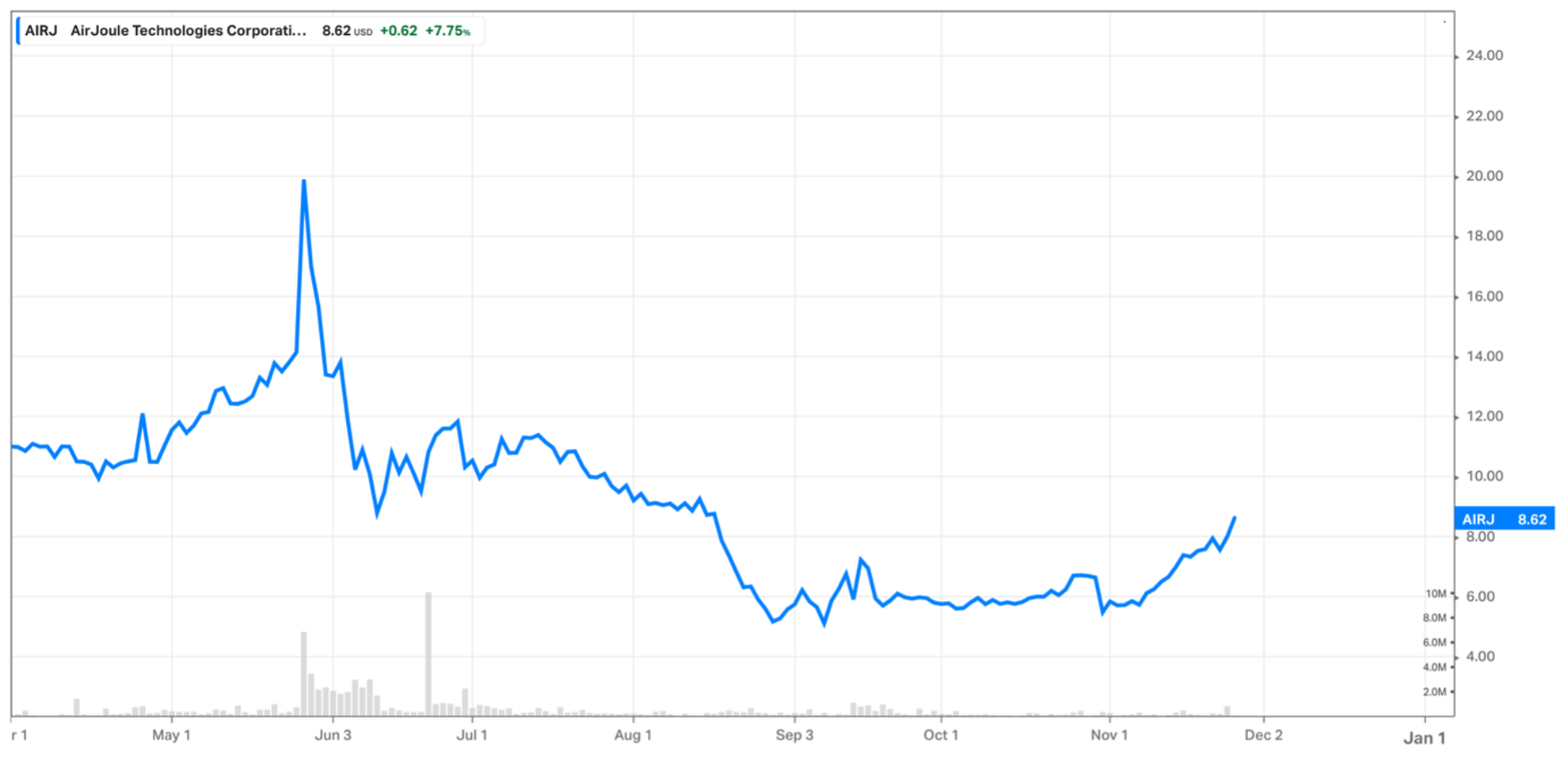
Shortly after its SPAC, it showed a surprising liveliness for a corner of market now highly distrusted. It spiked sharply, but then did fall back to around $6, below its $10 list price. Now, having consolidated, it is showing lower volatility and recent strength.
 Source:
 What’s exciting is that CEO Matt Jore more than doubled his exposure to the company’s share price very recently, on 14 November. This is a good sign, especially as it was shares not options. It isn’t clear if he bought or was granted them, but he added 4.7 million shares, on top of a 3 million existing position. In total his stake is now worth over $60 million, at a share price of over $8/share.
There are over 2 million convertible securities outstanding on a total base of around million, which is not an unreasonable ratio at this point.
With a few months of stability behind us, and years of commercialisation milestones ahead, we think prices around $8 mark a good entry point.
Action to take: buy AirJoule Technologies Corporation
Ticker: AIRJ
ISIN: US6121601016
Market cap: $442 million
52-week high/low: $49.11/$4.94
Buy up to: $11
Big Breakthroughs
Breakthrough tech: Optimus or Figure 02 in your house?
Sam:
I recently moved into a new house. In doing so, there’s now a list as long as my arm of things that I need to get done.
Fencing, some doors, painting… oh, the painting… cleaning and clearing. Just a whole bunch of stuff I want and need to get done.
Also, I’ll be honest with you: I’m not what you’d call a handyman. Sure, I can change a tap, light fixtures, lay a bit of flooring – relatively easy things. But overall, I’m more of an “outsourcer”.
And let me tell you this, if you think trades are expensive in the UK, you should see the cost of trades in Australia!
By the time I get everything done I need to, I’m pretty sure I could have covered the cost of a robot to do it for me… and then keep the robot at the end to help with ongoing things around the house.
As ludicrous as that may sound, in 2025 this may be the cost trade-off that people are being made to finally consider.
That’s because the speed in which AI and robotics is moving right now means that in 2025, we may see the commercial sale of humanoid robots to the general public.
Imagine that… a robot that stands 5’8” kicking about the house helping with general day-to-day things, and then the not so day-to-day things (like clearing the gutters, which typically we only remember to do when it’s peeing down with rain, and we realise they’re completely blocked with leaves!).
Then as these robots get upgrades and their software improves, there’s the potential to upload a set of instructions to them (such as a complex IKEA assembly) and then just let them do their thing.
Let’s go back to my example of getting a fence done. I could source all the panels, posts and concrete needed, upload the boundary I need to get re-fenced along with the installation standards to meet building code, then let the robot crack on with it.
A decade ago, this probably sounded too far-fetched to become reality. But we now sit at the dawn of humanoid robots in the home – and from where I sit, it’s an inevitability that this is the future and not just a possibility anymore.
This isn’t just my take on it either. Earlier this year at Nvidia’s GTC developer conference, in his keynote, CEO Jensen Huang showed off a number of these humanoid robots when announcing Nvidia’s General Robotics 0 0 Three (GR00T) project to give people an idea as to just how close we are to this future:
 Source:
 But what are some of these companies that are on the verge of selling humanoid robots into the consumer market?
Optimus, Figure 02 and Iron
There are three likely candidates that could deploy a humanoid robot as a consumer device in 2025. Two that are investible.
Tesla (NASDAQ:TSLA), Figure and XPENG (NYSE:XPEV).
Each of these (as you’ll see) has a very similar offering, sparking the beginning of the human x robot future.
Let’s start with the biggest, most headline worthy and famous… Tesla’s Optimus.
Elon Musk has been touting his robot for a while. In fact, it was first announced in 2021 at the company’s “AI Day”. In 2022 he went on record saying production could start “next year” (2023).
Clearly that didn’t happen. But the chance of it happening in 2025 are much better. We’ve seen ongoing development videos, and public outings of Optimus, but perhaps the thing that signifies just how close it really is, is Kim Kardashian.
That’s not some obtuse segway. I mean that recently Tesla delivered to Kim Kardashian’s house one of Telsa’s CyberCabs as well as a gold Optimus robot.

Source: @KimKardashian via X.com
While this might seem a tad silly, you need to remember Kim K is one of the most famous people on earth. Her social reach is paramount here to the realisation and acceptance of a humanoid robot in society.
Elon says Optimus could retail for around half the price of a car, or around US$20,000 to $30,000. Which if it lasts as long as a car, and proves to be exponentially more useful, might be reasonably good value for money.
As I say, Tesla is not the only player in this space.
Figure is a robotics company that is developing its own humanoid robots for use in key areas of industrial, manufacturing, domestic and interplanetary markets.
Or as Figure puts it:

Source: Figure
It’s already pushing forward at full speed, with deployments of its latest “Figure 02” robot in manufacturing, such as car assembly lines with BMW:

Source: @adcock_brett via X.com
In a recent podcast, Brett Adcock (Figure’s founder) said, “I would within the next three years, we’ll definitely have robots piloting at homes.”
Adcock estimates the Figure robot for the home will also be in that $20,000 to $30,000 range.
Then there’s XPENG’s latest release, the Iron. This is aimed squarely at both Tesla and Figure. We know it’s aimed at these two because XPENG has long been accused of copying Tesla in the automotive EV market. Even now Iron is being accused of copying… by Figure’s founder, Brett Adcock:

Source: Brett Adcock via X.com
And yes, all three robots are about five foot eight-to-ten inches tall, all weigh about the same and have similar degrees of freedom. In short, you can clearly see a bit of tomfoolery in designs from one maker to the other.
Nonetheless, this is but three of many companies developing humanoid robots all with intent on getting them into the home.
I think that’s coming late 2025. That is also likely to mean that 2025 could be the year where we see the robot theme well and truly reflected in stock opportunities too. Maybe Tesla, maybe XPENG, maybe Figure launches an IPO. And that’s something we’ll look at too.
But this is a big, game-changing technology trend that will reshape society and how we interact with machines, AI and the world around us.
Buy List update
Global X Lithium & Battery Tech UCITS ETF (LSE: LITG)
Global X Lithium & Battery Tech UCITS ETF has gained by 2% over the month to trade last at around £6.33 at the time of writing, putting it around 30% below our £8.96 entry price.
The ETF allows investors exposure to the lithium and battery sectors.
It seeks to provide returns similar to those of the Solactive Global Lithium Index by holding shares in a broadly diversified cross-section of industries that range from lithium miners to battery producers, all the way to the producers of electric vehicles.
By owning mining, refinery and battery production companies in the fund, Global X has its fingers in multiple parts of the lithium industry.
Although lithium prices hit a three-year low during Q3, industry analysts expect a rebound by year-end amid forecasts of increased demand for electric vehicles (EVs) in the fourth quarter of 2024. September’s EV global unit sales number rose to 1.7 million, a new high.
The ETF remains a HOLD in the portfolio while the market finds its feet.
Central Asia Metals (AIM: CAML)
Central Asia Metals has lost around 7% over the last month to 164.40p at the time of writing, still leaving it around 40% underwater in the model portfolio.
The company operates Kazakhstan’s Kounrad copper mine and the Sasa lead-zinc asset in North Macedonia. The Kounrad mine, in particular, remains one of the lowest-cost copper producers globally, with C1 cash costs of $0.78 per pound.
It trades at a forward price-to-earnings (P/E) ratio of just 9, with a price-to-earnings growth (PEG) ratio of 0.3 – well below the benchmark value of 1. Central Asia Metals also offers an impressive dividend yield of 9.6% this year.
What’s more, the company maintains a robust balance sheet with $56.3 million in cash and no debt. It is generating healthy EBITDA margins of 72% at Kounrad, and Sasa’s new methods extend the mine life to 2039. It is also continuing to search for transformative acquisitions.
Certainly, the future outlook appears promising, especially given forecasts of rising demand for copper.
Global copper consumption is expected to climb by 30% between 2023 and 2035, according to McKinsey & Company. Meanwhile, supply is likely to fall short due to delays in new projects and declining production from existing mines.
However, despite this, copper prices have fallen sharply in the second half of 2024 amid intensifying demand worries, taking the stock down with it. This downtrend could continue if core economic data from the US and China continues to underwhelm.
With the stock still showing short-term volatility, let’s keep the stock as a HOLD for now.
Volt Lithium (TSXV: VLT)
Volt Lithium, which entered the Southbank Growth Advantage on 2 August at C$0.37, has fallen by 32% over the past month to trade last at C$0.28, putting it 24% down in our model portfolio at the time of writing.
The company has developed proprietary direct lithium extraction (DLE) technology aimed at extracting lithium from North American oilfield brines, contributing to a secure critical minerals supply chain for the region.
The stock has fallen after the company first announced and then closed a public financing and concurrent private placement that saw it raise approximately $6.5 million. The funds were raised by selling units that include common shares and share purchase warrants.
The price action seems brutal for what was a relatively small raise but, unfortunately, that seems typical of the Canadian capital markets currently and how small companies are treated.
Although it’s unfortunate for the stock price, at this pre-revenue stage, raising cash is needed for Volt. But now it has enough cash to continue developing the direct lithium extraction (DLE) technology and improve operating efficiencies and scale-up operations at the field unit.
We certainly expect this to be the last raise, with the company set to become cash-flow positive in H1 2025.
Earlier in the month, Volt announced it had been continuously optimising the modular US field-unit with modifications and process improvements, significantly reducing the processing extraction time from four hours to just 30 minutes.
This sets the stage for commercial production in the range of 5,000 to 10,000 barrels per day of brine production by the end of 2024.
In addition, most recent results in the field have demonstrated up to 75% lithium extraction rates within a 10-minute lithium extraction cycle time – an improved cycle time that will allow Volt to significantly increase throughput capacity in its operations in the Delaware Basin in Texas.
This is hugely exciting. The brine production from the Permian Basin today is approximately 19 million barrels/day, representing an estimated potential of 325,000 tonnes per annum of lithium carbonate production. This will ensure a continuous supply to Volt’s DLE unit.
Certainly, I’m looking forward to an exciting 2025, with the commercial unit expected to be ready by mid-2025.
The stock remains a BUY under its buy limit of C$0.50.
Newmont Corporation (NYSE: NEM)
At the time of writing, Newmont Corporation, the world’s largest gold miner, is trading around $42.50, 12%down on the month. The stock is now 35% below our $65.39 entry point.
Newmont has agreed to sell a big gold mine in northern Canada for $795 million in cash, continuing its aggressive divestiture strategy.
The transaction involves the Éléonore mine, located in Quebec, which will be sold to privately owned UK-based Dhilmar. This sale is part of Newmont’s broader effort to streamline its portfolio following its acquisition of Newcrest last year.
The sale boosts Newmont’s gross proceeds from asset sales to an expected $3.6 billion, far surpassing its initial target of at least $2 billion from divesting non-core operations. This divestment is the second major sale of a Canadian asset by Newmont recently, following the agreement to sell the Musselwhite mine to Orla Mining for $850 million.
Proceeds from these transactions will bolster Newmont’s financial position, supporting its shareholder return initiatives, including a $3 billion stock buyback programme. To date, $1.1 billion worth of shares have been repurchased under this plan, with additional asset sales likely to provide further capital.
The company has announced plans to offload a total of six operations and two projects spanning its Australian, Ghanaian, and North American portfolios. With definitive agreements in place for four operations and one project, Newmont aims to finalise the sale of its remaining North American non-core assets by the first quarter of next year.
Rising gold prices, which have hovered near record levels in recent months, add a favourable backdrop to these developments. Newmont also anticipates its strongest production volumes for the year in the final quarter, aligning with its strategic efforts to optimise its asset base.
Newmont remains a BUY under $100.
Prysmian Group (IL: 0NUX)
Prysmian Group remains 30% up in the model portfolio despite falling 9% over the past month to around €62.50.
At the end of October, the cabling giant reported robust financial results for the first nine months of 2024, marked by a 9.6% increase in adjusted EBITDA to €1.409 billion and a net profit rise to €619 million.
The company’s profitability was bolstered by strong performance in its Transmission and Power Grid segments, alongside the successful integration of Encore Wire, leading to improved margins across its operations.
The cabling giant continues to proceed with its share buyback programme that involves a maximum of 8 million shares, equal to around 3% of the company’s share capital.
As of 22 November, the company had purchased a total number of 4,469,621 shares for a total consideration of €274 million.
The stock remains a buy under its buy limit of €60.
SilverCrest Metals Inc (TSX: SIL)
SilverCrest Metals, recommended in the May issue of Southbank Growth Advantage at C$12.55, has fallen 4% over the last month to trade last at C$14.30, leaving it 14% up.
The Canadian silver miner has agreed to be acquired by Coeur Mining in an all-share deal valued at US$1.7 billion. This is set to close in late Q1 2025.
In its third quarter of 2024, SilverCrest reported a record performance with notable increases in revenue, mine operating earnings, and cash flow, driven by favourable metal prices and efficient operations. The company’s treasury assets saw a significant growth of 29% to $158.2 million.
Key highlights of the quarter included record revenue of $80.4 million, a 23% increase in mining rates, and a 49% rise in free cash flow per share to $0.24.
Operating cash flow reached $44.2 million, while all-in sustaining costs decreased to $13.72 per ounce of silver equivalent, showcasing operational efficiency.
The stock remains a BUY up to C$16.
Ashtead Technology Holdings PLC (AIM: AT)
Ashtead Technology Holdings was last seen at around 544p, putting it 7.8% down from our recent entry point of 590p.
Ashtead has a history supplying subsea services to the oil and gas sector but has diversified into the fast-growing offshore wind market, specialising in renting out equipment crucial for the operations of installations throughout their lifecycle.
The company’s technology offerings include surveying equipment, sensors and robotics essential for installation, operation, maintenance and decommissioning of assets.
Ashtead Technology has now completed its £63 million acquisition of Seatronics and J2 Subsea, expanding its subsea survey and robotics capabilities portfolio.
According to Ashtead Technology, the deal bolsters the company’s rental fleet by approximately 30% and brings over 100 specialist technical employees into its workforce.
The purchase of Seatronics and J2 Subsea will be Ashtead Technology’s ninth acquisition in seven years, signalling a strategic expansion of its capabilities.
A flurry of M&A deals helped Ashtead see a surge in revenue in its 2023 full-year results, with revenue growing 51% to £110.5 million compared to £73.1 million in 2022.
The stock remains a buy under 700p.
AB Dynamics (LSE: ADBP)
AB Dynamics has been a strong performer for us over the last couple of years. Our view on the demand for its services in automotive testing was correct and we’ve now seen the stock again punch through the 100% gain from our original recommendation.
It has been a bit of a slow grind to get there. But now we feel that we’ve maximised the potential from this that we set out to achieve. We always want more, but a 102% gain is a terrific outcome for the stock.
Action to take: SELL AB Dynamics (LSE: ABDP)
Team17 (LSE: TM17)
With the good comes the bad. And after hitting a high of 315Gbp middle of this year, Team17 has been on a long slide lower. While fundamentally a big player in the development of indie games, this kind of momentum doesn’t look like abating anytime soon.
With recent board changes, it’s increasingly looking like the market is losing confidence in the company’s ability to turn things around. And so are we. After over two and a half years in this position, it has failed to really deliver value for shareholders.
It’s in a sizeable loss for us, but before things get any worse it’s time to cut our losses and exit this position.
Action to take: SELL Team17 Group (LSE: TM17)
Team Internet Group (LSE: TIG)
Team Internet Group has had a very poor second half of 2024. Since July and August where the stock had been trading over 200 Gbp, it’s now lost over half its value from those highs. The largest drop came just a couple of weeks ago when the company released its nine months results to 30 September 2024.
The results were average at best, and there were a few parts in the announcement that have got us a little worried about where the company is heading next.
While it is profitable, that profit is being scaled down for the full year, but one part of note was the comment, “The Board will continue to assess group structure to maximise Shareholder returns.”
The way we read that is expect layoffs, cost cutting, possible divesting of parts of the business… In other words, taking the butcher’s knife to the company to trim it right back because revenues aren’t growing at a rate that justify the operating expenses anymore.
It just doesn’t read right. And while we might now be down on the stock, it beats being heavily down on the stock if things get worse for the company.
We think it’s time to also trim Team Internet Group from the portfolio.
Action to take: SELL Team Internet Group (LSE: TIG)
CleanSpark (CLSK) and Hut 8 Corp (HUT)
Two of our bitcoin mining plays are currently sitting in comfortable profit positions. This is to be expected with the rise in bitcoin’s price and with a pro-crypto government coming into power in the US in about 50 days’ time.
But we can never be too careful with these kinds of stocks; volatility is part and parcel of their nature.
So, with both in a profit for us now, it’s important to protect the downside from here.
We thoroughly expect bitcoin to surpass $100,000 and even $500,000 this cycle, which if that happens, the miners will fly higher too. So, we want to remain in these positions as long as possible to extract that potential.
However, if that doesn’t pan out, we don’t want to take big losses on these either.
We’re lifting the stop exit price on both CleanSpark and Hut 8 to their entry prices. That means if CleanSpark trades at $10.49, we will exit the stock for a 0% outcome.
Likewise, if Hut 8 trades at $12.15, we will exit the stock for a 0% outcome.
Having said that, if these do tear higher, then we want to bank some profits on the way up, minimising capital risk.
If either of these gets to a 200% gain, sell half the position.
That means if CleanSpark trades at or above $31.47, sell half the position.
If Hut 8 trades at or above $36.45, sell half the position.
Armed with these pre-emptive moves, we will look to extract profit from these but also minimise downside if the market turns hard against us, quickly.
Inside the lives of James and Sam

James:
Honest answers only: do health and nutrition supplements have any effect whatsoever?
For the last three months, I’ve taken a veritable cocktail of vitamins and supplements every day – and I still have absolutely no idea if any of them work at all.
I’ve been on somewhat of a health kick since the end of the summer and, curious at what all the mysterious pills and potions on my partner’s side of the cabinet actually did, I decided to try some of them for myself – before buying a few more of my own for good measure.
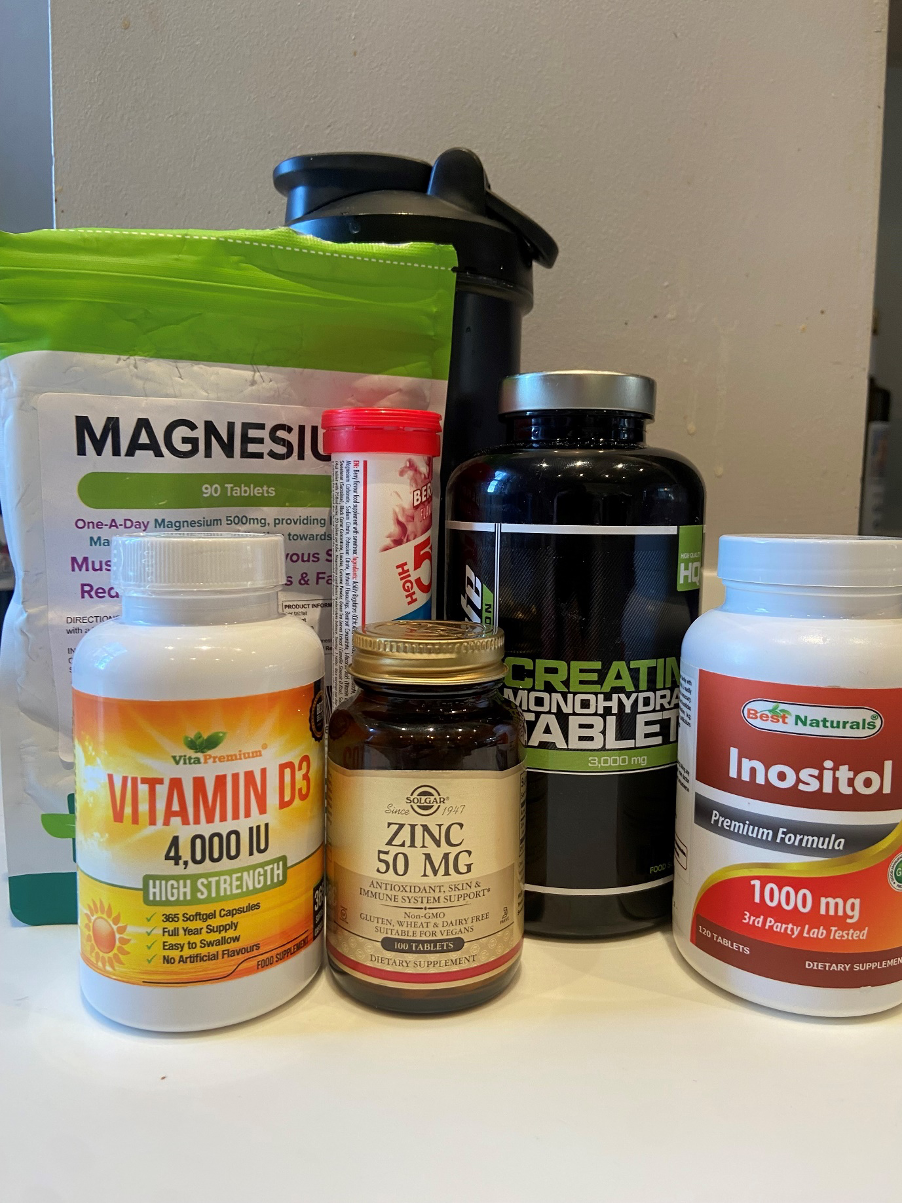
So every morning I now take capsules of vitamin D3 (presumably the new and improved versions of D1 and D2), magnesium, zinc, creatine and inositol, all washed down with a purple electrolyte drink in my brand new shaker.
On the packets, they all claim to have some quite wonderous benefits, ranging from muscle strength, immune function and healthy skin (vitamin D3); nervous system reduction of tiredness and fatigue (magnesium); immune function (again) and metabolism (zinc); improving athletic performance, strength and cognitive function (creatine); and boosting mood, metabolism (again) and reducing fatigue (inositol).
I feel somewhat like sprinter Ben Johnson back in the day, taking all these pills, few questions asked.
Now, I can’t lie – I do feel better. I definitely have more energy, feel calmer as well as stronger and I think I have more colour in my cheeks than at the onset of winter 2023/24.
But is that because of the supplements or due to the fact I’m also now going to the gym three or four times a week, taking cold showers, going to bed much earlier, eating healthier food and have drastically cut down on alcohol to the point I’m now barely drinking at all?
Or is it a combination of all of these measures? Or are the vitamins and supplements themselves just snake oil with few medical benefits and work, if at all, primary through the placebo effect?
There don’t seem to be any clear answers to these questions.
Certainly, there remains some doubt in the medical field around the efficacy of vitamins and supplements at all.
In a 2022 Harvard Men’s Health Watch article by Matthew Solan titled “Don’t Waste Time (Or Money) On Dietary Supplements,” Dr Pieter Cohen, associate professor at Harvard Medical School, wrote: “The thinking is that taking these pills can somehow improve your health or protect you from disease. While some people may need specific vitamins or supplements to help with deficiencies, for the average healthy person, following a diet with plenty of fruits and vegetables provides all the essential vitamins and minerals.”
Against that, my partner, Ms Southbank Growth Advantage, absolutely swears by her daily regimen of supplements – so I’m genuinely confused.
Certainly, taking the capsules every morning helps sets the tone for what I hope to be a health and fitness-focussed day ahead, so I’m of a mind to continue taking my daily supplement cocktail, even though each bottle, jar and packet of pills cost a small fortune.
I can certainly see why, as well as bewildering, the dietary supplement industry is also big business. According to analysts Vantage Market Research, it was valued at £122 billion as of 2022, and is projected to reach £221 billion by 2030.
These types of numbers normally set my pulse rating, though I’d want to know a lot more before I’d look to invest. It does seem propped up by a whole industry of celebrities and wannabees selling a huge range of pills, powders and elixirs, some of which is certainly based on science that is at the very least shaky.
So for now, the sucker that I am, I’ll just continue with my new regime, hoping the pills are doing at least some of what is claimed on the tin.
Of course, if I find any answers to my questions, or an investment in the supplement industry I can be confident in, I’ll let you know.

Sam:
I was supposed to receive a shipping container on my doorstep this Friday.
That was my estimated arrival of all our goods from Portugal to Australia. In total, 92 days from collection to delivery.
That did seem long to me. But I was told early on that shipping right now is slow and there are some routes that can’t be taken due to geopolitical tensions.
OK. Fine.
Except this week I got a notification that my shipment was delayed. It was stuck in the Chinese ports and was taking longer than expected to move ships and then head out.
It would be another 21 days (estimated). Another 21 days for my kids to wait for all their toys, books, beds – a lot of stuff that makes them feel at home.
So be it. But in my conveyance of displeasure to the movers, I asked for tracking information so that at least we could track the shipment live. They were able to do that which was beneficial.
I jumped online, put our shipment number into the tracking system and saw that indeed it was in Ningbo, China, having left Lisbon on 31 August, departing Spain on 17 September and arriving in Ningbo on 19 November.
The bit that blew me away the most was that ship took 63 days to get from Spain to China. It didn’t stop anywhere else. And I say that blew me away because that’s 63 days (1,512 hours) of continuous operation.
To give that some perspective, I reckon on average, I use my car for about 30 minutes a day. Over the course of a year, that’s around 10,950 minutes or 182.5 hours.
It would take me 8.2 years to run my car as long as this one ship took to get from Spain to China in 63 days.
Looking up the ship, it’s a 300-metre-long container ship, running 92,000 Bhp diesel engines. That’s a lot of power… and a lot of emissions.
This is also just one ship doing one route. Multiply that out by the number of ships that at any given time are trundling around the world and you get some idea as to the scale of emissions the entire shipping industry puts out.
To show you what that looks like, here’s a snapshot from MarineTraffic.com. It shows all ships currently tracked by global shipping systems.

I thought FlightRadar was busy, but this blew me away (again).
Immediately I asked the question: why on earth are governments so obsessed with the push to Net zero, when all that really needs to be fixed is global shipping?
I guarantee you that more than 99% of these ships are not electric. There are some electric ships, tugs and fishing vessels out there, but in the hundreds at best. That’s less than 1% of the entire global fleet of commercial vessels.
No matter what obsession the UK government has with net zero it will never make the slightest dent on the world’s environment if the shipping industry keeps on as it is. And while there are plans for more electric ships, it’s not changing in our lifetime to that degree.
So at what cost is the government willing to pay when nothing they do will make a dent? You can still do the right thing, still do what’s needed to play your part in keeping a healthy world, but not at the cost of the breakdown of society, the decimation of the economy and the erosion of citizens’ wealth.
I can only hope there is someone in the UK’s near-term future who can right the ship (pun intended).
Crypto Corner
Is MSTR the ultimate “money glitch”?
Sam:
The Urban Dictionary definition of “money glitch” reads as,
A type of glitch that makes the player earn a lot of currency in video games that have virtual currency.
Right now, there’s a common thread going around online that MicroStrategy has figured out the money glitch with its approach to its “bitcoin strategy” and is on an infinite ride higher.
Every fibre of experience and education says nothing can go up forever… but then again, we’re talking about bitcoin here and its impact on global finance and now big money stock markets.
So… can something go up forever?
The fact is that MicroStrategy’s stock price has seen a huge run-up, with its market capitalisation reaching around $101 billion. Even after the pullback this week, the stock is up around 2,500% since the start of 2022.
Some in the market are calling it a Ponzi (we’ve heard that before, some are saying it’s a bubble (heard that too) and some are saying that it will all collapse and go to zero (reoccurring theme here).
But what are you to make of it?
Michael Saylor, MicroStrategy’s CEO, is now somewhat of a “God” to bitcoiners, and the price action in the company is more exciting than the price moves in bitcoin.
Many argue that is a key driving force behind bitcoin’s rise towards (and ultimately through) the $100,000 mark.
It is now an entrenched part of the crypto world. It pays to understand just what is going on here and whether the sceptics are right.
First off, if you look at the company, it just announced it has added another 55,500 BTC to its treasury, bringing the total to 386,700 BTC. This makes MicroStrategy the largest corporate holder of bitcoin.
At a price of $93,000 that’s 35.9 billion worth of bitcoin the company holds.
The rising value of bitcoin directly benefits the company’s stock price due to the perception that MicroStrategy’s value is closely tied to its bitcoin reserves.
But what it’s also actively doing is raising more money to buy more bitcoin to add to its treasury.
MicroStrategy does this by raising capital through equity issuances and convertible debt offerings.
Essentially, it’s using the market’s faith in a longer-term higher price of bitcoin to finance more bitcoin acquisitions.
Here’s Peter Schiff’s take on it:

Source: @PeterSchiff via X.com
It’s worth noting that when the company issues new shares of its stock, the money goes into buying more bitcoin, but this process also dilutes holders as it increases the total number of shares, potentially reducing the value of each share unless the price of bitcoin rises enough to offset this.
Thus far, the price of bitcoin offsets this, and by some margin.
Then there’s the debt issuance. Here the company borrows money by issuing bonds that can convert into stock. In fact, it expects it to convert to stock. Its latest offering was a 0% bond (in other words, the buyers get no interest payments at all) but with a conversion price 55% above the purchase price at an implied price of $672.40.
The return from the rise in the stock price is better than the return on normal bonds. Plus as this continues, MicroStrategy also continues to add bitcoin to its balance sheet, returning what Saylor describes as “Bitcoin Yield”.
MicroStrategy essentially transforms itself into a bitcoin investment vehicle, or a “bitcoin development company” as is often used.
Let me put it to you this way…
Apple is a company that offers products. Those products are devices. If you like them, you buy them. Apple banks the revenues and generates a profit.
Apple reports on this and that eventually flows through to give some kind of determination on the value of Apple. Last quarter Apple made a $14.7 billion profit. The company trades at a price-to-earnings ratio of 38.6-times which gives Apple a market cap of $3.55 trillion.
MicroStrategy also sells products. Just not the consumer kind. It sells a bitcoin product and the company itself. This product isn’t to everyone’s taste. Those who like it hold a long view on the price of bitcoin and the importance of bitcoin in global finance. These products are bought, and MicroStrategy uses the revenues from these products to buy bitcoin.
That bitcoin it buys is the yield Saylor talks about.
Now, as Saylor rightly points out, the current quarter meant a yield of 88,820 bitcoin. Or at a price of $92,000, $8.2 billion for the quarter.
You need to rethink your approach to capital here, but that’s about 55% of the profits Apple made for the quarter. Now MicroStrategy is not currently worth $1.95 trillion. But if you’re of the view that its bitcoin generation for shareholders is the same as profit that Apple generates for its shareholders, then you start to see where some of the crazy bullish takes on the value dynamics of MicroStrategy might lie.
Of course, not everyone sees it that way. And not everyone sees the idea of bitcoin being worth $1 million and more as a feasible reality.
Those that do, probably hold MicroStrategy stock.
The stock is then also at the mercy of bitcoin’s movements, the ability to generate this yield ongoing and other factors like market sentiment, short sellers, whether MicroStrategy enters the S&P 500, and other key indexes that result in passive capital flow form index ETFs… a lot of factors really.
Does this make MicroStrategy a good stock to own for the long term? Well, maybe. It’s certainly on our list of considerations when looking at what to recommend to you next.
Is it a factor in the movement of bitcoin and crypto markets? Yes, I would say it is. That’s because Saylor is on a path to buy as much bitcoin as he can for the stock, for shareholders and for his own benefit.
Whether you hold MicroStrategy or not, or bitcoin or not, it is certainly one of the most fascinating examples of a company that’s made a big bet on one very specific opportunity and gone all in on it. The other example I can think of lately is Nvidia’s move about a decade ago to go all in on AI.
These big bets don’t always pay off. But when it does, it pays off hugely as it has so far for the company. It is definitely one that we will continue to keep a very close eye on.
What else we’ve been looking at this month
James:
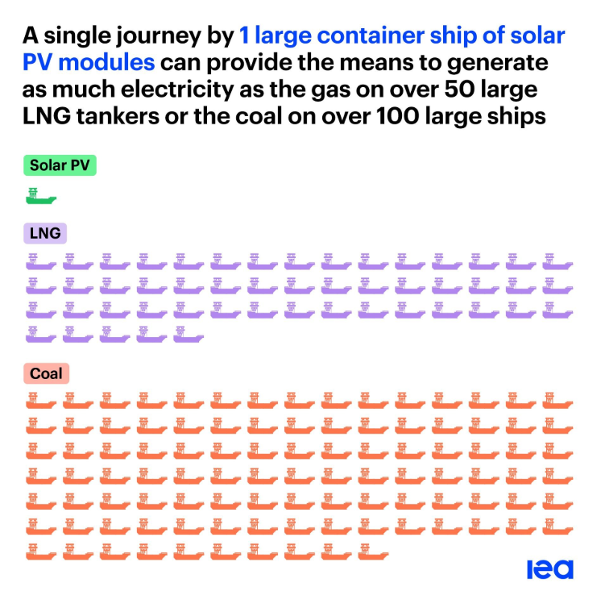
One ship load of solar PV is worth more to the grid than 100 ships of coal
The International Energy Agency (IEA) recently highlighted a stunning comparison: one container ship loaded with photovoltaic (PV) solar panels can generate as much electricity over its lifetime as 100 large coal ships or 50 LNG tankers.
Source: International Energy Agency
The calculation, published in the IEA’s recent Energy Technology Perspectives 2024 report, certainly warrants further investigation, so let’s take a closer look at the reasoning behind it.
Let’s start with the solar panels. A typical container on a 15,000-TEU (20-foot equivalent unit) ship can hold about 133 kilowatts (kW) of solar panels. With 15,000 containers, the ship effectively carries 2 GW of solar capacity.
Over their estimated 40-year lifespan, these solar panels operate with a 17% capacity utilisation – accounting for day-night cycles, weather and other factors – resulting in about 120 terawatt-hours (TWh) of electricity generation.
Contrast this with coal. A large coal ship typically carries around 150,000 tonnes (150 kilotonnes, or kt) of coal. Coal has an energy content of 8 megawatt-hours per tonne (MWh/t), giving this shipment a total energy content of 1.2 TWh – 100 times less than the PV ship.
Solar PV modules, of course, are capital goods, while fossil fuels are consumable. This means that while a coal or LNG shipment is consumed in days or weeks, solar panels continuously generate electricity for decades. It’s this long-term energy production that magnifies the output from a single shipload of solar modules.
But what’s interesting is that the disparity from solar PV and coal gets even wider if you consider that the solar modules generate electricity. Coal, on the other hand, is only primary energy. Almost 60% of this energy is lost in power stations.
The IEA graphic, therefore, does not show the many “ghost ships” that only transport the part of the coal that then passes through the chimney as waste heat in our power stations.
If you take final energy (the electricity from coal) instead of primary energy (the heat in the coal), you’d actually need around 300 times as many ships for the same electricity content as a ship of solar panels.
Of course, solar panels do require energy to be produced. The raw resources in solar panels need energy to be extracted from the ground. The factory that makes the solar panels uses energy. In fact, each and every component involved in the production of the panels requires energy one way or another.
But as solar panel production has become more energy efficient, the amount of time that they need to operate to recoup the energy invested in the panel’s construction has fallen markedly from ~8 years in the 1990s, to 2-3 years in the 2010s, to approach just 1 year now. This is one reason why they’ve fallen in price so dramatically.
If you want to geek out further on this then head to page 376 of the IEA report.
Copper is becoming harder to mine than ever before
Researching the copper market last week, I came across this graphic from MinEx Consulting and BHP:

Source: MinEx Consulting and BHP
The graphic shows the depths and sizes of all copper discoveries with over 3 million metric tonnes of copper equivalent found since 1900, based on data up to 2022.
It shows just how copper deposits are increasingly challenging to locate and extract, resulting in mines now harder to develop than ever before.
For instance, the Escondida deposit, discovered in 1981 at a relatively shallow depth of 40 metres, stands in stark contrast to the Resolution deposit, found in 2002 at a depth of 1,280 meters.
The latest major discovery, Filo del Sol, made in 2020, is located 600 metres below ground and contains just over 11 million metric tonnes of copper equivalent.
By comparison, the Andina Copper Camp in Chile, discovered in 1955, holds an extraordinary 144 million metric tonnes of copper equivalent, making it the largest copper deposit found since 1900. Remarkably, this massive resource was located near the surface – a rarity in today’s mining landscape.
Of course, as deposits are found deeper underground, accessing these resources becomes more costly and technically complex, ultimately impacting copper prices.
Remember, copper is perhaps *the* critical metal. Without it, we have no transportation, no communication, no electricity.
While copper recycling is expected to play an essential role in meeting growing demand, it won’t be sufficient on its own. We need lots more primary supply, that’s for certain.
Prices will surely need to rise to stimulate what BHP estimates is $250 billion of required investment in copper sector over the next decade.
The US drilled baby drilled under Biden
Donald Trump wants oil companies to “drill, baby, drill” on the first day of his presidency, but you might not know that is exactly what they have been doing over the last few years already.
Under President Joe Biden, the US cemented its position as the largest crude oil producer in the world, pumping out nearly 13 million barrels on average every day in 2023. That’s an all-time record according to data from the US Energy Information Administration.
In fact, for the previous last six years, the US has outstripped Russia, Saudi Arabia and other OPEC countries in crude oil production.

Source: US Energy Information Administration
That’s an awkward milestone for President Biden, who promised to facilitate America’s transition away from fossil fuels to greener alternatives. But it does show that it’s not necessarily politics that dictate these things, but markets.
Sam:
He invented Netscape after all…
Joe Rogan isn’t to everyone’s taste. That’s fine. But you can’t ignore that he gets the most interesting guest on his show. Some of them are the most influential people in the world, and this latest episode is no different.
Marc Andreessen is arguably one of the most influential people in modern history. And some of the things he discusses with Rogan are mind blowing.
Again, even if Rogan podcasts (or videos) aren’t really your thing, this once I think is worth it.
China’s US dollar flex
This is one of the most interesting things I’ve read in the last month. I can’t recall seeing one slither of coverage about it in the mainstream media. But that’s not all that surprising either.
Rather than me hack my way through the explanation, just read the post here, as it goes into some detail about recent moves by China that appear to be a warning shot across the bow of the US government.
With Donald Trump’s inauguration only about 50-ish days away, you get a sense that foreign powers have a limited time horizon to “flex” their powers – not that it probably makes a difference when Trump actually gets into the White House.
Liz takes aim – think she’s jaded much?
How salty do you reckon Liz Truss is? I reckon very salty, still.
Sure, being outlasted by a lettuce takes a big hit to one’s ego, but c’mon. I’m sure she’s got plenty of private sector things to do, things to speak at, etc. She was, after all, the British prime minister, if only for a fleeting moment.
But in a sliding-doors thought exercise, I do often wonder just how things would have played out had she stayed in power, not been ousted and let her “mini budget” come to fruition.
Would it have been as big a disaster as the mainstream media had everyone thinking? Or maybe, just maybe, would it have solved a lot of the problems that the Tories carried on with and now Labour are crushing the economy with?
Could Liz have been the hero everyone didn’t want but possibly needed? Maybe, but we’ll never know. However, I do enjoy reading her work since because you can taste the salt in every word she writes.


James Allen and Sam Volkering
Editors, Southbank Growth Advantage