Will Canada pump bitcoin 16-fold in the next few months?
21st February 2022 |
Have you ever heard of the term,“bank run”?
A bank run is a situation where a lot of bank customers withdraw their deposits due to fears (typically) over the solvency of the bank.
This becomes a perpetual cycle, where as more people withdraw their funds, the bank needs to dive into its own capital reserves, ultimately getting to a point where withdrawal requests exceed the actual deposits held – with the result that the bank becomes insolvent.
This might seem impossible. The idea that a bank doesn’t actually have enough money to meet the withdrawal requests of all depositors is wild.
But that’s exactly how the banking system works. It’s fractional banking. That means the actual physical deposits held as ready cash are only a fraction of the total money in circulation. The remainder is available to the banks to be lent out or invested.
Thereby, if everyone wanted to hold physical cash instead of a bunch of numbers in a bank account… they couldn’t. There is simply not enough note and coin in the world to meet the requirements if everyone wanted their money.
This also is why a bank run can be dangerous. If people realise there’s a chance they might not be able to get all their funds, they will attempt to be the first to get their money ahead of those who wait or take their time.
In a bank run, you want to be first, not last to that ATM or bank teller.
How a bank run starts can be for many reasons. The historical reason as mentioned is due to concerns over the solvency of the bank. But what if the reason is that people are worried the banks might just shut off access to their accounts altogether?
Ask yourself that question…
If you thought the bank was going to restrict your access to your money, what would you do? Leave it there, or look to get it all as quickly as you could?
Even the idea around a bank run can be enough to cause a bank run. But when the government and the banks give plenty of ammunition for that idea, it’s a hard one to ignore.
But that’s exactly what’s happening in Canada right now.
The abbreviated version is the government has enacted powers to ensure that financial institutions can cut off those who are participating in and funding the current protest groups in Ottawa.
The “truckers” protests are seen domestically by the government to be akin to terrorism, and therefore should be financially choked into submission.
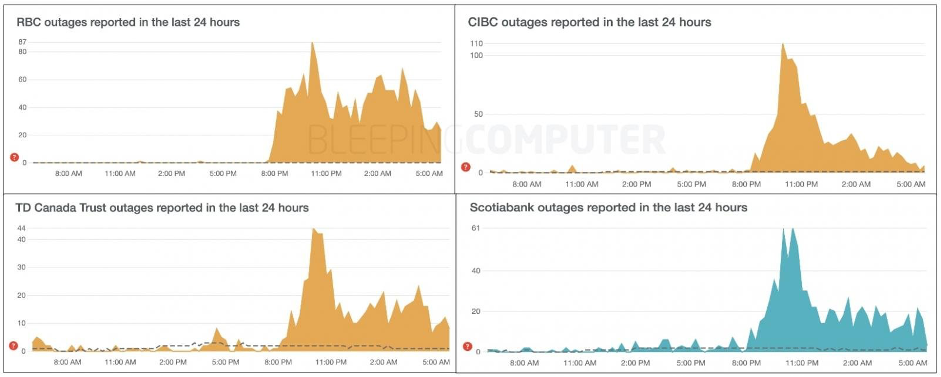
Added to this mix is a highly unusual spate of banks with access “issues” last week. A number of Canada’s biggest banks all reported major outages all at the same time on 16 February.
 Source: Bleeping Computer
This is all leading towards a very average outcome for the humble Canadian. You see if there is a run on the banks, then it would appear those outages might be a “test run” for the banks shutting down access to funds.
Which… would only emphasise the need to get money out of the banks even more, exacerbating the potential for a bank run.
Now, bank runs are rare. And the last one I can remember was in relation to the Cypriot banking crisis in 2013.
Considering that Canada’s economy is roughly 70-times bigger than that of Cyprus, a bank run would be exponentially more serious there, than it was in Cyprus.
Of course, try telling that to people in Cyprus in 2013.
Also interesting is that in response to the Cypriot banking crisis and bank run in 2013, there was one particular, decentralised, permissionless asset class that went parabolic on this crisis…
You guessed it, bitcoin.
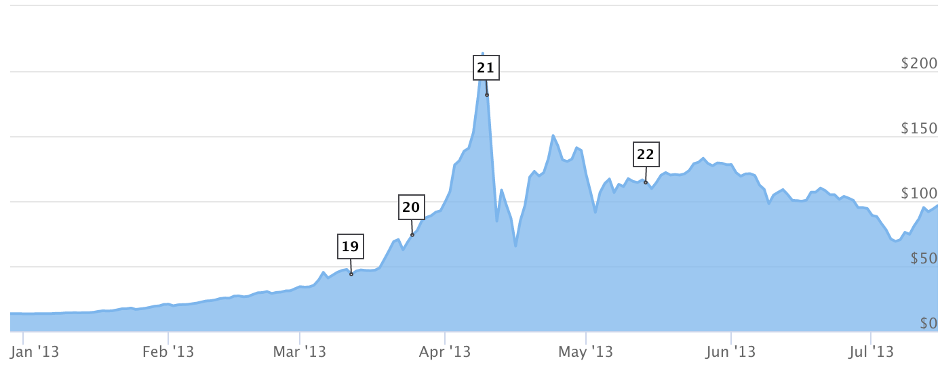
Here’s what happened to bitcoin’s price during the Cypriot banking crisis in 2013:
 Source: 99Bitcoins
At the start of 2013, one bitcoin was worth around $13.
By early April it was over $213.
While bitcoin was still relatively unknown to the mass market, it was still recognised enough as an exit strategy from the fiat-money system that – at least in Cyprus – was falling to pieces.
Subsequently there were fears the Cyprus crisis would flow out further becoming systemic across all of Europe, triggering widespread financial instability.
In short, it was a bonkers time to be in crypto as bitcoin’s price surged 16-fold in the space of a couple of months as the traditional finance (TradFi) system once again showed itself to be unfit for purpose.
Of course, governments, central banks and other banks came in to sweep up the mess. And the semblance of “stability” was restored. Real stability in the global financial system has never actually happened since the global financial crisis of 2008/9. That was the point when governments and central banks began to use quantitative easing (QE – the creation of fiat money from thin air in order to buy bonds) and other unorthodox measures to prevent financial and economic crises.
And this perceived end to the crisis in Cyprus saw bitcoin’s price fall back down. But it was our first sign that, in a real global financial crisis, bitcoin would indeed be a safe haven for depositors and investors.
We’ve not really seen another global financial crisis since 2008/9 of potentially cataclysmic scale. The subsequent Cypriot crisis gave a glimpse of what could happen. Admittedly, in 2020, at the earliest stages of the pandemic, we again saw what could happen.
While bitcoin’s price had cratered from previous all-time highs in 2018 to just $4,000 when the pandemic was in full swing, bitcoin then went from strength to strength. At the time, almost perfectly to the day in March 2020, I told investors to cease all action except holding bitcoin.
From that point, even today after coming off the all-time highs, it’s up 10-times from those March 2020 “lows”.
Compared to the levels of the 2013 Cypriot crisis, in March 2020, bitcoin was still up 307-times, and at the time of writing, compared to where we were all the way back in 2013, bitcoin is up an astounding 3,230-times.
That was only nine years ago, and yet here we are now where a “democracy” like Canada is imposing economic sanctions on domestic citizens who oppose the government’s actions in relation to pandemic and economic policy.
It is, of course, a complex issue. We don’t deny that. However, the actions being put in place give us again a preview of what’s to come.
If governments around the world completely ditch fiat money for a digital economy, and then roll out central bank-backed digital currencies (CBDCs) what do you think will happen?
What kind of power do you think they’ll have to crush political opposition? What power do you think they’ll have over society with the literal ability to turn off the ability to access the financial system to any citizen they so choose?
Imagine having your entire livelihood and ability to interact economically with society flicked off in an instant. You can’t buy a pint of milk, you can’t fill up at the petrol station, you can’t pay your bills, you can’t even get the kids to school.
That’s the kind of sweeping power that’s on display right now, thanks to what has happened in the last few days in Canada.
That’s why a permissionless, decentralised financial system like crypto is so powerful.
They cannot switch it off. They cannot stop you from using it. They will force financial institutions to stop dealing with crypto providers. But there is nothing to stop Canadian A from sending Canadian B bitcoin for goods or services.
There’s no reason why people now, armed with the power of these decentralised networks, can’t fully function outside of the controlled and authoritarian traditional financial system.
What Canada is doing is showing us exactly why there is a need for networks like bitcoin and other cryptos.
And if this gets worse. If there is a bank run in Canada, which day by day looks increasingly possible, my take is it will have a similar impact on the bitcoin market that we saw in 2013.
It might seem outlandish to think that. Could a bank run in Canada see bitcoin explode 16-fold in the blink of an eye? That would take the price to around $672,000.
That seems crazy, I know. However, the numbers now are so big.
But in 2013, having lived through bitcoin’s 16-fold rise from $13 to $213, it seemed crazy then too. Hindsight says that was just the start of it.
And if the traditional global financial system isn’t getting better, yet only getting worse, then what do the next nine years look like for bitcoin and cryptos more generally?
If Canada does have a bank run, and there are global consequences, what do you think happens to bitcoin then?
My point should be clear here…
Keep stacking those sats. Keep incrementally adding to your bitcoin as a base of your crypto portfolio. In my eyes, it’s the smartest play to make right now.
Binance GBP deposits are back!
Binance recently announced that GBP bank deposits via bank transfer (Faster Payments) are back online for verified users.
In short, you can directly deposit GBP again to Binance and then trade for crypto. This is helpful as Binance is a huge exchange with over 500 trading pairs.
It’s pretty easy to use and allows you to withdraw your crypto and move it to your own self-custody wallets with ease.
There are, of course, fees associated with any deposit or withdrawal to exchanges like Binance. Therefore, just be aware of those fees that are relevant to the particular transaction you’re making. Overall though, the fees aren’t too bad compared to fees you might associate with an online stock broker.
If you’re at all unsure of then how to use the Binance trading platform, it might be worth referencing the “How to use Binance” editorial I sent out last year, which you can review here.
Crypto to Know
Below is our “Crypto to Know” list where you’ll find several cryptos that we think you should be taking the time to learn and understand.
They each form an important part of the burgeoning crypto ecosystem.
Several of these cryptos are doing very different things to others.
What’s key is to learn that every crypto has its own use cases, its own guiding principles, and its own particular potential.
Each crypto is to be judged and assessed on its own merits.
Our aim here is to help you understand these cryptos and the wider crypto world.
These aren’t specific recommendations but a guide to help you learn and build your confidence in operating in this space.
We will add more names to this list over time. However, if you’re new to the world of crypto, these are the names where we think you should start your education and learning.
We’ve also added links to each one.
The links are to what we believe, in each case, is the best resource for learning about that crypto.
“Crypto to Know” watchlist
- Bitcoin –it/wiki/Main_Page
- Ethereum – ethereum.org/en/what-is-ethereum
- IOTA – docs.iota.org
- Tezos – https://tezos.com/learn/getting-started/
- Filecoin – docs.filecoin.io
- Cosmos – v1.cosmos.network/intro
- Binance – binance.com/en/about & research.binance.com/en/projects/bnb
- FTX – ftx.com & help.ftx.com/hc/en-us
- Solana – https://docs.solana.com/introduction
- Secret Network – https://scrt.network/about/about-secret-network
Sam Volkering
Editor, Sam Volkering’s Crypto Network